
Where you live is probably one of the two or three biggest decisions you’ll make in your adult life, right up there with who you marry and whether you have kids. And the whole city-versus-suburbs question has gotten a lot more complicated lately. Remote work flipped everyone’s priorities, housing prices went haywire in basically every metro area, and different generations seem to want completely different things out of their neighborhoods.
So whether you’re a first-timer daydreaming about a downtown condo, a family trying to land in a decent school district, or you’re finally ready to downsize and stop mowing that giant lawn, it pays to actually understand the trade-offs. Get this wrong and you could lose years being miserable and a scary amount of money on top of it.
I’m going to walk through the stuff that actually matters: what it costs, how long you’ll spend commuting, how much space you get, the community angle, and whether either one is a smart place to park your money. Real numbers, not vibes.
Table of Contents
- Defining Urban and Suburban Living
- Cost of Living: Urban vs Suburban Living Compared
- Commute Times and Transportation
- Space, Housing Types, and Lifestyle
- Schools, Families, and Community
- Investment Potential: City vs Suburb
- Who Thrives Where? Matching Lifestyle to Location
- Frequently Asked Questions
Defining Urban and Suburban Living
Quick housekeeping before we get into the good stuff, because these words mean slightly different things to different people.
Urban living usually means you’re inside a city’s core or one of the dense neighborhoods around it. High-rises, walkable blocks, restaurants and offices and bars all crammed within a few minutes of your front door. Suburban living is the residential stuff outside the center. Single-family homes, bigger lots, and a car you basically can’t function without.
Except the lines have gotten fuzzy. A lot of “urban” neighborhoods now have mixed-use developments with actual green space, and plenty of suburbs have built walkable little downtowns with train connections. But the core difference is still there: how dense it is, what the houses look like, and the rhythm of your average Tuesday.
For what it’s worth, about 55% of Americans live in the suburbs, roughly 31% in urban cores, and the rest are rural, per the Census Bureau. That suburban majority hasn’t really budged in decades. The pandemic did juice suburban and exurban growth between 2020 and 2022 (everyone wanted a yard and an office door that closed), but city rentals came roaring back by 2023. So much for the “everyone’s fleeing the cities forever” narrative.
Cost of Living: Urban vs Suburban Living Compared
Money’s usually the first thing people think about, and it’s almost never as simple as “the suburbs are cheaper.” Depends entirely on what you’re actually measuring.
Urban apartments generally cost more per square foot than a suburban house. In a lot of big metros, downtown condos run 20 to 40% more per square foot than a comparable suburban place, based on Zillow’s research numbers. But here’s the wrinkle: city units tend to be tiny, so even though the rate is higher, your total bill can end up lower. A 700-square-foot condo at a premium price can still beat a 2,400-square-foot house.
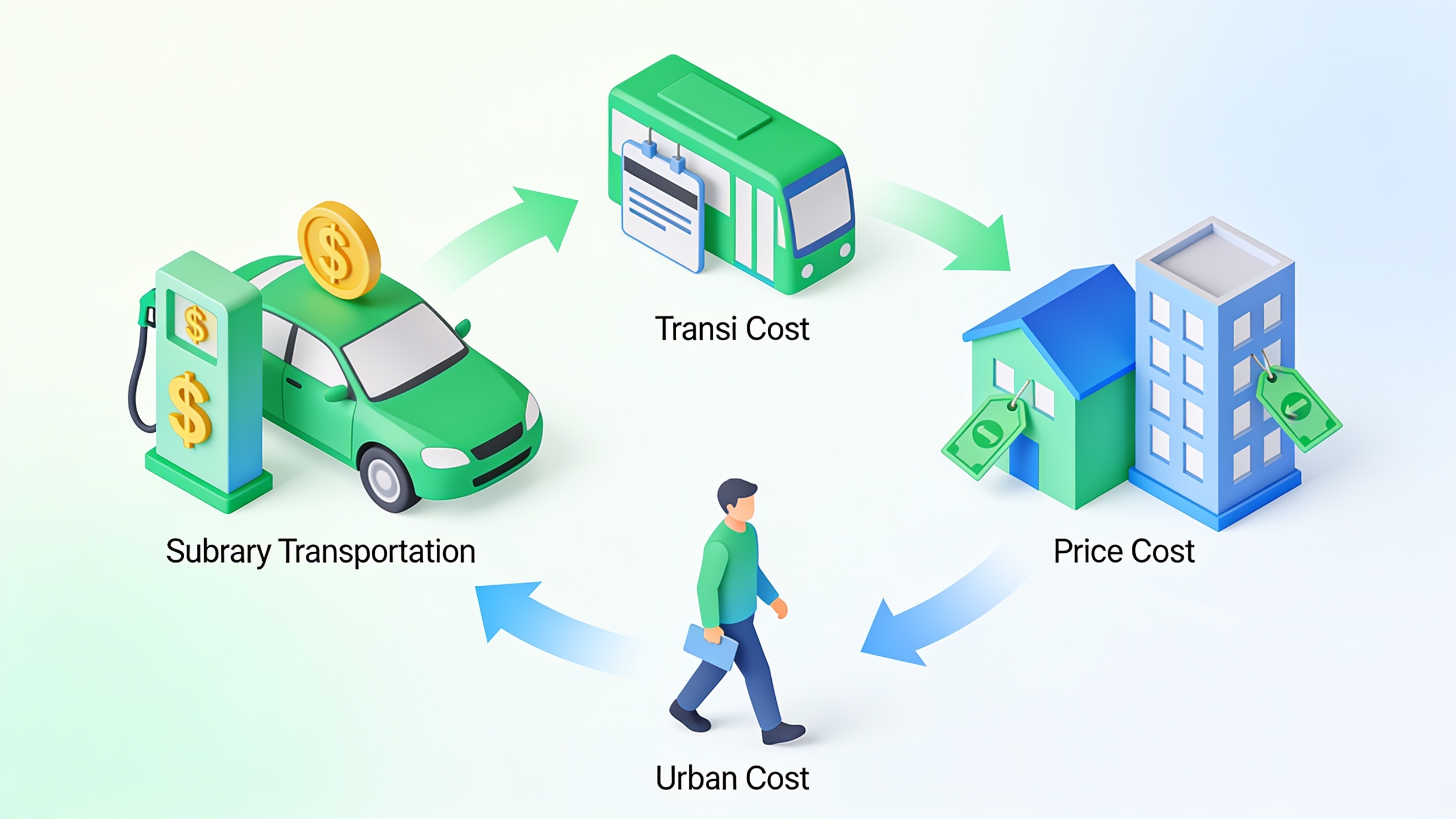
And then there’s the stuff nobody puts on the spreadsheet. Suburban life usually means a car. Maybe two. Plus gas, insurance, and whatever your mechanic decides your brakes need this month. AAA figures the average American spends around $12,000 a year to own a car once you count depreciation, insurance, upkeep, and fuel. Twelve grand. That’s a serious chunk of change that quietly closes the gap between city and suburb, and most people never even think about it when they’re comparing home prices.
| Cost Factor | Urban Living | Suburban Living |
|---|---|---|
| Average home price per sq. ft. | Higher (15–40% more) | Lower |
| Typical unit/home size | Smaller (600–1,200 sq. ft.) | Larger (1,800–3,000+ sq. ft.) |
| Property taxes | Often lower rates, higher assessed value | Often higher rates, moderate value |
| Transportation costs | Lower (transit, walking, biking) | Higher (car ownership, fuel, tolls) |
| Utility costs | Lower (smaller space to heat/cool) | Higher (larger homes, more square footage) |
| HOA/condo fees | Common and can be $200–$800/month | Less common, lower when present |
| Groceries and dining | Higher average prices | Moderate, big-box store access |
Bottom line, don’t just stare at the listing price. Add in what you’ll spend getting around and heating the place, or you’ll fool yourself into thinking one option is way cheaper than it really is.
Commute Times and Transportation
For a lot of people, especially young professionals and busy families, the commute is the whole ballgame.
City folks usually get shorter, more predictable trips. Twenty minutes or less on a subway, a bus, a bike, or their own two feet. The Census Bureau’s American Community Survey puts the average American one-way commute at about 27.6 minutes, but if you’re a suburbanite heading into a major downtown job center, you’re often looking at 35 to 50 minutes each way. And that’s before some jackknifed truck turns the highway into a parking lot.
Let me put a longer commute in perspective, because the numbers are kind of brutal. A 45-minute one-way trip is about 7.5 hours a week. Stretch that across a year and you’re at nearly 390 hours in transit. That’s basically 10 full work weeks of your life spent staring at brake lights. Nobody factors that into their home search, but research out of the University of Waterloo has tied long commutes to lower life satisfaction and higher stress. Which, honestly, feels obvious to anyone who’s ever done one.
Now, remote and hybrid work changed all this math. If you’re only going in two or three days a week, suddenly a longer suburban commute doesn’t feel like such a life sentence. That’s a big part of why the suburbs got so popular again after 2020.
One more thing though, and it’s a big one: not all suburbs are equal here. The ones with solid commuter rail or express bus service (you’ll find these around Chicago, New York, Boston) basically let you cheat the system. Suburban space, near-urban commute. So don’t just eyeball the distance on a map. Check how often the train actually runs and how long it really takes to get to your specific office, not the vague “the city.”
Space, Housing Types, and Lifestyle
This is where the difference stops being abstract. Suburban homes are nearly double the size of urban apartments in most markets, according to the National Association of Home Builders. New suburban single-family homes average around 2,300 square feet. Urban multifamily units? Somewhere in the 1,000 to 1,100 range. That’s not a small gap. That’s the difference between a home office and a laptop balanced on your kitchen counter.
In the suburbs you’re getting real room to breathe. Space for a guest room, a place to store all the junk you swear you’ll deal with someday, a yard for the dog or the kids, a garage instead of circling the block for twenty minutes hunting for street parking. And it’s just quieter. Fewer sirens at 2 a.m.
The city sells you something different. You can walk to brunch, walk to the gym, walk to the grocery store, walk home from a show without ever touching a car. Museums and theaters and decent food are minutes away instead of a whole planned outing. And a lot of buildings throw in amenities (rooftop lounges, a doorman, a gym downstairs) that kind of make up for your apartment being on the smaller side.
Honestly, this one comes down to who you are. If your ideal weekend is a hike at the nearby park followed by burgers in the backyard, the suburbs are speaking your language. If it’s brunch, a matinee, and never once thinking about where to park, you’re a city person. And that’s fine. There’s no wrong answer, just an answer that fits you.
Schools, Families, and Community
If you’ve got kids, let’s be real, one factor usually swallows all the others: schools.

Suburban districts often outperform urban ones on the standardized stuff, and a lot of that comes down to how schools get funded. When your budget is tied to local property taxes, wealthier suburbs end up with fatter budgets. Research from Brookings and the National Center for Education Statistics backs this up. Suburban public schools tend to have smaller classes and more money per student in a lot of states. But (and this is important) it’s not a rule. Plenty of cities have killer magnet and charter schools that’ll run circles around the suburban average.
The community angle is interesting too. Suburbs tend to breed that classic tight-knit thing: block parties, kids’ soccer leagues, the PTA, neighbors who actually know your name. Cities have community, obviously, but it’s built differently. It tends to form around shared interests or your job or a specific neighborhood’s personality, not just the fact that you happen to live next door to someone.
And a word on safety, because people love to generalize here and it drives me a little nuts. Crime varies wildly by the specific block, not the broad “city bad, suburb good” label. FBI crime data shows two neighborhoods a few streets apart in the same city can look totally different, and the same goes for neighboring suburbs. So do the actual work. Look up recent trends for the specific address you’re considering instead of leaning on the stereotype.
Investment Potential: City vs Suburb
If you’re thinking about this as an investment, or you just want to know your money’s safe, appreciation and rental demand matter as much as whether you personally love the place.
Urban condos and apartments usually see strong rental demand from young professionals, students, and short-term renters, which is great if you’re chasing cash flow. The catch is appreciation can be a rollercoaster, closely tied to the local job market and whether downtown is having a moment. Cities anchored by tech, finance, or healthcare tend to hold their value better when things get shaky.
Suburban single-family homes have historically been the steadier bet, especially in good school districts. Case-Shiller data showed suburban and exurban prices outpacing urban condos in several major metros between 2020 and 2023. Suburban rentals also tend to attract families who want to settle in, which means longer leases and fewer of those expensive turnover headaches landlords hate.
| Investment Factor | Urban Properties | Suburban Properties |
|---|---|---|
| Rental demand | High from young professionals, students | High from families, long-term renters |
| Tenant turnover | Higher (shorter leases common) | Lower (longer tenancies) |
| Appreciation stability | More volatile, market-dependent | Generally steadier over time |
| Entry price | Higher per unit | Lower per unit, more square footage |
| Maintenance/management | Often simplified with HOA/property management | More hands-on, larger properties |
| Liquidity (resale speed) | Faster in strong job markets | Slower but broader buyer pool |
If you’re poking around listings on a site like Vivienda Lista, do yourself a favor and compare actual cap rates and days-on-market for both property types in your target area. General trends are nice, but real local numbers are what’ll keep you honest.
Who Thrives Where? Matching Lifestyle to Location
There’s no trophy for picking “correctly.” There’s only what’s right for where you are in life and what you actually care about.
If you’re a first-time buyer in your 20s or early 30s, the city usually makes a lot of sense. The walkability, the short commute, the social scene, all of it lines up with the years when you’re building a career and don’t need much space anyway. And that one-bedroom near the office? It can turn into a rental property down the road once you move on.
Then the kids show up, and suddenly the calculus changes fast. School districts, the need for space, the sudden burning desire for a backyard, it all starts to outweigh being able to walk to a wine bar. This city-to-suburb migration is honestly one of the most predictable moves in all of real estate.
Investors, don’t let personal taste run the show. Think about who your tenant is. Urban units for turnover-friendly rental income, suburban homes for the stable, long-haul renters.
Retirees and empty-nesters are the split ones. Some downsize into a low-maintenance city condo near good hospitals and stuff to do. Others want the opposite: peace, space, and a lower cost of living out in a quieter suburb or somewhere semi-rural.
My advice? Write down your top five non-negotiables. Commute, budget ceiling, outdoor space, school quality, walkability, whatever they are for you. Then score an actual city option and an actual suburban option against that list. Hard numbers beat gut assumptions every single time.
Frequently Asked Questions
So is it actually cheaper to live in the suburbs or the city?
Depends what you’re counting. Suburban homes usually cost less per square foot and get you more room for the money. But once you throw transportation into the mix, things even out. Owning a car runs around $12,000 a year, and that can wipe out the suburban savings for someone who’d otherwise just take the subway. Run the full numbers, not just the mortgage.
If I’m a young professional, should I go urban or suburban?
Most people in their 20s and 30s lean city for the short commute, the walkability, and, let’s be honest, the social life. But if you’re working remote or hybrid, a suburb with a good train line can get you most of the same convenience with more space and often a smaller monthly bill. Worth considering before you write off the suburbs.
Are suburban schools really better than city schools?
On average, suburban public schools tend to have smaller classes and more funding per kid, thanks to how local property taxes work. That’s what the National Center for Education Statistics data shows. But “on average” is doing a lot of work in that sentence. Quality swings hard from one district to the next, and cities are loaded with strong magnet and charter programs. Research the exact school your kid would attend. Don’t trust the stereotype.
Which is the smarter investment, an urban condo or a suburban house?
Urban condos usually pull in strong rental demand and decent cash flow, but the appreciation can bounce around with the local job market. Suburban houses tend to climb more steadily and hold onto tenants longer, especially near good schools. Which one wins depends on your target renter, how long you plan to hold, and what your local market’s doing. There’s no one-size answer here.
Can I just get the best of both?
Kind of, yeah. A lot of buyers land in what I’d call urban-suburban hybrid towns. Walkable little downtowns with a commuter train into the city. You get suburban space and schools plus a commute that won’t crush your soul. If you’re genuinely torn, start looking at these. They’re the sweet spot for a lot of people.
At the end, this isn’t about declaring a winner. It’s about matching the trade-offs to your real, actual daily life. Your budget, your goals, all of it. Test-drive both if you can. Do a short-term rental, spend a few extended weekends, build out a real cost breakdown. Once you’re looking at real numbers instead of stereotypes, the right fit tends to make itself pretty obvious.
You Might Also Find Useful
- Vivienda Lista – Compare curated home listings, property data, and expert buying advice to simplify your urban or suburban home search.
- t7b – A wholesale marketplace platform for bulk product sourcing and distribution.
- State6 – AI-powered promotion coaching designed specifically for UK police officers.
Leave a Reply