
Buying a condo or a single-family home might be the biggest fork in the road you hit as a buyer, and there’s no universal right answer. It depends on your budget, how much of your weekend you’re willing to sacrifice to a lawnmower, and honestly, what kind of life you’re trying to build. A condo usually means less money down and someone else handling the boring maintenance. A house gives you more room, more privacy, and total control over your own patch of earth. It also costs more and hands you every repair bill personally. Neither one wins the debate on its own. It’s about matching the property to your money, your stage of life, and how you actually want to spend your Saturdays.
If you’re only just starting to poke around at the idea of owning anything, it’s worth reading 10 Signs You’re Ready to Buy Your First Home before you get sucked into the condo-versus-house argument. Knowing you’re actually ready, financially and emotionally, makes every decision after this one a lot less stressful.
Table of Contents
- Condo vs. Single-Family Home: What’s the Core Difference?
- How Much Does a Condo Cost Compared to a Single-Family Home?
- Maintenance and Upkeep: Who Does What?
- Lifestyle Differences: Space, Privacy, and Community
- Which Home Type to Buy If You’re a Real Estate Investor?
- Which Home Type to Buy Based on Your Life Stage?
- Condo vs. Single-Family Home: Pros and Cons at a Glance
- Frequently Asked Questions
Condo vs. Single-Family Home: What’s the Core Difference?
A condo is a unit you own inside a bigger building, where the interior is yours but you share the land, the exterior, and the common areas with everyone else through a homeowners association (HOA). A single-family home is a standalone house on its own lot. You own the building, you own the dirt underneath it, there are no shared walls, and no HOA is required (though plenty of suburbs have them anyway).
That one distinction, shared ownership versus owning the whole thing yourself, basically drives everything else. When you buy a condo, you’re actually buying a slice of the building’s shared bits too: the roof, the lobby, the elevators, the landscaping, the parking garage, plus exclusive rights to your own unit. Buy a house and it’s all yours. Foundation, roof shingles, the fence in the back. Yours to fix, yours to change, yours to let fall apart if you’re feeling reckless.
And it doesn’t stop at the money. In a condo you often need board approval to do anything major, you might not be allowed to rent it out, and you’ll live by community rules about everything from how much your dog can weigh to what you’re allowed to string up on your balcony. Buy a house and the only people you answer to are the local zoning office and the building code.
How Much Does a Condo Cost Compared to a Single-Family Home?
Condos generally run 10% to 30% cheaper than single-family homes in the same metro area, according to data the National Association of Realtors publishes regularly. But that lower sticker price comes bundled with monthly HOA fees that most houses just don’t have. And the gap swings wildly depending on where you are. In dense markets like New York, San Francisco, or Miami, a condo might be the only way to get into ownership at all. Out in the suburbs, a house might not cost that much more than a comparable condo anyway.
Upfront Costs
The purchase price is only half the story. Condo buyers usually pay lower property taxes since each unit is assessed at a smaller value, and depending on the lender and loan, they might get in with a smaller down payment. Might. Some lenders actually demand bigger down payments on condos because they’re scrutinizing the whole building, not just your unit. That’s especially true if the building has a ton of rental units or, worse, some pending lawsuit hanging over it.
House buyers get hit with higher closing costs in raw dollars, simply because the price is bigger. They also need to budget for an independent inspection covering the roof, foundation, HVAC, plumbing, the works. A condo buyer basically only worries about their own four walls.
Ongoing Costs
Now here’s where it actually gets interesting. HOA fees on a condo can run anywhere from $200 to over $1,000 a month, depending on how fancy the amenities are (pool, gym, doorman, security) and how old the building is. And older buildings that have let maintenance slide? They love hitting owners with special assessments. Those are one-time charges that can climb into the tens of thousands when the roof needs replacing or the facade is falling apart. Nasty surprise.
Houses don’t come with HOA fees, usually (planned communities being the exception). But you eat 100% of every repair yourself. The rule of thumb real estate pros throw around is to set aside 1% to 2% of your home’s value every year for maintenance and repairs. On a $500,000 house, that adds up fast.
| Cost Factor | Condo | Single-Family Home |
|---|---|---|
| Median purchase price | Typically lower | Typically higher |
| Down payment requirements | Varies; some lenders stricter | Standard conventional guidelines |
| Property taxes | Usually lower per unit | Usually higher |
| Monthly HOA/association fees | $200–$1,000+ | Rare, unless in an HOA community |
| Annual maintenance budget | Limited to unit interior | 1%–2% of home value |
| Special assessment risk | Yes, can be significant | No |
| Insurance cost | Lower (HO-6 policy) | Higher (full dwelling coverage) |
| Resale value volatility | Can lag in oversupplied markets | Generally more stable long-term |
If you want to really wrap your head around these numbers before you’re standing in someone’s living room trying to do mental math, the First-Time Home Buyer’s Guide: Where to Start in 2025 walks through financing basics, credit score cutoffs, and how to figure out what you can genuinely afford.
Maintenance and Upkeep: Who Does What?
In a condo, the HOA handles the exterior, the landscaping, structural repairs, and everything in the common areas, so you’re only on the hook for what’s behind your unit’s walls. In a house, it’s all you. Roof, gutters, siding, lawn, driveway, HVAC, plumbing, and every random structural problem that pops up. No association to call, no one to split the bill with.
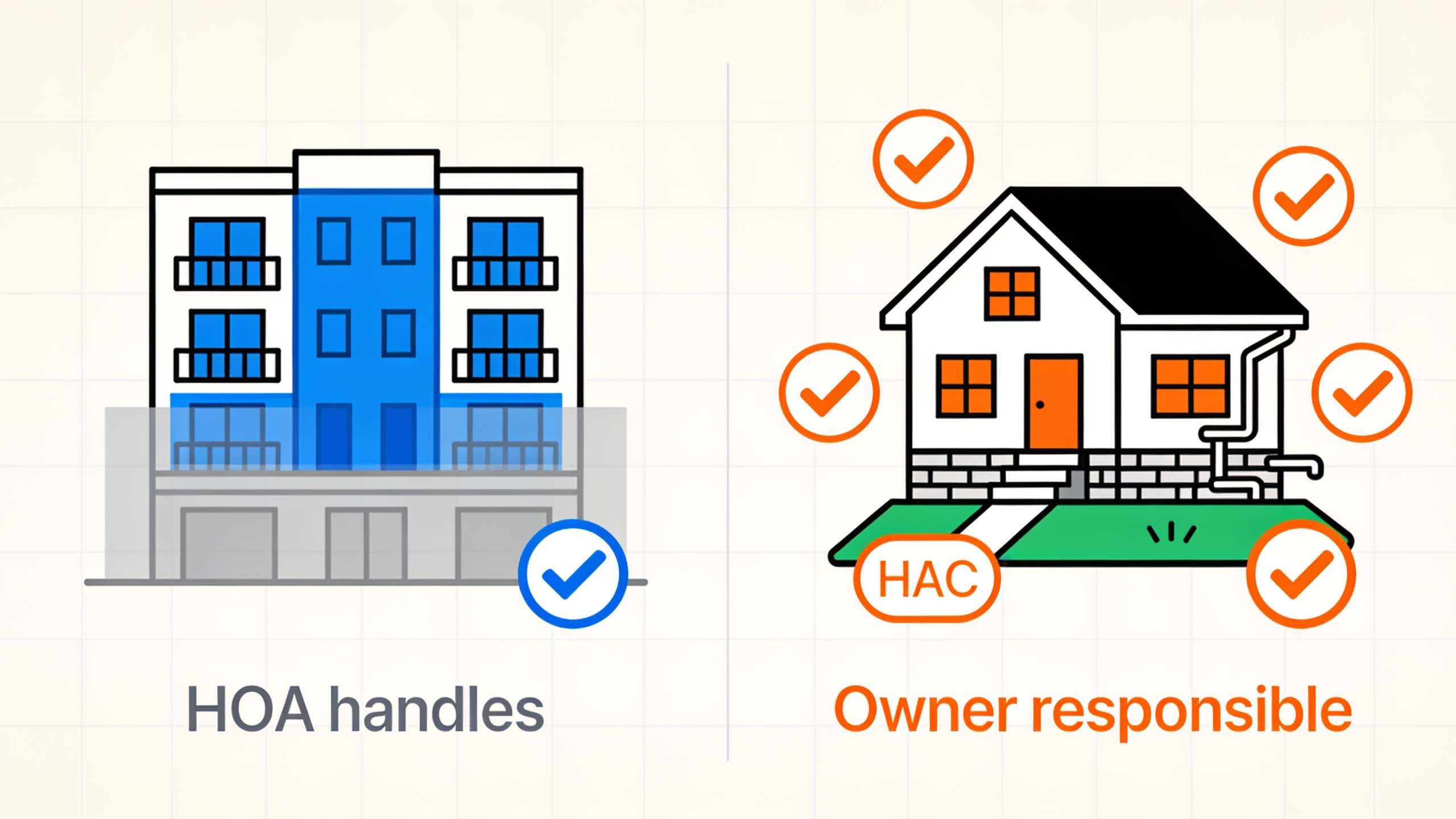
For a lot of first-timers, this is the deciding factor. Honestly? If mowing the lawn every weekend, clearing gutters before the first freeze, and playing phone tag with a roofer sounds like a special kind of hell, a condo wipes almost all of that off your plate. For a monthly fee. But if you’re the type who actually enjoys a home improvement project, wants a garden, or just refuses to pay someone for work you could do yourself, a house hands you full control. And full responsibility.
One thing worth saying, though. Condo maintenance isn’t magic. Those HOA boards are run by volunteers and elected residents, and a badly run association can mean sluggish repairs, an underfunded reserve, or endless bickering over how the money gets spent. Before you buy, ask to see the HOA’s financial reserves, the recent meeting minutes, and the history of special assessments. Seriously, this digging matters as much as the home inspection does. Maybe more.
Security’s another piece people forget about. Plenty of condo buildings roll security staff, gated access, or cameras into that monthly fee. Meanwhile a homeowner out in a more isolated or higher-crime area sometimes has to hire it out separately, contracting with services like Stormhammer Security for patrols or monitoring. Comparing what security’s already baked into the condo fee against what you’d have to set up yourself for a standalone house is a cost most buyers don’t even think about until they’ve already moved in.
Lifestyle Differences: Space, Privacy, and Community
Condos usually give you less square footage and less privacy but more built-in community and amenities, while houses give you more room, more privacy, and more freedom but almost no social infrastructure out of the box. Again, neither is “better.” It comes down to whether you’d rather have convenience and connection, or space and control.

Space and Privacy
Houses win on raw square footage, yard space, and just plain not sharing a wall with someone. No footsteps overhead. No stranger’s 2 a.m. TV bleeding through the drywall. For families with kids or pets, a backyard alone can settle the whole argument. There’s really no substitute for private outdoor space when you’ve got small children or a big dog that needs to burn energy.
Condos flip the value equation. Instead of private square footage, you’re paying for shared stuff: pools, gyms, rooftop decks, a concierge, sometimes even co-working spaces that a homeowner would have to go pay for à la carte (gym membership, a landscaper, a security service). For urban professionals somewhere in the 25-to-35 range who want walkability and absolutely do not want a second job maintaining a house, that trade is usually an easy yes.
Community and Social Dynamics
Condo living just builds in more chances to bump into people. HOA meetings, shared lobbies, awkward elevator small talk, community events. For some folks, especially people moving to a new city or downsizing after decades rattling around a big house, that instant community feels like a genuine win, not a compromise. Retirees looking to downsize often chase condos or 55-plus communities for exactly this. Less physical upkeep, more built-in social life they don’t have to organize themselves.
Houses can build community too, especially in suburban subdivisions, but it’s looser and less scheduled. Think block parties and PTA meetings instead of a Thursday-night mixer in the lobby. And a lot of families shopping for a house aren’t really shopping for a neighborhood at all. They’re shopping for a school district, and the “community” they care about is centered on the schools, not the building type.
Which Home Type to Buy If You’re a Real Estate Investor?
For rental income, single-family homes tend to appreciate more over the long haul and hold onto tenants longer (families, especially), while condos often throw off strong cash flow in high-demand urban spots but come saddled with HOA rental restrictions and extra monthly costs that nibble at your margins. Which one’s right depends on your strategy, appreciation versus cash flow, and how much of a hands-on landlord you actually want to be.
Single-family rentals attract tenants who stick around, partly because a family with kids settled into a good school district isn’t going to bounce every twelve months. That stability cuts down on turnover costs and vacancies, which are two of the biggest hidden money pits in rental investing. The flip side is brutal, though. Every repair lands on you. A dead water heater or a leaking roof comes straight out of pocket, and straight out of that month’s cash flow.
Condos appeal to investors for the opposite reason. Exterior maintenance, landscaping, and often the insurance on the building itself get handled collectively, which makes the whole thing a lot simpler to own. The catch (there’s always a catch): tons of HOAs cap how many units can be rented at once, and lenders get twitchy about buildings packed with rentals. That can gum up both your purchase and your ability to flip it to another investor later.
The same way sharp investors study market cycles before buying, more and more of them are diversifying across totally different asset classes too. Some real estate people keep an eye on adjacent markets, tracking sources like Cryptocoinsjournal to get a feel for how liquidity and volatility swings in digital assets might shape their broader portfolio, even when the bulk of their money stays parked in physical property. Real estate is obviously way calmer day-to-day than crypto, but understanding how risk correlates across your whole net worth is just smart if you’re serious about this.
Which Home Type to Buy Based on Your Life Stage?
Honestly, the right call usually has less to do with the property and more to do with where you are in life. Your income trajectory, how big your family is, and how much of your free time you’re willing to hand over to upkeep. Here’s roughly how it shakes out for different buyers.
First-Time Buyers (Ages 25–35)
For this crowd, a condo is often just the realistic entry point, especially in pricey job markets where a house is flat-out unaffordable on an early-career paycheck. Lower price, lower property taxes, maintenance included. All of it lets you start building equity and credit history without a surprise roof bill blowing up your second year of ownership. And if your career or personal life still has some question marks about where you’ll be, a condo’s usually-easier resale (compared to some quirky one-off house) takes a little risk off the table.
Families Seeking Space and Schools
If you’re chasing square footage, yard space, and a specific school district, a house is almost always the move. The extra cost and the extra work are generally worth it for the private space, the storage, and the long-term stability a house gives a growing family. Plenty of families also love being able to renovate whenever they want. Finish a basement, add a bedroom, fence the yard, all without begging a board for permission.
Investors
Like I said above, this one’s all about strategy. Houses for appreciation and tenant stability, condos for lower-maintenance cash flow in dense markets where rental demand is strong.
Retirees Downsizing or Buying a Second Home
Condos are usually the favorite for retirees ready to be done with yard work and repairs, and who want built-in community and, often, better security thrown in. A single-level condo with an elevator also quietly solves mobility issues that a two-story house never will. That said, some retirees deliberately go the other way and pick a smaller house instead, wanting room for visiting grandkids, hobbies, or a garden. They’ll trade a little maintenance for more space to breathe.
If you’re still not sure which bucket you fall into, or how your specific money situation tips the scale, it’s worth throwing your exact scenario at a community advice platform like Qastme, where real buyers and actual pros tend to chime in on the little details a generic article like this one just can’t cover. Every market and every budget is a little different, after all.
Condo vs. Single-Family Home: Pros and Cons at a Glance
Everyone weighs these trade-offs differently, but sometimes just seeing them lined up side by side makes it obvious which ones actually matter to you.
| Factor | Condo | Single-Family Home |
|---|---|---|
| Upfront cost | Generally lower | Generally higher |
| Monthly fees | HOA dues required | Typically none (unless HOA community) |
| Maintenance responsibility | Interior only | Entire property |
| Privacy | Lower (shared walls/common areas) | Higher (standalone structure) |
| Space | Smaller, less storage | More square footage and yard |
| Amenities | Often included (gym, pool, security) | Must arrange independently |
| Rental flexibility | Often restricted by HOA | Full owner discretion |
| Appreciation potential | Can lag in oversupplied buildings | Generally steadier long-term |
| Ideal buyer | Urban professionals, retirees, first-timers | Families, long-term investors, space-seekers |
Frequently Asked Questions
Is a condo actually a smart first home for a young professional?
For a lot of young professionals, yeah. A condo usually costs less upfront, needs way less hands-on maintenance, and tends to sit closer to city job centers and nightlife. The downsides are the monthly HOA fees and having less say over big building decisions. But if you’re building equity for the first time, those trade-offs are often more than worth the lower barrier to getting in.
Do condos hold their value as well as houses?
Historically, houses have appreciated more consistently than condos. Part of that is because land itself appreciates while the building on top of it slowly wears out and depreciates, and part is that condo supply can balloon quickly in a market, pitting a bunch of near-identical units against each other on price. It’s not a hard rule. Condos in supply-starved urban cores can absolutely climb fast. But as a general pattern, owning the land tends to be the steadier long-term driver.
What’s the biggest hidden cost people miss when comparing the two?
For condos, it’s special assessments. Those out-of-nowhere one-time charges from the HOA to cover a big repair the reserve fund couldn’t. For houses, it’s the slow drip of ongoing maintenance and the repairs you don’t see coming (roofs, HVAC, water heaters). A ton of first-time buyers budget only for the mortgage payment and get blindsided by the rest.
Can I rent out a condo the same way I’d rent out a house?
Not always, and this trips people up. Loads of condo associations impose rental caps, minimum lease lengths, or tenant approval processes that a homeowner never has to think about. If rental income is part of your plan, read the HOA’s governing documents (they’re called the CC&Rs) before you buy, and confirm that rentals are even allowed and under what terms.
How do I choose if I can genuinely afford either one?
If money isn’t the tiebreaker, decide based on how you want to spend your time and how much control you want over your space. People who want more free time, built-in amenities, and less physical labor tend to be happier in a condo. People who want space, privacy, and full run of their own place tend to be happier in a house. And do yourself a favor: tour both types in the neighborhood you’re targeting before you commit either way.
At the end of it, picking between a condo and a house really comes down to how you want to live day to day, not just what the spreadsheet says you can swing. Walk through your actual weekly routine in your head, think about your next five years, and be honest about your tolerance for either sharing decisions with a board or handling every repair solo. The right place is the one that fits your life. Not just your budget.