
Finding a good tenant isn’t luck. It’s a process. A solid screening checklist walks you through verifying income, checking credit and background history, confirming references, and catching red flags before you ever hand over a set of keys. And skipping steps because someone seems friendly, or because they’re in a hurry to move in? That’s exactly how landlords end up staring down missed rent, trashed carpets, or a months-long eviction. This guide breaks down how to screen tenants the way experienced property managers actually do it, with a step-by-step checklist you can reuse for every unit and every applicant.
Doesn’t matter if you’re renting out a single-family home you inherited, a condo you bought as an investment, or the basement apartment under your own feet. The fundamentals don’t change: gather the same information, verify it independently, and hold every applicant to the same standard. If you’re still comparing properties before you even become a landlord, honestly, read How to Read Property Listings Like a Pro first. Understanding what a listing is really worth helps you set realistic rent and screening expectations from the jump.
Table of Contents
- What Is a Tenant Screening Checklist?
- How to Screen Tenants Step by Step
- What Documents Should Be on Your Tenant Screening Checklist?
- Running Credit and Background Checks the Right Way
- Verifying References and Employment
- Red Flags That Signal a Problem Tenant
- How Do You Stay Legally Compliant While Screening Tenants?
- Comparing Screening Methods
- Frequently Asked Questions
What Is a Tenant Screening Checklist?
A tenant screening checklist is a standardized list of documents, checks, and questions you use to evaluate every rental applicant before approving a lease. The point isn’t paperwork for the sake of paperwork. It’s consistency. When you apply the same criteria to every applicant, in the same order, you cut your risk of a bad outcome and you protect yourself legally, because fair housing law requires you to treat applicants equally regardless of race, religion, national origin, sex, familial status, or disability under the federal Fair Housing Act.
A decent checklist usually covers five areas: a rental application with identifying info, proof of income, a credit report, a background and eviction history check, and verified references from current or past landlords. Miss one of those and you’re basically running on gut feeling instead of evidence. Which is, not coincidentally, how landlords end up blindsided six months into a lease. Think of the checklist as a filter, not a formality. Its whole job is to separate people who’ll reliably pay rent and look after the place from people who won’t (or can’t).
How to Screen Tenants Step by Step
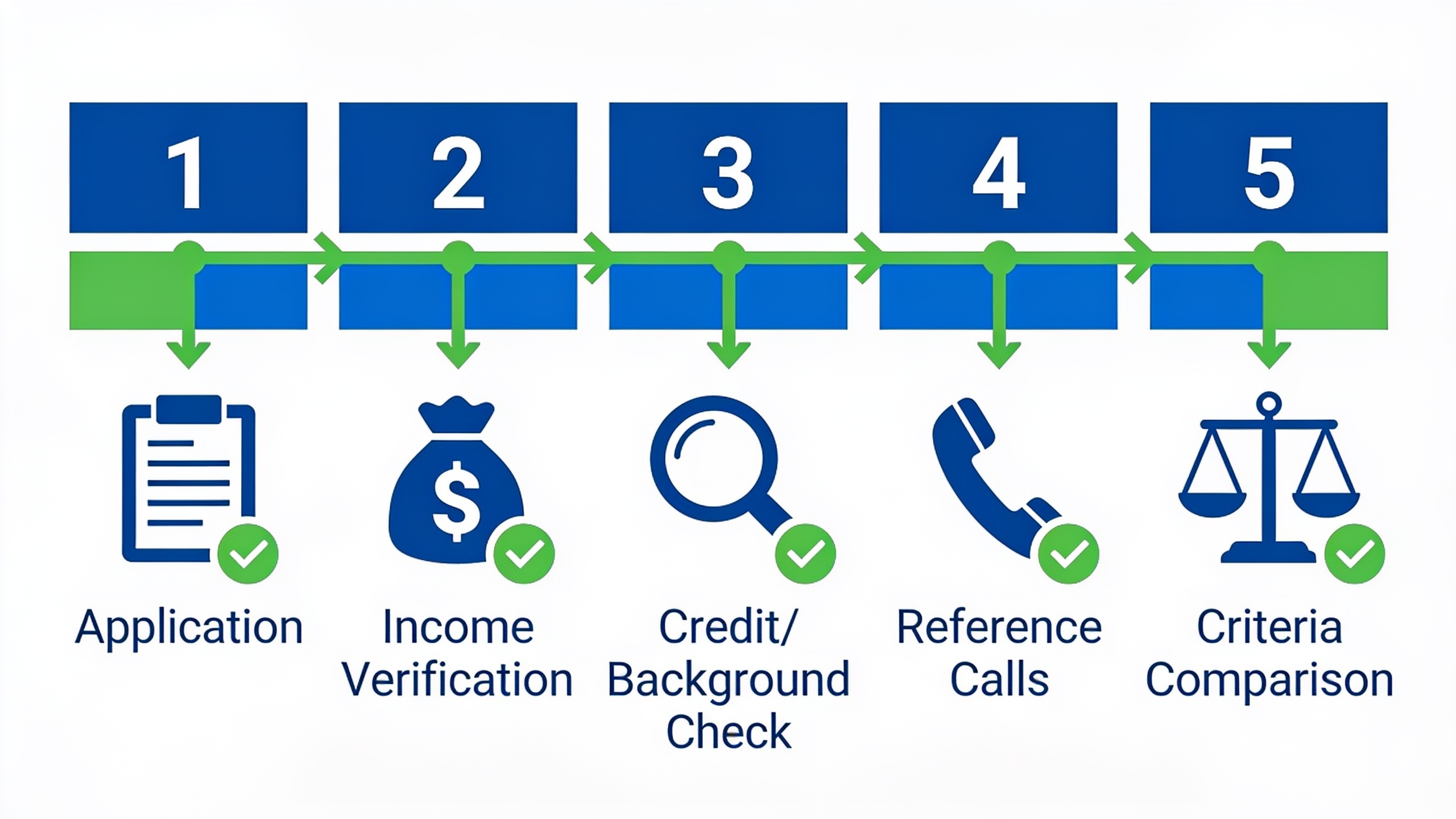
Screening a tenant properly means moving through a set sequence before you ever offer a lease: application, income verification, credit and background checks, reference calls, and a final comparison against your written criteria. Do these out of order, or jump ahead because you like someone, and that’s where most screening mistakes get born.
Step 1: Get a complete application from everyone. Every adult who plans to live in the unit fills out the same form. Current address, employer, income, past landlords, and consent to a background check. Incomplete applications are a signal in themselves. Someone who won’t cough up a previous landlord’s phone number is usually hiding something.
Step 2: Verify income before you look at anything else. The common rule of thumb is that gross monthly income should be roughly three times the rent, though you should pick your own threshold and stick to it. Ask for recent pay stubs, an offer letter, or two to three months of bank statements if they’re self-employed. And if you want a sense of how carefully employers vet candidates before hiring them, tools like JobScans show how an AI-driven fitment score works on the employer’s side of the table. It’s a useful reminder, too: a fancy job title on an application means a lot less than actual, verifiable proof of steady income.
Step 3: Pull a credit report and background check, with signed consent. More on this below, but the short version is simple. Never skip it, and always get written authorization first, because credit checks are regulated under the Fair Credit Reporting Act (FCRA).
Step 4: Call the landlords. All of them, not just the references they picked. Ask every applicant the same specific questions so you can actually weigh the answers side by side.
Step 5: Compare each applicant against your written criteria, not against each other’s personalities. Decide your minimum credit score, income ratio, and background standards before applications start rolling in, then apply them the same way to everyone.
What Documents Should Be on Your Tenant Screening Checklist?
At a bare minimum, your checklist should require five documents from every adult applicant: a signed rental application, government-issued photo ID, proof of income, a signed credit/background authorization form, and landlord references. Requiring the exact same set from everyone is what keeps your process fair and, frankly, defensible if anyone ever pushes back.
Here’s what each one gets you. The rental application should have their full legal name, current and previous addresses (usually going back two years), employer info, and an emergency contact. The government-issued ID confirms they’re who they say they are and that the name matches what’s going on the lease. Proof of income means recent pay stubs, an offer letter, tax returns for the self-employed, or a benefits award letter if the money comes from Social Security, disability, or a pension. The signed authorization form is explicit written consent to run a credit and background check, and the FCRA requires it before you pull any third-party report. And landlord references should include names and numbers for at least the current landlord plus one prior one, because a current landlord will sometimes hand out a glowing review just to get a problem tenant out of their hair.
Some landlords also ask for a co-signer application if the primary applicant’s income doesn’t quite clear the bar, and if there’s a pet, request vet records or a pet resume with breed, weight, and behavior history. None of this is about making renting harder than it needs to be. It’s about holding the same evidence for every applicant so your final call holds up if someone ever questions it.
Running Credit and Background Checks the Right Way
A tenant credit and background check tells you how someone has handled their financial obligations and whether they’ve got a criminal or eviction history that matters for a tenancy. But it only protects you if you run it consistently, with consent, and read the results in context instead of treating them as an automatic yes or no.
Credit reports usually show payment history, outstanding debts, collections accounts, and a score. A low number by itself doesn’t tell the whole story. A 24-year-old first-time renter with a thin file looks nothing like someone with a trail of collections for unpaid rent and utility bills. Look specifically for rental-related debt, because that’s the stuff that’s most directly relevant to your decision.
Background checks generally cover criminal history and civil judgments, and this is where you need to tread carefully. The U.S. Department of Housing and Urban Development (HUD) has issued guidance warning that blanket bans on anyone with any criminal record can actually violate fair housing law, because those policies tend to hit certain protected groups disproportionately. The smarter move is to weigh the nature, severity, and recency of an offense as it relates to the safety of other residents and the property, rather than slamming the door automatically.
Eviction history is often the single most useful thing you’ll dig up, since a past eviction is one of the strongest predictors of future non-payment or lease violations. A lot of screening services bundle eviction records right in with credit and criminal history, which saves you the headache of digging through county court records by hand.
One more thing: always run these through a legitimate screening service or credit bureau. Do not let an applicant email you a screenshot of their own credit score. Self-reported numbers are trivially easy to fake, and you’ve got no way to verify where they came from.
Verifying References and Employment
Verifying references means actually calling the people and employers on the application, not just reading what the applicant wrote down, to confirm rent history, lease violations, and job stability. This one step catches more trouble than almost anything else in the process, because paperwork can be doctored, but a landlord on the phone describing three missed rent payments is really hard to fake.
When you call a previous landlord, ask direct questions that you can compare across applicants. Did they pay rent on time every month? Did they give proper notice before moving out? Did the deposit come back in full, or were there deductions for damage? Would you rent to this person again? That last one is usually the most revealing, because a hesitant “well, it depends” tells you way more than a flat no ever could.
For employment, call the HR department or main company line directly instead of leaning only on a number the applicant handed you. A buddy pretending to be the “supervisor” is a well-worn trick. Confirm the job title, how long they’ve worked there, and whether it’s full-time or part-time. If they’re self-employed or gig-based, ask for bank statements and, where it makes sense, a business license or 1099 forms from the last year.
Red Flags That Signal a Problem Tenant
A red flag during screening is any inconsistency, gap, or piece of evidence hinting that an applicant might not pay reliably, might trash the place, or might break the lease. The earlier you spot it, the cheaper the mistake.
A few patterns worth watching for:
- Reluctance to finish the application or authorize a background check. Legit applicants expect this and cooperate without a fuss.
- Income that barely stretches to cover rent, or income you can’t verify. Someone who insists on paying several months upfront in cash to dodge income verification is trying to buy their way around a real concern.
- A string of short tenancies. Multiple addresses in two years, each lasting a few months, can point to repeated evictions or landlord fights rather than just someone who moves a lot.
- References that dodge direct questions, or that turn out to be a friend or cousin posing as a landlord. A quick property records search, or a call back to a different number, usually settles whether the “landlord” actually owns the place.
- Defensiveness or pressure tactics, like pushing you to skip the credit check because they’re “in a rush,” or waving an above-asking deposit specifically to skip screening.
- Unexplained gaps in their address or job history. A missing six months deserves a polite, direct follow-up question, not an assumption either way.
None of these is automatically disqualifying on its own, and context really does matter. Ask the applicant about anything murky before you decide. But when two or three of these show up together? That’s your cue to slow way down and dig before anyone signs anything.
How Do You Stay Legally Compliant While Screening Tenants?
You stay compliant by applying the exact same criteria and process to every applicant, getting written consent before you pull any report, and basing decisions on objective, tenancy-related factors instead of a protected characteristic. The federal Fair Housing Act bars discrimination in housing based on race, color, national origin, religion, sex, familial status, or disability, and plenty of states and cities pile on extra protected categories like source of income, sexual orientation, or age.
In practice, this means writing down your criteria before you list the place. Minimum credit score, income-to-rent ratio, background standards. Then you apply those exact same numbers to everyone who submits a complete file. And if you deny someone based on something in a credit or background report, the FCRA requires you to send an “adverse action” notice telling them which agency you used and that they’ve got the right to dispute anything inaccurate. Keeping a simple log of the criteria you used and the dates you applied them to each applicant is honestly one of the easiest ways to cover yourself if a rejected applicant ever comes back questioning your decision.
Comparing Screening Methods
Different landlords lean on different mixes of tools depending on how many units they’ve got and how hands-on they want to be. Here’s how the core components stack up against each other, both what they show you and why each one earns its place.
| Screening Step | What It Reveals | Why It Matters |
|---|---|---|
| Rental application | Identity, employment, rental history, household size | Establishes a consistent baseline for every applicant |
| Income verification (pay stubs, bank statements) | Whether income realistically covers rent | Reduces risk of late or missed rent payments |
| Credit report | Payment history, debts, collections, credit score | Shows financial reliability and existing debt burden |
| Criminal/background check | Criminal history, civil judgments | Helps assess safety risk within fair housing limits |
| Eviction history search | Prior evictions or unlawful detainer filings | One of the strongest predictors of future non-payment |
| Landlord reference calls | On-time payment habits, lease compliance, notice given | Confirms real-world behavior, not just paperwork |
| Employment verification | Job title, tenure, income stability | Confirms income claims are accurate and current |
No single row here is a stand-in for the rest. A clean credit report paired with a glowing but unverifiable landlord reference is still half a picture, and that’s precisely why working through every row for every applicant beats betting on any one signal.
Frequently Asked Questions
How much does tenant screening actually cost?
Depends on the provider, the location, and what’s bundled in (credit only versus credit plus criminal and eviction history), so there’s no single national price you can count on. A lot of landlords pass the cost to the applicant as an application fee, but whether you can do that, and how much you can charge, varies by state. Check your local landlord-tenant law before you set a number.
Can I screen a tenant without asking them first?
No. Pulling a credit report or background check without written authorization violates the Fair Credit Reporting Act. Always get a signed consent form as part of the application before you run any third-party report.
What credit score should I require?
There’s no magic universal number, because acceptable scores swing with the market, the rent, and how much risk you’re willing to stomach. What matters more than picking a specific score is deciding your minimum in writing before you start reviewing applications, then applying it the same way to everyone. That’s what keeps you consistent and fair.
How many previous landlords should I call?
At least two, the current landlord plus one prior one, gives you a more balanced read than a single reference. Remember, a current landlord will sometimes talk up a tenant just to get them out the door.
What’s the biggest mistake new landlords make here?
Skipping steps for someone who “seems nice” or is rushing to move in. A consistent checklist exists for exactly that reason, to yank personal impressions out of the equation and swap in verified facts. Which protects both your property and your legal standing if a decision ever gets challenged.
Screening carefully takes more time upfront than just trusting your gut, no question. But it eats up a whole lot less time than chasing unpaid rent, repairing damage, or filing for eviction down the road. Build your checklist once, apply it to every single applicant without exception, and you’ll spend far less time firefighting after the lease is signed.