
If you want to find a home near a great school, the trick is to start with actual school-performance data and search filters, not a real estate agent’s vague “oh, that’s a good area” hand-waving. I’ve watched too many buyers do it backward. They fall for a house first, then discover it’s zoned for a school two rating points lower than the one three blocks over.
So let’s not do that.
Whether you’re a young family making the classic move to the suburbs, or an investor sizing up rentals in a district where families are clawing for enrollment, lining up your home search with school quality is one of the smartest things you can do before you ever step foot in a showing. Below I’ll walk through how to actually do it on Viviendalista, how to read school ratings without getting fooled by a single number, how to compare districts, and the mistakes that quietly cost buyers thousands.
Table of Contents
- Why Homes Near Good Schools Matter for Buyers
- How Do You Find Homes Near Good Schools Online?
- Understanding School Ratings and Data Sources
- How Much More Do Homes Near Top-Rated Schools Cost?
- Step-by-Step: Running a School District Home Search on Viviendalista
- What to Verify Before You Make an Offer
- Special Considerations for Investors and Retirees
- Frequently Asked Questions
Why Homes Near Good Schools Matter for Buyers
Homes near good schools hold their value better, sell faster, and pull from a much deeper pool of buyers, because school quality is reliably one of the top three things families weigh when picking where to live. According to the National Association of Realtors’ 2023 Profile of Home Buyers and Sellers, roughly one in four buyers with kids under 18 said school quality was a decisive factor in choosing their neighborhood. And that share only climbs among people actively raising school-age kids.
This isn’t just sentimental parent stuff, either. It shows up hard in the resale numbers. A home zoned for a school with strong academic performance often carries a real, measurable price premium over a nearly identical home a few minutes away that happens to feed into a weaker school. That premium isn’t magic. It’s just steady, stubborn demand, which is exactly why buying inside a strong school zone works a little like a hedge. Even when the broader market cools, families still want these homes.
For investors, the same thing plays out with rentals. Families renting still care about school assignment, and listings near top-rated elementary, middle, and high schools tend to lease faster and pull higher rents. And retirees? You might think schools are irrelevant once the kids are grown. Not really. A home in a strong district is just plain easier to sell later, even to buyers without kids, because it signals a well-kept, desirable neighborhood. Good schools are shorthand for “this place is looked after.”
How Do You Find Homes Near Good Schools Online?
The fastest way to find homes near good schools online is to use a search platform that lets you filter by school boundary or rating directly, instead of manually cross-checking every address against a separate school-rating site. Viviendalista’s map search has a school overlay that draws the actual public school zones, so you can see which listings sit inside a specific elementary, middle, or high school boundary before you even click into a single property.
Here’s what drives me nuts about most general listing sites: they only show the “assigned school” as a little line of text buried on the property page. Which means you have to open a listing just to learn whether it qualifies. Multiply that by the dozens of homes you’re comparing and you’ve burned an afternoon. A proper school district search flips it. You pick the school first, and the map instantly narrows to only the homes that make the cut. No more trial and error.
If you’re comparing platforms, it’s worth reading something like this Zillow alternative showdown between Zillow and Viviendalista, which digs into how each site handles filtered searches, including school-boundary filtering, map accuracy, and how fresh the listing data actually is. Short version: the big portals are great for lazy Sunday browsing, but a school-specific search really benefits from a tool built around boundary-accurate mapping rather than zip-code guesswork. School zones cross zip codes constantly. They’ll even split a single street right down the middle, one side feeding one school, the other side another.
Understanding School Ratings and Data Sources
A school rating is a composite score, usually 1 to 10, that boils down standardized test performance, student growth over time, and sometimes graduation rates or college-readiness numbers for a given public school. It’s handy shorthand. But it’s not the whole story, and leaning on that one number without any context is honestly the most common mistake I see buyers make.
The most widely used source is GreatSchools.org, a nonprofit that turns state testing data into its 1-10 system and is the source a lot of listing platforms, including most of the big portals, license and display. Beyond that, your state’s department of education site publishes raw test scores and graduation data, and district-level report cards break things down by subgroup, class size, and per-pupil spending. Those are less flashy but often more honest.
When you’re comparing homes near good schools, look past the headline number and dig into a few things:
- The student growth score, which tells you how much kids improve year to year, not just where they started (a school in a well-off area can post great scores while barely moving the needle)
- The student-to-teacher ratio versus your state average
- Whether the rating is actually for the school your target home is zoned for, and not some nearby school with a confusingly similar name
- How recently the boundary data was updated, since district lines get redrawn as enrollment shifts
One more thing worth saying out loud: a high overall rating doesn’t automatically mean the right fit for your kid. A family with a student who needs extra academic support, say, will often supplement even a great school with outside help. Resources like Quiethelpgcse, which focuses on exam prep and study support, are proof that even in strong districts, families still go looking for extra help with standardized exams and coursework. Rating a neighborhood by school quality is where you start. It’s not the whole decision.
How Much More Do Homes Near Top-Rated Schools Cost?
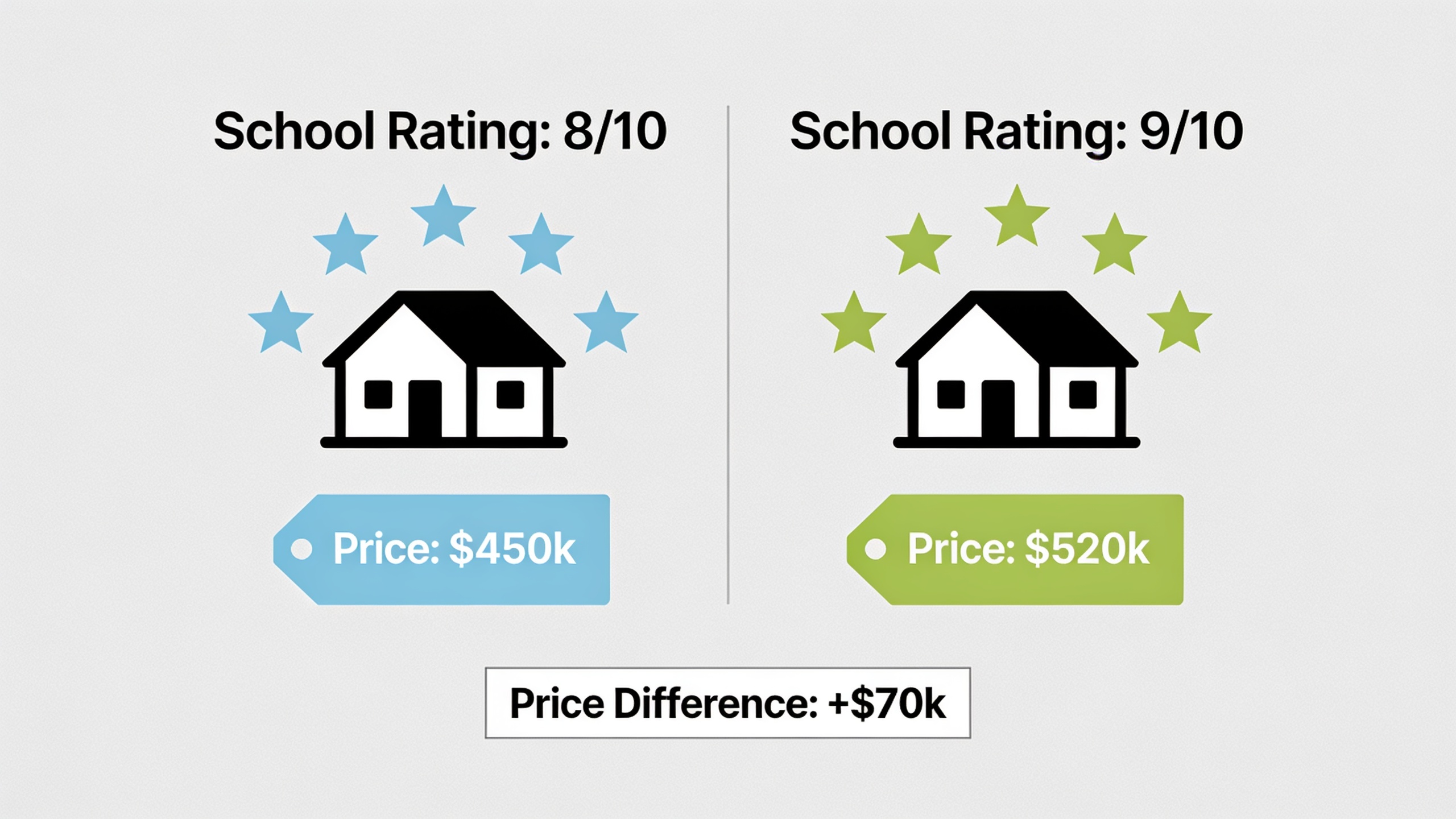
Homes zoned for top-rated schools usually sell at a premium over nearby homes in lower-rated zones, though how big that premium gets swings a lot depending on your metro and how wide the rating gap is. Research on this “school premium,” including academic work published through the National Bureau of Economic Research on school quality and home prices, has found that a one-point bump in standardized test scores at an assigned school can line up with noticeably higher home values in the surrounding boundary, even after you control for home size and lot size.
Where you really see it is at the boundary lines. Two houses that look almost identical, sitting a block apart, feeding into different school zones, can have list prices that diverge by tens of thousands of dollars. That’s the whole argument for a precise school district search over a fuzzy neighborhood search. Broad neighborhood names sprawl across multiple school zones, and people who search “by neighborhood” instead of “by verified boundary” sometimes assume they’re getting the great school when the house actually sits just outside the line. Ouch.
| Search Factor | General Neighborhood Search | School-Boundary-Specific Search |
|---|---|---|
| Accuracy of school assignment | Approximate, based on area reputation | Precise, based on verified district boundary lines |
| Time to shortlist qualifying homes | Hours of manual cross-checking per listing | Minutes, using a school overlay filter |
| Risk of boundary changes going unnoticed | Higher, since general searches skip boundary data | Lower, if the platform updates boundary maps regularly |
| Typical price premium visibility | Hard to isolate from other neighborhood factors | Easier to compare, since search is isolated to one school zone |
| Best suited for | Casual browsing, broad area comparison | Buyers with a specific school as a hard requirement |
Because the premium is real but uneven, run the numbers on two or three comparable zones instead of fixating on the single highest-rated school in your metro. A school rated 8 out of 10 with strong growth scores might deliver nearly the same outcomes as the 9-out-of-10 down the road, but at a meaningfully lower price. That trade-off is worth taking seriously before you lock your whole search onto the “best” school in the region.
Step-by-Step: Running a School District Home Search on Viviendalista
Running a solid school district search on Viviendalista takes about five steps and under ten minutes once you know your target school or rating threshold. Here’s how I’d do it start to finish.
Step 1: Set Your Base Location and Radius
Type your target city, county, or metro into the main search bar, then widen or tighten the radius based on how flexible you are about commute. If you’re relocating for work, do yourself a favor and map your workplace first, then search outward in a 15- to 30-minute commute radius before you ever touch the school filters. This one habit keeps you from falling head over heels for a school zone that quietly turns your daily drive into an hour each way. (Been there. It’s soul-crushing.)
Step 2: Activate the School Boundary Overlay
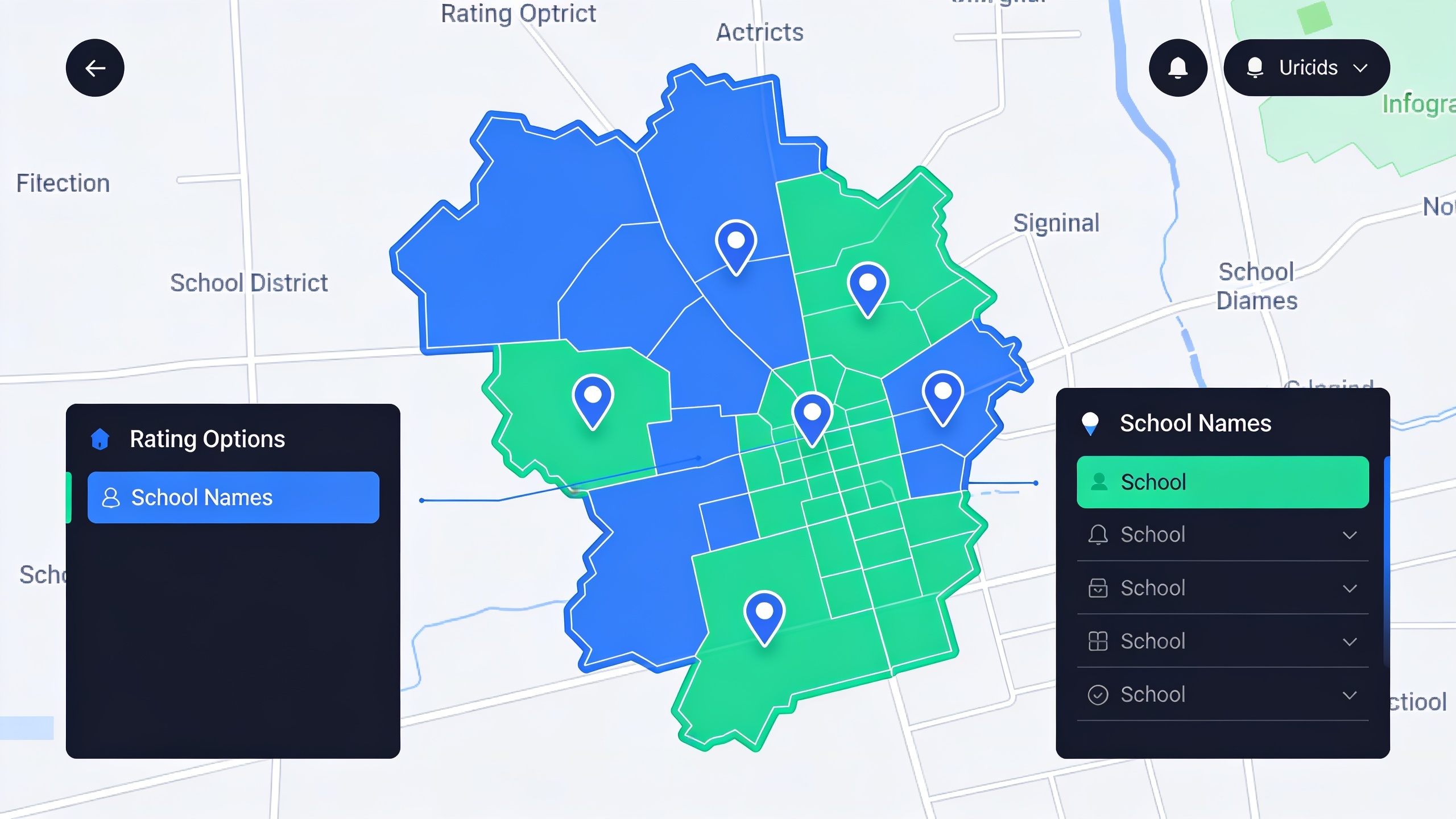
From the map view, toggle on the school boundary layer. This draws the actual attendance-zone lines for public elementary, middle, and high schools, instead of just plopping a pin on the school’s address. And since boundary lines are weird, they follow rivers, highways, old municipal lines, anything but tidy squares, this visual step is way more reliable than assuming a house “must” be zoned for whatever school looks closest on the map.
Step 3: Filter by School Rating or Specific School Name
With the overlay on, you can filter two ways. Either by a minimum rating threshold (say, only homes zoned for schools rated 7 or higher), or by typing in a specific school name if you already know exactly which one you want, maybe because a sibling’s already there or you’ve done your homework on a particular program. Searching by name is especially handy for magnet schools, dual-language programs, or IB tracks that a plain numeric rating just doesn’t capture well.
Step 4: Layer in Home-Specific Filters
Now that the school zone’s locked in, add your usual filters: price range, beds and baths, lot size, home age, and any must-haves like a garage or a fenced yard. Do this after the school filter, not before. That way your results only include homes that already clear your non-negotiable school requirement, and you’re not wasting time evaluating houses you’d have thrown out anyway.
Step 5: Save the Search and Set Alerts
Once the filtered results look right, save the search and turn on new-listing alerts. Inventory in strong school zones moves fast. Homes near sought-after schools tend to go under contract quicker than the metro average, so a saved search with instant alerts is often the difference between touring a place the day it lists and finding out it’s already pending. This is where a platform like Vivienda Lista, built around curated listings and comparison tools, earns its keep, because you can tune alerts tightly to your school and price parameters instead of drowning in every new listing in the city.
What to Verify Before You Make an Offer
Before you make an offer on a home near a top-rated school, verify the assignment directly, either with the district’s own boundary tool or by picking up the phone and calling the district office. Even accurate listing platforms pull from boundary files that can lag behind a recent rezoning. This one step protects you from the nightmare scenario: closing on a house, then discovering the district redrew the lines after the listing went up and now you’re feeding into a different school.
A few other things worth confirming straight from the district or municipality. First, whether the school is at or near capacity, since overcrowded schools sometimes trigger boundary changes to shuffle kids into newer or emptier buildings. Second, whether there’s an open-enrollment or school-choice policy that would let you apply to a preferred school even if you buy just outside its line. Third, bus route availability and ride time, because in big suburban districts “zoned for” doesn’t always mean “walking distance.” And finally, any planned new school construction nearby, which can redraw boundaries within a couple of years of your purchase.
It’s also just smart to visit the school in person if you can, or at least skim recent school board meeting minutes and parent reviews. A rating snapshot from a data aggregator reflects test scores from previous school years, and it won’t catch recent staff turnover, new leadership, or program changes. Pair Viviendalista’s boundary-accurate search with this kind of legwork and you’ll have a far fuller picture than any single rating number could ever give you.
Special Considerations for Investors and Retirees
If you’re an investor hunting rentals near good schools, watch enrollment trends, not just current ratings. A district gaining students year over year is a strong signal of durable rental demand, while a shrinking one can hint at future boundary consolidations that might yank a property out of its nice zone. Cross-referencing your school district search with local population growth data, often available through your state’s demographic office or the U.S. Census Bureau’s American Community Survey, adds a layer of due diligence that ratings alone can’t touch.
Think about tenant type, too. Family-oriented rentals near top-rated elementary schools tend to draw longer-staying tenants who want stability for their kids, which can mean lower turnover costs even if the rent premium is modest compared to a downtown unit full of young professionals cycling through short leases.
Retirees are a different animal. You’re probably not buying near good schools for your own household. But strong zones still matter for two reasons: resale value, and rental potential if you ever convert the place to income property later. If you’re chewing on whether a smaller home in a strong district beats other downsizing options, it’s worth reading a dedicated guide on downsizing for retirement, which covers how location decisions, including proximity to schools, healthcare, and transit, factor into a retiree’s long-term housing plan even with no kids in the house.
And here’s a slightly odd parallel that’s stuck with me. Housing searches and travel logistics have more in common than you’d think across life stages. A retiree relocating to a new region for a slower pace needs the same careful, detail-obsessed planning a traveler leans on when arranging transportation somewhere unfamiliar, kind of like how a service such as Ricaritranslombok helps visitors coordinate transportation and logistics around an unfamiliar region in Lombok, Indonesia. The lesson carries straight over to house hunting: local, detail-level information beats generic assumptions every single time, whether you’re decoding a neighborhood’s school zones or a new country’s roads.
Frequently Asked Questions
Does Viviendalista use the same school ratings as everyone else?
Viviendalista shows school boundary and rating data from established public education data providers, similar to what many major listing platforms use, but the boundary overlay gets refreshed regularly so the map reflects current attendance-zone lines instead of stale district files. Still, always cross-check with the district before you finalize an offer. Even frequently updated third-party data can lag behind a very recent rezoning.
Can I search by a specific school name instead of just a rating number?
Yep. On the map search, you can type a specific school name into the school filter, which is a lifesaver for magnet programs, language-immersion schools, or specialized high schools that a plain numeric rating won’t capture. It’s often more precise than filtering by rating alone, since two schools with the same overall score can differ wildly in what they actually offer.
Are homes near good schools always more expensive?
Usually, yes. Homes zoned for higher-rated schools carry a premium over similar homes in lower-rated zones nearby, though how big that premium gets depends on the metro, the size of the rating gap, and overall supply. In some markets, homes just outside a top boundary line, but still zoned for a solidly rated school, come in meaningfully cheaper with only a small difference in school quality. Which is exactly why comparing two or three zones side by side is worth the extra hour of research.
What if the district changes the boundaries after I buy?
Districts do redraw boundaries now and then, usually because of enrollment growth, new school construction, or efforts to balance class sizes. If this really worries you, ask the district straight up whether any boundary reviews or rezoning proposals are on the table before you close. And keep in mind that homes deeper inside a zone are generally safer from a boundary shift than homes sitting right on the edge.
Should I search by district or by individual school?
Depends on what you care about. Searching by district gives you a bigger pool of homes and works fine if you’re happy with any school in that district. Searching by individual school is better when you’ve got one specific school in mind, whether it’s for a particular program, a sibling already enrolled, or just a noticeably higher rating than its neighbors. Viviendalista supports both, so you can start broad at the district level and tighten down to a single school once you see how the ratings shake out.
Look, searching for homes near good schools doesn’t have to mean an afternoon of copy-pasting addresses into a separate ratings site. With boundary-accurate map filters, saved searches that ping you instantly, and the discipline to verify assignments with the district before you make an offer, you can move through this whole thing with a lot more confidence. First-time buyer thinking about your future kids, investor chasing steady rental demand, or retiree quietly planning for resale down the road. Same playbook works for all three.