
If you’re staring down retirement and trying to figure out where you’ll actually live, a vacation home vs retirement home is probably one of the biggest calls you’ll make. And it’s not a small one. A vacation home is a second place you use seasonally or now and then, while a permanent retirement residence is where you plant yourself full-time, the home where the everyday stuff of life happens. Both come with their own money math, tax headaches, and lifestyle trade-offs. The right answer? It depends almost entirely on your budget, your health, how close you want to be to family, and honestly, how you picture spending your days.
So let’s go through the real costs, the good, the bad, and the annoying, so you can make this decision with your eyes open instead of just crossing your fingers.
Table of Contents
- What’s the Difference Between a Vacation Home and a Permanent Retirement Residence?
- Vacation Home vs Retirement Home: Which Costs More Over Time?
- Pros and Cons of Owning a Vacation Home in Retirement
- Pros and Cons of Settling Into One Permanent Retirement Home
- How Do Taxes and Insurance Differ Between the Two?
- What Other Retirement Housing Options Should You Consider?
- How to Decide: Key Questions to Ask Before Choosing
- Frequently Asked Questions
What’s the Difference Between a Vacation Home and a Permanent Retirement Residence? {#difference}
A vacation home is a second property, usually somewhere with a beach, a mountain, or a golf course nearby, that you live in for part of the year while keeping a primary home somewhere else. A permanent retirement residence, on the other hand, is the single place you settle into full-time once you stop working, picked for comfort, accessibility, and being close to good doctors or the people you love. The real difference isn’t the building itself. It’s how much of your actual life is anchored there.
Retirees who go the vacation-home route are basically running two addresses. They split the year between a hometown (or a downsized primary place) and a seasonal escape, think a Florida condo they camp out in from November through March. The folks who commit to one permanent home pull everything into a single base. That makes life way simpler on paper, but it also boxes you in a little if your tastes or your health end up changing down the road. For what it’s worth, the U.S. Census Bureau’s American Housing Survey counts roughly 7.5 million housing units in the country as seasonal, recreational, or occasional-use homes, and a good chunk of those owners are retirees or people getting close, planning for whatever comes next.
Why does this distinction even matter? Because the two paths carry wildly different cost structures, upkeep burdens, and tax treatment, and all of that compounds over a retirement that could easily run 20 or 30 years.
Vacation Home vs Retirement Home: Which Costs More Over Time? {#costs}
Over a full retirement, a vacation home almost always costs more, because you’re footing the bill for two properties’ worth of taxes, insurance, utilities, and repairs. A single permanent residence keeps all that in one spot and, better yet, can be sized down to fit what you actually need. But that gap can shrink or blow up depending on a few things: whether you rent the vacation home out when you’re not there, how far apart the two properties sit, and how ruthlessly you downsize your main place.
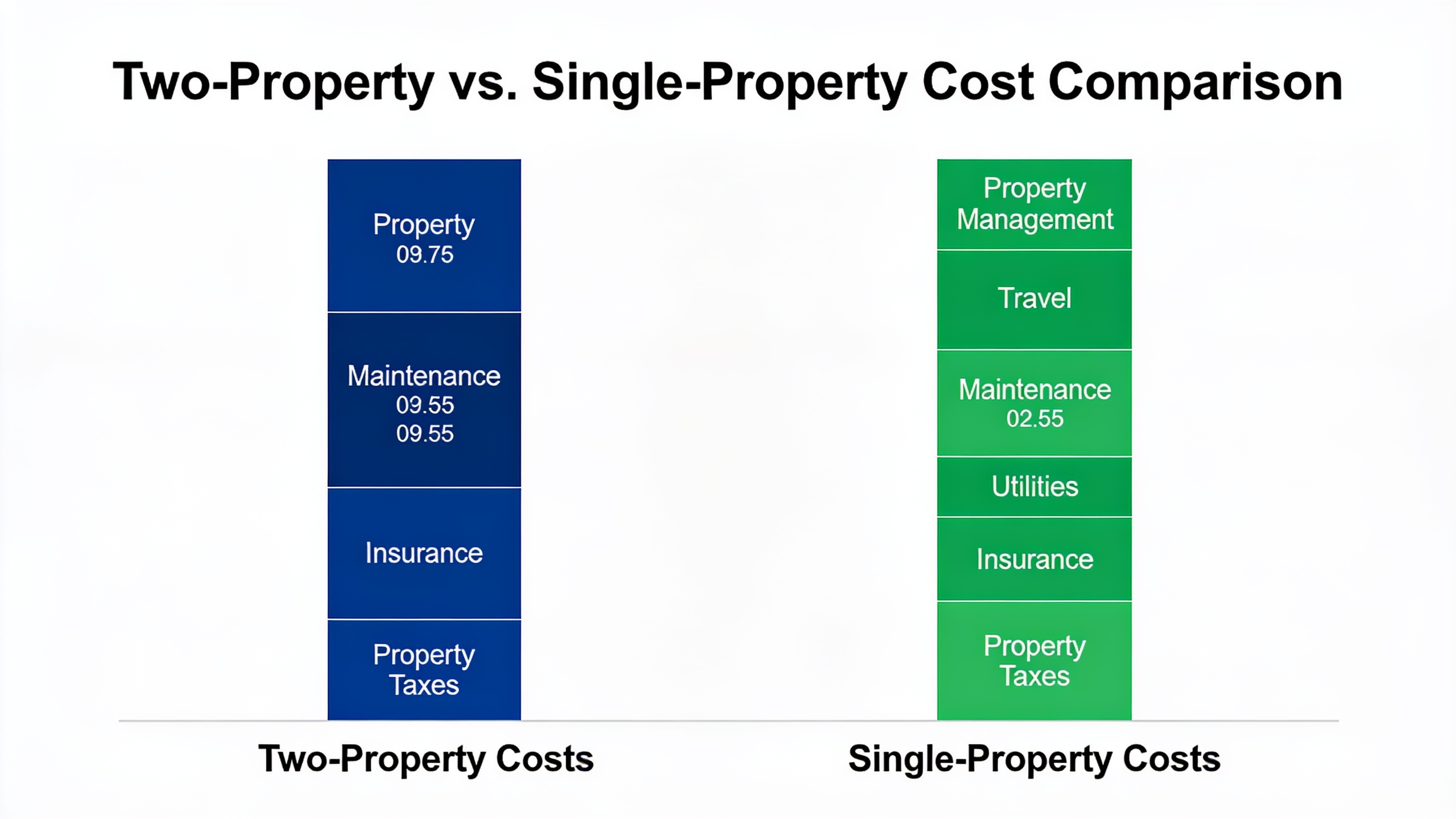
Two homes means two property tax bills, two homeowners insurance premiums, and often two sets of HOA fees, even when one place is empty eight months of the year. And here’s what people forget: the house doesn’t stop needing you just because you’re not there. Lawns keep growing. Pipes still need winterizing. Roofs keep getting older whether you’re watching or not. So a lot of owners end up hiring a local property manager or caretaker for the vacation home, which is one more recurring bill that a single-residence retiree never has to think about.
Compare that to retirees who commit to one home. A lot of them take the equity from selling a big family house and buy something smaller and cheaper to run, which quietly drops their fixed housing costs below what they were paying during their working years. It’s a smart move, and it’s covered in more detail over at Downsizing for Retirement: What You Need to Know, which digs into how right-sizing your primary home can free up cash for healthcare, travel, or leaving something behind, instead of sinking it into a second property.
| Cost Factor | Vacation Home (Two Properties) | Permanent Retirement Residence (One Property) |
|---|---|---|
| Property taxes | Paid on both properties, often in different states | Paid on one property only |
| Insurance | Two policies; vacation homes in flood/hurricane zones cost more | One policy, potentially lower-risk location |
| Maintenance & repairs | Duplicated systems (HVAC, roof, plumbing) in two locations | Single set of systems to maintain |
| Travel costs | Regular travel between two homes (flights, gas, tolls) | Minimal, since you live in one place |
| Rental income potential | Possible if rented out when not in use | Not typically applicable |
| Furnishing costs | Full furnishing needed for a second home | One-time furnishing for primary home |
| Flexibility to relocate | Higher, since you can sell either property | Lower, since your whole life is centered there |
And if you do buy a vacation home and suddenly realize you’ve got to furnish an entire second place from empty, buying furniture and household stuff in bulk from wholesale suppliers like t7b can shave a real amount off your setup costs versus grabbing everything piece by piece at retail.
Pros and Cons of Owning a Vacation Home in Retirement {#vacation-pros-cons}
A vacation home gives you seasonal flexibility and a change of scenery without ripping up your whole life, but you pay for it with double the responsibilities and double the carrying costs. It works best for retirees who’ve got solid finances, a clear seasonal rhythm they enjoy, and a genuine reason to keep a foot in two places.
Pros of a Vacation Home
The upside is easy to picture. A second property lets snowbirds skip the brutal winters, gives grandparents a place to gather the whole clan every summer, and can even bring in rental income during the stretches you’re not using it. A lot of vacation-home markets, especially in Florida, Arizona, and the Carolinas, have historically held their value pretty well thanks to steady demand from both retirees and vacationers, according to National Association of Realtors data on second-home sales trends. There’s another sneaky benefit too: a vacation home doubles as a trial run for a future full-time move. Spending a few months a year in a place before you commit for good is a fantastic way to avoid an expensive, gut-wrenching relocation mistake.
And don’t underestimate the mental side of it. Having a dedicated retreat gives the year some shape, something to look forward to and plan around, which genuinely helps a lot of people through those weirdly disorienting first couple years of retirement.
Cons of a Vacation Home
Now the not-so-fun part. The financial weight of two properties is the obvious one. But beyond taxes and insurance, vacation homes in disaster-prone spots (coastal Florida, California wildfire country) have watched their insurance premiums shoot up in recent years, and some carriers have straight-up walked away from certain markets. Then there’s the vacancy problem. An empty house is an invitation for break-ins, sneaky water damage, and pests you won’t find until it’s a real mess, which is exactly why so many owners end up paying for monitoring or a property manager.
There’s an emotional cost too, and it’s easy to miss until you’re living it. When you split your life between two homes, neither one ever quite feels like home base. And all that back-and-forth travel? It gets physically harder as you push into your 70s and 80s. Selling one of the two eventually, whether it’s health, money, or just being tired of the upkeep, is a pretty common ending. So honestly, it’s smart to think of a vacation home as a chapter rather than a forever thing.
Pros and Cons of Settling Into One Permanent Retirement Home {#permanent-pros-cons}
A single permanent home gives you simplicity, predictable costs, and easier access to steady healthcare and a real community, but it can start to feel limiting if you crave seasonal variety or want to stay near family who are scattered all over the map. This route tends to suit people who value stability, low overhead, and planning to age in place.
Pros of a Permanent Residence
Pulling everything into one home makes life so much easier. One set of utility bills. One property to keep up. One community where you actually build relationships. That last part matters more than most people expect, because having a trusted primary care doctor, your specialists, and a pharmacy that knows you gets more valuable with every passing year. A single home is also far simpler to retrofit for accessibility. Grab bars, ramps, a first-floor primary suite, whatever you need. You’re only investing in one place, not two.
Money-wise, one home usually means a lower overall cost of living, especially if you bought it with downsizing proceeds from a bigger family house. That freed-up equity can pad your nest egg, cover long-term care insurance, or just give you more spending money for travel and hobbies that don’t require owning real estate somewhere else.
Cons of a Permanent Residence
The big trade-off is flexibility, or the lack of it. If you settle somewhere and then figure out the climate, the community, or the distance from family just isn’t working, moving again in your 70s or 80s is a whole lot more disruptive and expensive than it would’ve been at 60. Staying put year-round also means eating the full range of local weather, and some retirees find that grinds on them, especially anyone who relocated from somewhere mild to a place with rough winters or blistering summers.
There’s also the loneliness risk if your community doesn’t have enough going on. No senior center, no clubs, nothing walkable, and you can feel pretty isolated. Picking the wrong location without a trial period (which, remember, a vacation home naturally gives you) is a genuine danger. That’s where having good research tools helps. Platforms with curated listings and comparison features, like Vivienda Lista, let you dig into neighborhoods, climate data, and cost-of-living differences before you lock yourself into one address for the long haul.
How Do Taxes and Insurance Differ Between the Two? {#taxes-insurance}
Taxes and insurance are almost always messier and pricier for a vacation home than for a single primary residence, mostly because a second property loses out on certain primary-residence tax breaks and often comes with higher risk-based insurance premiums. You really want to understand this stuff before you buy, not after.
Tax Considerations
In the U.S., the capital gains exclusion when you sell a home (up to $250,000 for single filers and $500,000 for married couples filing jointly, per IRS guidelines) only applies to a primary residence that passes the ownership and use tests. It does not apply to a vacation home. So selling a vacation property later in retirement can hit you with a bigger tax bill than selling your primary home would. Mortgage interest deductions can also be trickier on a second home depending on your total debt across both properties. And if you rent the vacation place out part of the year, that income generally has to be reported, though the flip side is you can write off some expenses too.
Property taxes vary by state as well, sometimes dramatically. Some states hand out homestead exemptions or senior property tax freezes that only apply to your primary residence, which means a vacation home in that same state wouldn’t qualify. You could end up paying noticeably more on the second property even though it’s worth about the same as your main one.
Insurance Considerations
Insurers usually charge more for vacation homes, and it makes sense when you think about it: an empty house carries higher odds of undetected damage, theft, and slower emergency response. Homes in hurricane, wildfire, or flood zones (which, surprise, is where a lot of vacation homes live) have seen premiums climb faster than primary residences in safer areas, according to data reported by the Insurance Information Institute on rising catastrophe-related claims. My advice? Get actual insurance quotes for the specific vacation property before you finalize anything, because those premiums can completely reshape the real cost comparison between the two paths.
What Other Retirement Housing Options Should You Consider? {#other-options}
The vacation-home-versus-permanent-home thing isn’t actually a clean either/or. There’s a whole spectrum of other retirement housing options worth a look: 55-plus active adult communities, house-sharing or co-buying with friends or family, extended-stay renting, and hybrid setups where you rent one season and own another. The vacation-versus-permanent question is really just one branch of a much bigger decision tree.
Active adult (55+) communities give you age-restricted neighborhoods loaded with amenities like fitness centers, golf, and a packed social calendar, which appeals to anyone who wants community without the isolation gamble of a lone house in an unfamiliar town. Continuing care retirement communities (CCRCs) take it further, bundling independent living, assisted living, and skilled nursing on one campus, so future transitions are smoother as your care needs shift. And renting instead of owning, whether full-time or seasonally, has gotten a lot more popular with retirees who want to move around without eating the transaction costs of buying and selling over and over.
A growing number of people also just test-drive a place by renting for six to twelve months in a candidate city before buying anything at all. It’s the “vacation home trial run” idea without the ownership strings attached. However you’re leaning, comparing real listings across a few markets, instead of trusting a hunch from one great vacation, tends to lead to way better long-term decisions. That’s exactly the kind of homework a broad property database is built for.
How to Decide: Key Questions to Ask Before Choosing {#how-to-decide}
Ultimately, the choice between a vacation home and a permanent retirement home comes down to your finances, your health outlook, how close you want to be to family, and an honest gut-check on how much upkeep you’re actually willing to deal with. There’s no universally right answer here. Just the one that fits your life.
Start with the money question: how much of your savings are you comfortable locking up in real estate versus keeping liquid for healthcare, travel, or the stuff you can’t predict? Then look at your health honestly. If mobility issues are likely within the next 10 to 15 years, a permanent, accessible, single-story home near good medical care probably beats a seasonal getaway. Family matters too. A vacation home somewhere the grandkids love to visit can strengthen those bonds in ways a single far-off residence just can’t.

And be real with yourself about your own personality. Some retirees genuinely love the rhythm of bouncing between two places. Others find the endless packing and unpacking and property-juggling completely draining. Funny enough, a big life shift like this benefits from the same structured, goal-oriented thinking people use for career moves. Just as folks in fields like law enforcement lean on structured coaching platforms such as State6 to map out their next step methodically, retirees do better treating this housing call as a deliberate plan rather than an emotional impulse buy.
Oh, and one more thing. If you’re the kind of retiree who plans to research everything, compare markets to death, and maybe even document your relocation journey online, tools that streamline research and content, like RobinRank, can help you organize your findings, track comparisons across locations, and share the whole process with family or an online community as you go.
Frequently Asked Questions {#faq}
Should I buy a vacation home before I retire or wait until after?
A lot of financial planners lean toward buying a few years before you fully retire, so you can test the location seasonally while you’ve still got income coming in to cover the extra costs. It also lets you sharpen your read on your retirement housing options with actual lived experience instead of guesswork, before you ever consider making it your primary home.
Can my vacation home eventually become my permanent retirement residence?
Absolutely, and it’s a common (and often smart) play. Plenty of retirees buy a vacation home in their late 50s or early 60s, use it seasonally for several years, then sell their original primary home once they’re confident the getaway spot really works for the long haul. Boom, the second home becomes the one permanent home.
How much more does a vacation home cost than just one retirement residence?
It swings a lot depending on location and how you use it, but owning two properties generally means paying for two sets of property taxes, two insurance policies, and two maintenance loads at the same time, even though you can only be in one at a time. Renting the vacation home out while you’re gone can chip away at that gap, but it rarely wipes it out entirely.
Do I really need a real estate agent who specializes in vacation properties?
Honestly, yes, I’d strongly recommend it. Vacation-home markets often have their own oddball rules around short-term rental permits, HOA restrictions, and flood or hurricane insurance requirements that look nothing like a standard primary-home deal. An agent who knows that specific market can save you from ugly surprises after closing.
What’s the single biggest mistake retirees make with this decision?
Two things, really. Underestimating the ongoing costs (especially insurance, HOA fees, and travel between two homes), and overestimating how often they’ll actually use a vacation home once the shine wears off. Running a realistic annual budget for each scenario before you commit is far and away the best way to dodge regret.
Finding the Right Fit for Your Retirement Years
Choosing between a vacation home and a permanent retirement residence isn’t just a spreadsheet exercise. It’s really a decision about how you want your days, your seasons, and your years to feel. Some retirees genuinely need the variety and the family pull of a second place. Others find real peace, and real financial breathing room, in one well-chosen home. Whichever way you land, taking the time to compare actual listings, run honest cost projections, and even live in a place before you buy will serve you a whole lot better than guessing off a single happy vacation memory or a well-meaning friend’s advice.