
So you’re stuck on the rent-or-buy question this year. Welcome to the club. It’s a bigger club than usual, because the math has gotten genuinely weird in a way it hasn’t been in over a decade. You’ve got mortgage rates that refuse to come down, home prices that somehow keep climbing anyway, and rents that have finally started to chill out in a lot of cities. There’s no clean answer. But the numbers can absolutely point you somewhere useful, as long as you look at your numbers and not whatever scary headline landed in your feed this morning.
What I want to do here is walk through the actual math. Current rates, price-to-rent ratios, how this all shakes out differently depending on where you live and what stage of life you’re in. Because “should I rent or buy” doesn’t have a national answer. It has your answer.
Table of Contents
- The 2025 Housing Market Snapshot
- Rent vs Buy 2025: The Core Math
- How Much Does It Actually Cost to Buy a Home in 2025?
- How Much Does It Cost to Rent in 2025?
- Price-to-Rent Ratio: The Fastest Gut-Check
- Should I Rent or Buy? A Decision Framework by Life Stage
- Regional Differences That Change the Answer
- Frequently Asked Questions
The 2025 Housing Market Snapshot
Buying costs a lot more per month than renting a comparable place in basically every major US metro right now. That’s the headline. But renters aren’t exactly living the dream either, since wages haven’t kept up with the housing costs that piled on over the last few years. Mortgage rates have parked themselves in the mid-to-high 6% range for most of the year, per Freddie Mac’s Primary Mortgage Market Survey. Compare that to the 3-4% deals people locked in back in 2020 and 2021 and you start to understand why everyone’s grumpy.
That rate gap created something economists call the “golden handcuffs” problem, and it’s exactly what it sounds like. If you’re sitting on a 3% mortgage, why on earth would you sell and take on a 7% one? So people don’t. Inventory stays tight, prices stay firmer than they have any right to be given how unaffordable everything is, and the National Association of Realtors keeps reporting median existing-home prices near record highs even though sales volume is way below what it was before the pandemic. Rentals, on the other hand, have loosened up in a lot of cities that went on an apartment-building spree, which means renters have more room to negotiate than they’ve had since 2019.
Bottom line? The 2025 equation isn’t one-size-fits-all. It hinges on your local market, how long you’re actually going to stay put, and whether you’ve got a fat down payment or great credit to blunt the sting of today’s rates.
Rent vs Buy 2025: The Core Math
Strip it all down and the decision comes to this: compare your total monthly housing cost (not the sticker payment, the whole thing) against how long you’ll live there and what your money could do if you invested the difference instead. Buying builds equity but locks up your cash and saddles you with maintenance, property taxes, and insurance. Renting builds you nothing but keeps you nimble. Both have a real cost. One’s just easier to see than the other.
A lot of financial planners lean on the “5-year rule,” and it’s a decent gut check. If you’re not planning to stay put for at least five years, the cost of buying and then selling (usually 8-10% of the home’s value once you add both ends together) tends to swallow whatever equity you’d have built, especially at these rates. Closing costs alone run 2-5% of the loan when you buy. Then selling costs you another 6-10% of the sale price once you factor in agent commissions, taxes, and the inevitable “oh, we need to fix that before it shows” repairs.
Here’s a simplified side-by-side of what renting versus buying actually looks like when you count more than the monthly payment:
| Cost Factor | Renting | Buying |
|---|---|---|
| Upfront cost | 1-2 months’ rent + deposit | 3-20% down payment + 2-5% closing costs |
| Monthly cost | Fixed rent, may increase yearly | Mortgage + property tax + insurance + maintenance |
| Maintenance responsibility | Landlord | Homeowner (budget 1-2% of home value/year) |
| Equity building | None | Yes, over time |
| Flexibility to relocate | High (lease term dependent) | Low (selling takes time and money) |
| Tax benefits | None | Mortgage interest/property tax deduction (if itemizing) |
| Exposure to rate/price swings | Low | High (especially with adjustable-rate loans) |
Neither column wins outright. A 28-year-old renting a downtown one-bedroom while their career takes off has completely different priorities than a 45-year-old family that just found the neighborhood with the good schools and the yard. If you’re still circling your first purchase, the First-Time Home Buyer’s Guide: Where to Start in 2025 covers the stuff that comes before you even open a cost calculator, like fixing your credit and getting pre-approved.
How Much Does It Actually Cost to Buy a Home in 2025?
Buying costs a lot more per month than it did a few years back, and it’s almost entirely because rates are roughly double what they were in 2021, even though price growth has slowed way down. On a median-priced US home, that principal-and-interest payment has jumped hard since 2021 for reasons that have nothing to do with the house getting nicer. It’s the rate. Just the rate.
Let me make this concrete. Take a $400,000 home, put 20% down ($80,000), and finance the rest on a 30-year fixed at 6.75%. Your principal and interest lands around $2,075 a month. Now pile on property taxes (which swing wildly, from under 0.5% a year in a place like Hawaii to north of 2% in New Jersey or Illinois), homeowners insurance, and maybe PMI if you put down less than 20%. Suddenly your all-in monthly cost is sitting somewhere between $2,600 and $3,100.
Now here’s the part that stings. That same house, financed in early 2021 at around 3%, would’ve run you about $1,350 in principal and interest. Same price. Same house. Over $700 a month cheaper. That one shift in rates explains most of why affordability has fallen apart even in markets where prices barely budged.
And the mortgage is just the opening act. You’ve also got closing costs, which run 2-5% of the loan and cover the appraisal, title insurance, origination fees, and prepaid taxes and insurance. There’s maintenance, where planners generally say to sock away 1-2% of the home’s value every year for repairs (and trust me, the water heater always dies at the worst possible time). And if you’re buying a condo or something in a planned community, there are HOA fees, which range from under $100 to over $600 a month depending on how fancy the amenities get.
If you’re torn between property types, read Condo vs. Single-Family Home: Which Is Right for You? before you start crunching numbers. HOA dues and who’s responsible for maintenance can genuinely flip your monthly comparison depending on which way you go.
How Much Does It Cost to Rent in 2025?
Renting is generally cheaper month-to-month than buying a comparable home across most major US metros right now. That said, rent growth has outpaced wage growth in a lot of cities over the past few years, so “cheaper” is relative. According to Zillow’s Observed Rent Index and Apartment List’s National Rent Report, national median asking rents have mostly flatlined or crept up only slightly year-over-year in 2025. Which is a huge shift from the double-digit rent explosions we saw in 2021 and 2022.
That plateau is basically a supply story. Cities like Austin, Denver, and chunks of Florida built apartments faster than people showed up to fill them. Vacancy rates went up, landlords lost their leverage, and rents softened. Meanwhile the supply-starved metros in the Northeast and parts of the Midwest? Rents keep climbing there because nobody’s building fast enough to keep up.
As a renter in 2025, here’s roughly what you’re on the hook for. A security deposit, usually one month’s rent but higher in competitive markets. Application and admin fees, often $50-$200 per applicant (which, don’t get me started, feels like a scam). Renters insurance, which is genuinely cheap at $15-$30 a month and increasingly something landlords require. And then the annual rent bump when your lease renews, typically 3-8% depending on your local market and whether any rent control laws apply.
The real selling point of renting right now is predictability plus freedom. You’re not staring down a 6.75% mortgage. You’re not the one paying for a new roof or a dead HVAC system. And if a great job offer lands in another city, you can just… leave. No listing, no showings, no three-month selling saga. Whether that flexibility is worth giving up equity really comes down to your city’s price-to-rent ratio, which is exactly what’s next.
Price-to-Rent Ratio: The Fastest Gut-Check
The price-to-rent ratio is the quickest sanity check you can run, and I love it precisely because it’s so simple. You take the median home price and divide it by the median annual rent for a similar place (that’s monthly rent times 12). One number, and you’ve got a rough read on whether your city leans buy or rent.
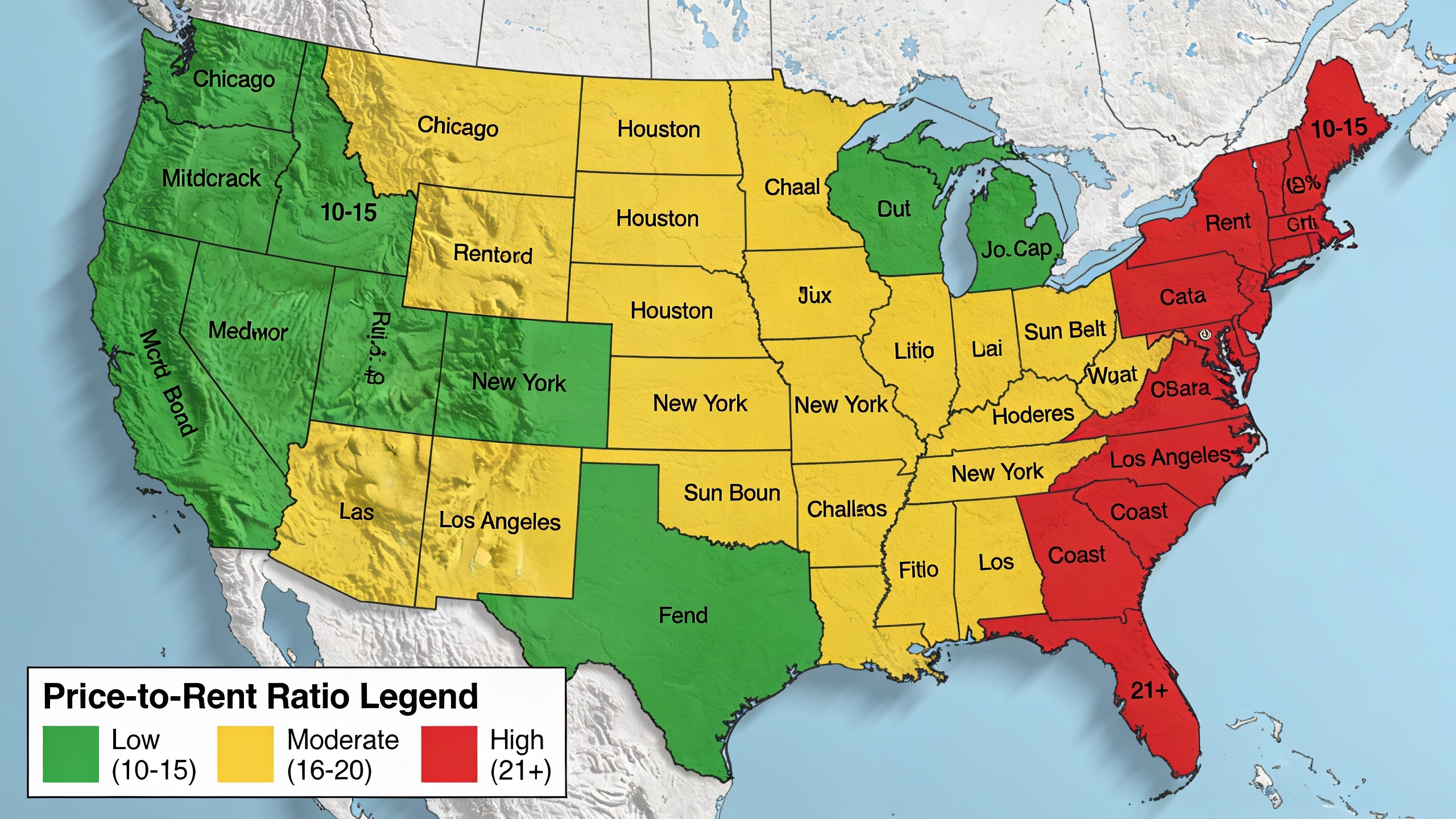
The rule of thumb analysts use goes like this: under 15 and buying is probably cheaper than renting. Somewhere between 16 and 20 and it’s basically a wash, so your personal situation matters more than the math. Above 21 and renting is likely the smarter money move, at least for the short-to-medium term.
Let’s run one. A $450,000 home in a market where similar places rent for $2,500 a month gives you $30,000 in annual rent, which works out to a ratio of exactly 15. Right in “buying tends to make sense” territory, assuming you’ll stick around long enough to eat the transaction costs. But that same $450,000 home somewhere rent runs only $1,800 a month? Now annual rent is $21,600 and your ratio is about 20.8. That tips things toward renting, especially if you’re not sure you’ll be there five-plus years.
Coastal, high-demand cities like San Francisco, New York, and LA have historically posted ratios well above 20, sometimes past 30. Which means renting has been the mathematically defensible move there for years, long before 2025’s rate mess showed up. Flip over to the more affordable Midwest and Southern metros (parts of Ohio, Texas, Georgia) and you’ll routinely see ratios in the 10-14 range, where buying pencils out a whole lot faster.
Should I Rent or Buy? A Decision Framework by Life Stage
There’s no universal answer to this, because the right call depends way more on your timeline, your cash reserves, and your lifestyle than on the national market. So let’s look at how the math tends to shift depending on who’s doing the asking.
First-Time Buyers in Their 20s and 30s
For folks aged 25-35 who love city living, this decision usually comes down to two things: how mobile is your career, and how much have you saved. If there’s any real chance you’ll switch jobs or cities in the next few years, renting almost always wins, because you dodge that 8-10% round-trip cost of buying and then selling. But if you’ve settled into a place for the long haul and you’ve got 10-20% saved for a down payment, a starter condo or small house can start paying off in about 5-7 years, particularly where the price-to-rent ratio sits under 18.
Real Estate Investors
If you’re an investor between 30 and 50 sizing up rental properties, honestly, “should I rent or buy for myself” is the wrong question. You should be living in cap rate and cash-on-cash return math. In 2025’s high-rate world, cap rates in a lot of markets have compressed because purchase prices haven’t dropped as fast as financing costs have jumped. Translation: you need to underwrite deals a lot more conservatively than you did in 2019-2021. Markets with strong job growth and landlord-friendly rules, mostly across the Sun Belt, are still pulling in investor money despite the rate headwinds.
Families Seeking Space
Families hunting for a bigger place in the suburbs with good schools often run into a frustrating reality: renting a comparable single-family home is either scarce or nearly as expensive as buying one. The single-family rental market is just smaller and more cutthroat than the apartment market. For these buyers the decision often isn’t even mostly financial. It’s school quality, a yard, stability for the kids, the sort of stuff that can justify buying even when the raw numbers land in toss-up territory.
Retirees and Downsizers
Retirees looking to downsize or grab a vacation home are usually sitting on a much better cash position, sometimes buying outright with equity from a previous sale, which changes everything since they’re barely exposed to today’s rates. Renting can still make sense here if you want the freedom to split time between places or you’re just not ready to commit to one town. But if you’ve found the retirement spot and you want to lock in your housing costs against future rent hikes, buying is a reasonable move.
Regional Differences That Change the Answer
The rent-vs-buy answer swings enormously by metro, because local supply, job growth, and construction all move independently of whatever the national numbers say. A national average completely hides the gap between, say, Austin (where apartment overbuilding pushed rents down while home prices also softened) and Miami (where rents and prices are still elevated thanks to everyone moving there).
Sun Belt metros that ballooned between 2020 and 2023, including big parts of Texas, Florida, and the Carolinas, generally have more balanced or even renter-favorable ratios now because construction finally caught up with demand. Coastal markets with restrictive zoning and almost no new building, like much of coastal California and the Northeast corridor, keep showing sky-high ratios. Which just reinforces renting as the default financial choice for anyone not planning to hunker down for decades.
Midwest metros like Cincinnati, Indianapolis, and Kansas City tend to have some of the lowest price-to-rent ratios in the country, often in the 10-13 range. That’s a big reason they’ve attracted both first-time buyers who got priced out of the coasts and investors chasing better cash flow.
If you’re building a bigger strategy around real estate content, marketing, or lead gen in this space, platforms like Digital Fusion Hub do web design and digital marketing aimed at real estate and service businesses trying to reach exactly this rent-vs-buy-curious crowd. And for real estate sites or advisors trying to scale organic visibility around timely topics like this, tools such as RobinRank have popped up to automate SEO content and backlink building, which matters when you realize how brutally competitive “rent vs buy” content has become in search.
I’ll also say this: a decision this big usually benefits from a real expert, not just a blog post (even a good one). Services like Advisorynavigator match people with vetted financial advisors or real estate consultants who’ve actually worked through the exact tradeoff you’re chewing on. Super useful if your situation has any curveballs, like self-employment income, a job relocation, or a debt-to-income ratio that’s, let’s say, complicated.
And on a lighter note that’s weirdly relevant: whether you rent or buy, moving day and general home upkeep mean spending real time outside in whatever weather decides to show up. Which is exactly why resources like Waterproof Sole, where they review durable, weatherproof footwear, are genuinely handy for anyone hauling boxes or doing yard work at a new place, rented or owned.
Frequently Asked Questions
So is it actually cheaper to rent or buy in 2025?
In most major US metros, renting is cheaper on a month-to-month cash-flow basis in 2025, thanks to those mid-to-high 6% mortgage rates. But buying can still be the better long-term play if you plan to stay at least five years and you’re in a market with a price-to-rent ratio under 18-20.
What counts as a good price-to-rent ratio in 2025?
Under 15 generally favors buying, 16 to 20 puts renting and buying roughly even, and above 21 generally favors renting. That’s the rule of thumb real estate analysts and appraisers lean on.
How long do I need to stay before buying makes sense?
Most planners say five years minimum. Closing costs (2-5% of the loan) and selling costs (6-10% of the sale price) usually need several years of equity growth and mortgage paydown to cancel out, and that’s especially true in a high-rate stretch like this one.
Will rates drop enough in 2025 to flip the math?
Rates have bounced around a fairly narrow band all year, and while forecasters at places like the Mortgage Bankers Association have floated modest declines here and there, nobody credible is calling for a return to those sub-4% 2020-2021 rates. So don’t sit around waiting for rates alone to swing the decision in your favor. It probably won’t happen.
What if I genuinely don’t know how long I’ll stay in a city?
Then rent. When your timeline’s a question mark, renting is the lower-risk move every time, because you skip the transaction costs and the market-timing gamble of buying and selling in a short window, and you keep the freedom to pack up for a job or a lifestyle change with zero financial penalty.
Final Thought
There’s no single national verdict here, and anyone who tells you otherwise is selling something. This is a local, personal calculation shaped by your city’s price-to-rent ratio, how long you’re staying, and how much cash you’ve actually got right now. Run your own numbers against the specific home and market you’re eyeing. Trust the local data over the headlines. And remember, both renting and buying can absolutely be the smart choice, depending on where you are in life and where you think you’ll be five years from now.