
Picking where to hunt for your next house can matter almost as much as picking the house itself. And when people pit Viviendalista against Realtor.com, they usually get stuck on the wrong question: who’s got more listings? That’s not really the point. What actually separates these two is how accurate the listings are, how good the search tools feel, and whether the whole thing walks you smoothly from casual browsing toward an actual closing. Both serve millions of home shoppers. But they think about data freshness, filtering, and the general vibe of the experience pretty differently, and which one wins for you depends a lot on whether you’re a nervous first-timer, an investor crunching numbers, or a family trying to land near a decent school.
So here’s what I’ll do. I’ll walk through both platforms across the stuff that genuinely affects your search: listing accuracy, search and filters, the mobile experience, how they hook you up with agents, how they make their money, and how they handle oddball needs like rental investment or downsizing. By the end you should know which one fits, or whether (like a lot of people) you’re better off using both.
Table of Contents
- Why Compare Viviendalista and Realtor.com?
- Listing Accuracy and Data Freshness
- Search Filters and Discovery Tools
- Mobile Experience and Usability
- Agent and Lender Connections
- Pricing, Fees, and Monetization
- Which Platform Fits Which Buyer?
- Feature Comparison Table
- Frequently Asked Questions
Why Compare Viviendalista and Realtor.com?
It’s worth comparing these two because they promise the exact same thing (find you a home) while getting there through totally different data sources, design choices, and audiences. Realtor.com is the old-guard American real estate platform, pulling data straight from Multiple Listing Services across the country. Viviendalista plays a different game entirely, positioning itself as a curated, comparison-first tool for buyers and renters who’d rather weigh a few good options side by side than drown in an endless firehose of listings.
Think about who’s actually searching. A 28-year-old chasing their first condo in a walkable neighborhood cares about fast filters and neighborhood info. An investor sizing up a duplex wants rental estimates and market trends. A family relocating for schools cares about district boundaries and square footage. Each of those people needs something different, and that’s the whole reason a real feature-by-feature look beats a lazy “which one’s bigger” writeup.
Because honestly? People assume more listings equals a better site, and that’s just not how it works. A platform with 2 million listings that are half-stale and full of duplicates is more annoying than one with fewer entries that are actually clean and verified. That’s the lens I’m using the whole way through.
Listing Accuracy and Data Freshness
Listing accuracy is probably the single biggest thing separating a good home-search site from one that makes you want to throw your phone, and it’s where these two split most clearly. Realtor.com syncs with MLS feeds, which are the databases agents use to list homes for sale. It updates in near real time across most U.S. markets, and the company says its listings refresh as often as every 15 minutes in a lot of regions. That makes it one of the more trustworthy big platforms for figuring out whether a home is still active, under contract, or already gone.
Viviendalista goes the other direction. Instead of vacuuming up every feed it can find, it leans on verified listings and property comparisons. The upside is fewer “phantom listings,” those homes that still show as available even though they sold or got pulled weeks ago. If you’ve spent any time on the giant aggregators, you know the pain. Stale data can hang around in search results for days after a status change, and it’s maddening.
Why Stale Listings Matter More Than You Think
Here’s why that lag actually costs you. A National Association of Realtors 2023 report found the typical home sells in around 24 days on the market in a balanced environment, and in hot metro areas that can crater into single digits. So a site running even a 48-hour delay can send you chasing homes that are already spoken for. That’s a genuine gut-punch for first-time buyers who don’t yet have an agent quietly double-checking status behind the scenes.
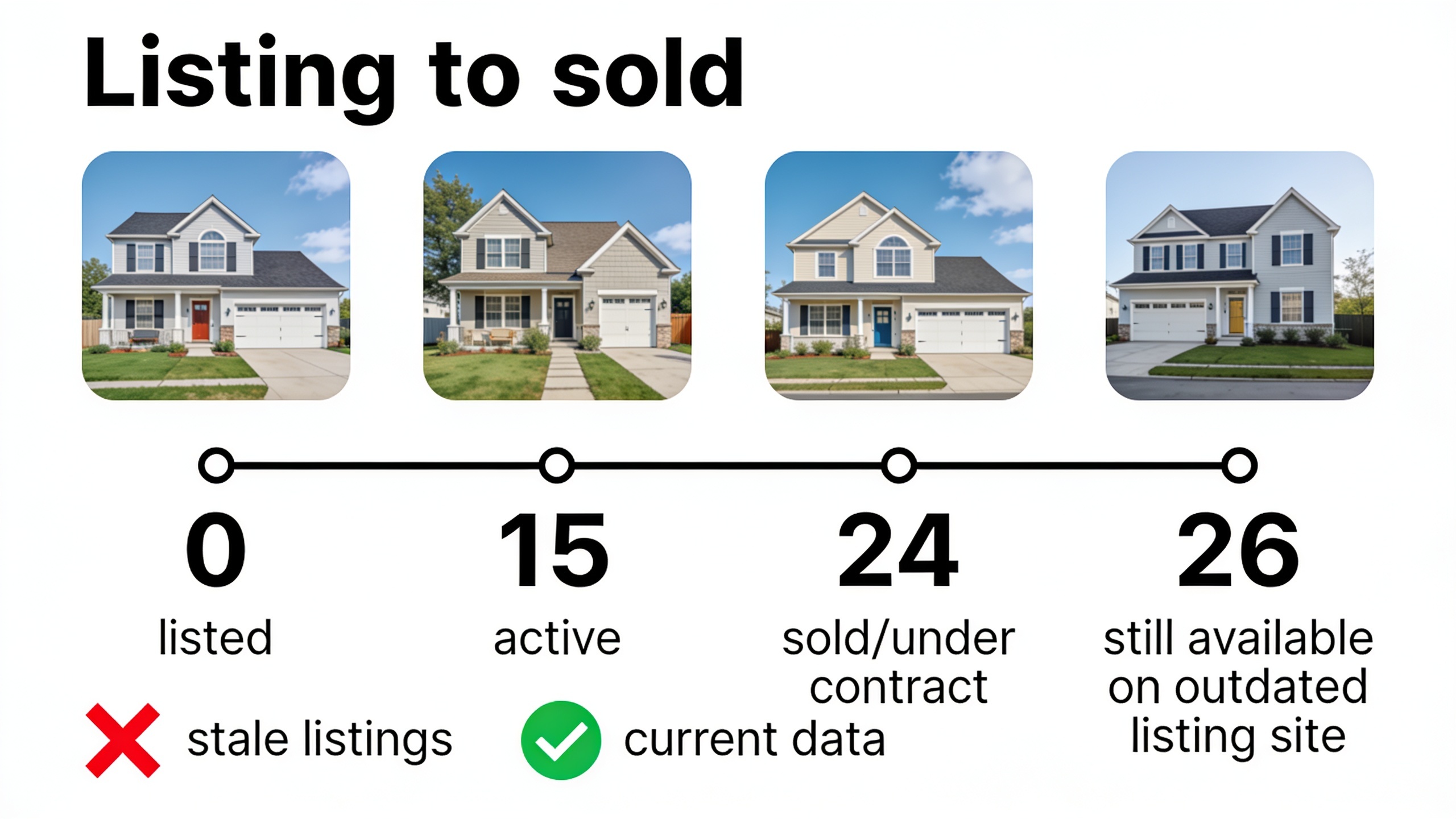
If you’re leaning mostly on listing sites instead of an agent’s direct MLS access, get in the habit of cross-referencing. A lot of seasoned buyers check a property on two sites before they’ll bother scheduling a showing, and learning to read “days on market” and those little status badges is worth your time. There’s more on that (plus how agents confirm real-time availability that listing sites sometimes flat-out miss) in the guide on how to choose the right real estate agent for your search.
Search Filters and Discovery Tools
Good filters are the difference between narrowing thousands of homes down to five that fit your life and giving up in frustration. Realtor.com throws a wide net here: price, bedrooms, square footage, school ratings, commute time, even keyword search for stuff like “pool” or “finished basement.” Its map search is genuinely one of the more polished tools in the business, and I like that you can draw your own custom search boundaries instead of being stuck with zip codes.
Viviendalista takes a different angle. Its whole thing is side-by-side property comparison rather than the usual search-and-scroll grind. You can shortlist a bunch of properties and line them up in one view, comparing price per square foot, estimated monthly costs, and neighborhood data all at once. If you’re the type who thinks in spreadsheets as much as in pretty listing photos, you’ll get it immediately. And for an investor comparing rental yield across three or four candidates, that layout saves you the misery of juggling ten browser tabs.
Both let you save searches and get email alerts when new stuff matches, but they surface “similar homes” differently. Realtor.com’s algorithm leans hard on recency and price proximity. Viviendalista basically nudges you to build a shortlist on purpose rather than passively scrolling some recommendation feed. Either way, the real trick is stacking filters smartly (price range plus commute time plus lot size, that kind of thing), which improves your results way more than people expect. There’s a full walkthrough on that in how to use Viviendalista search filters effectively.
Neighborhood and School Data
If you’re moving for schools, both platforms show school ratings, usually pulled from third-party education data providers, right alongside the listings. Realtor.com goes deep here, laying out rating scores, student-teacher ratios, and district boundaries directly on the map. Viviendalista’s neighborhood info tilts more toward affordability and comparison: median price trends, price-per-square-foot benchmarks, proximity scoring. Which, if you’re an investor or a retiree downsizing, is often more useful than granular school metrics you don’t really need.
Mobile Experience and Usability
Mobile can make or break one of these sites, and it matters because most people are searching from their phones. Realtor.com says the majority of its traffic comes from mobile devices, and that’s true pretty much across the board for real estate platforms. Both apps are mobile-optimized, but their priorities on the go are different. Realtor.com pushes notifications for price drops and new listings that match your saved searches, plus a “nearby homes” map that’s genuinely handy when you’re literally driving through a neighborhood you like.
Viviendalista built its mobile experience around quick comparison. Picture yourself standing in a driveway, pulling up two or three shortlisted homes side by side to see which one actually pencils out. Fewer taps, less filter clutter, more just-help-me-decide. It suits buyers who’ve already narrowed things down and need to commit.
That said, no mobile app rescues a badly designed site overall, and this is where the broader digital experience quietly matters. A real estate platform lives or dies on thoughtful UX, same as any business trying to earn trust online. Agencies like Digital Fusion Hub do the UX/UI and content strategy work that makes a property site feel intuitive instead of cluttered, and that’s honestly a decent benchmark. It’s the reason one real estate site feels effortless and another makes you want to close the tab.
Agent and Lender Connections
Connecting you with licensed agents and lenders is both a service and a money-maker for these platforms, and they handle it differently. Realtor.com is owned by Move, Inc., a subsidiary of News Corp, and it’s got deep ties to agent referral networks. You’ll see “local expert” profiles right on listing pages, along with lead-gen tools for agents who pay for premium spots. Which is the part worth knowing: the agent you get matched with through Realtor.com might be paying for that visibility, not earning it by being the best fit for you.
Viviendalista frames its agent connections around simplifying the whole process, pairing curated listings with expert advice instead of a straight pay-to-play model. If you’re overwhelmed staring at dozens of agents, that curation cuts down the decision fatigue. The trade-off, of course, is a smaller pool than a nationwide aggregator like Realtor.com throws at you.
Whatever site introduces you, treat picking an agent as its own separate decision. A responsive, locally sharp agent moves the needle way more than which listing site made the introduction. (That’s covered in depth in the agent guide I linked earlier.) And remember, agents get paid through commission structures that vary by market and brokerage, so ask blunt questions about fees and representation early. Nobody likes surprises at the closing table.
Pricing, Fees, and Monetization
Both are free for buyers and renters to browse, with the money coming from agent advertising, brokerage partnerships, and lead-generation fees. Standard stuff in this space. Realtor.com pulls serious revenue from “Featured Agent” and advertising products that let agents buy premium visibility in specific zip codes, and yeah, that model has taken some heat for potentially favoring the agent who paid over the agent who’s actually the right fit for you.
Viviendalista leans on its curated listings and advisory angle, trying to keep browsing free while partnering with agents, brokerages, and probably some mortgage or insurance affiliates who touch the broader home-buying journey. This affiliate-ish approach is everywhere in consumer platforms adjacent to real estate. The immigration and insurance world runs similar hybrid models, for instance with providers like Super Visa Insurance Calgary, which connects visiting parents and grandparents in Canada with tailored coverage while keeping the core service accessible and upfront about fees.
The real takeaway for you? “Free” platforms are never actually neutral. Every listing site has some financial relationship with the agents and lenders it puts in front of you. Your best defense is boring but effective: use multiple sources, verify claims yourself, and don’t assume the first agent or lender you see is automatically your best match.
Which Platform Fits Which Buyer?
Honestly, the winner in Viviendalista vs. Realtor.com depends way more on where you are in the process and what you’re buying than on one being flatly “better.” So here’s how I’d break it down by buyer type.
First-time urban buyers (ages 25-35): You’ll usually appreciate Realtor.com’s dense filters and real-time MLS data when a market’s competitive and every hour counts. But you might lean on Viviendalista’s comparison tools when you’re weighing a handful of condos against each other on price-per-square-foot and total monthly cost. First-timers tend to fixate on the sticker price and forget about the ongoing stuff, like HOA fees, that quietly eats your budget.

Real estate investors (ages 30-50): Investors sizing up rentals live for side-by-side comparison of cap rate estimates, price trends, and rental demand, which is exactly Viviendalista’s home turf. That said, Realtor.com still earns its keep here purely on data freshness. Miss a newly listed distressed property by a single day and a faster buyer snaps up your deal.
Families chasing suburban homes with good schools: Realtor.com tends to shine for this crowd, thanks to its deep school-rating integration and map-based commute tools. When you’re relocating a whole family, school district boundaries and drive time to work are usually the two filters that make or break the decision.
Retirees downsizing or buying a vacation place: This group usually wants simplicity over sheer volume, which makes Viviendalista’s curated, comparison-driven feel really appealing. Especially if you’re weighing two or three specific markets (a smaller condo near the grandkids versus a place near the coast, say) instead of scrolling an endless national database.
Feature Comparison Table
Quick reference for anyone who skipped straight here. No judgment.
| Feature | Viviendalista | Realtor.com |
|---|---|---|
| Data source | Curated, verified listings | Direct MLS feeds, near real-time updates |
| Listing accuracy | Fewer listings, lower stale-listing risk | High volume, occasional lag in status updates |
| Search style | Comparison-first, side-by-side shortlisting | Deep filter and map-based search |
| School data | Basic/affordability-focused | Detailed ratings and district boundaries |
| Mobile experience | Optimized for quick comparisons | Optimized for alerts and map browsing |
| Agent connections | Curated advisory model | Paid agent placement/lead generation |
| Best for | Comparison shoppers, investors, retirees | Fast-moving markets, families, broad search |
| Cost to buyers | Free | Free |
Frequently Asked Questions
So which one’s actually better for a first-time buyer?
Neither, universally. Realtor.com’s real-time MLS data wins in fast, competitive markets where speed matters, while Viviendalista’s comparison tools help you weigh total cost of ownership across a shortlist instead of just doom-scrolling listings. A lot of first-timers just use both: one for discovery, one for comparison. Nothing wrong with that.
Which platform has more accurate, up-to-date listings?
Realtor.com generally edges it out on raw freshness because it syncs directly with MLS feeds that update frequently in most U.S. markets. Viviendalista prioritizes curated, verified listings that cut down on stale or duplicate entries, even though the overall volume is smaller.
Do I have to pay to use either one?
Nope. Both are free for buyers and renters to browse and search. Their money comes from agent advertising, brokerage partnerships, and referral deals, not from fees charged to you.
Can investors use these to estimate rental income?
Yes, though how deep you can go varies. Viviendalista’s comparison layout is great for weighing multiple rental candidates side by side on price and neighborhood trends. Realtor.com’s strength is surfacing new listings fast, which is what you want when you’re competing for deals in a hot market.
Should I still use an agent if I found the home myself?
Yeah, you should. Listing platforms are discovery tools, not a replacement for having someone in your corner. A good local agent verifies a property’s real-time status, negotiates for you, and spots problems a listing page will never show you. Which is exactly why picking the right agent matters no matter which site led you to the house.
Bringing It All Together
So this was never really a fight with one winner. It’s about matching each platform’s strengths to your actual search. If you’re chasing hot inventory in a cutthroat market, you’ll probably lean on Realtor.com’s real-time data and mature filtering. If you want a calmer, comparison-driven process (investors running rental numbers, retirees narrowing two markets, first-timers comparing monthly costs), Viviendalista’s curated approach might just click better for you.
And like most tools in modern home-buying, from AI-assisted content platforms like RobinRank that help businesses communicate more clearly online to the real estate sites themselves, the smart play is usually the same: use more than one resource, cross-check what you find, and lean on a qualified agent to turn all that browsing into a confident, informed offer.