
Rental real estate can build serious long-term wealth. But only if you go in with your eyes open. The difference between investors who end up with steady cash flow and the ones who buy a slow-motion money pit usually comes down to the questions they asked before they signed anything. Not the listing photos. Not the countertops. The questions.
So whether you’re looking at a duplex near downtown or a single-family rental out in some fast-growing suburb, these are the ten questions I’d want answers to before I got anywhere near an offer. Treat this as a checklist you pull out every single time, first rental or fifth.
Table of Contents
- What Will My Monthly Cash Flow Actually Look Like?
- How Strong Is Tenant Demand in This Neighborhood?
- What’s the True Cost of Financing This Property?
- How Much Will Maintenance and Repairs Really Cost?
- What Is the Property’s Long-Term Appreciation Potential?
- Who Will Manage the Property, and What Will It Cost?
- What Are the Local Rental Laws and Regulations?
- How Does This Property Compare to Similar Listings?
- What’s My Exit Strategy If Things Don’t Go as Planned?
- Am I Financially and Emotionally Ready to Be a Landlord?
1. What Will My Monthly Cash Flow Actually Look Like?
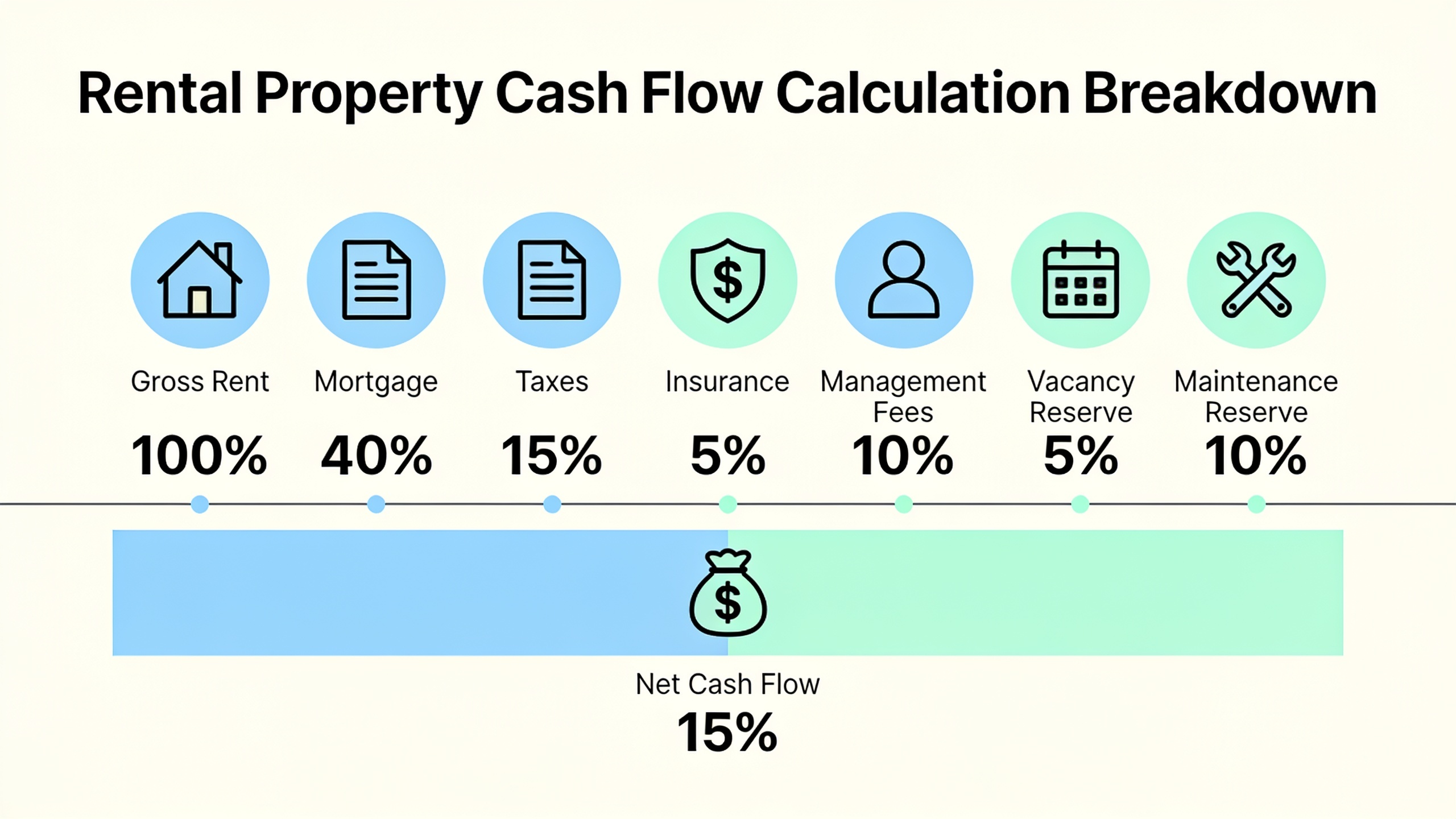
Cash flow is the money left in your pocket each month after you’ve collected rent and paid every single expense tied to the property. It’s the most important number you’ll deal with, full stop. And here’s what trips people up: a property that looks profitable on the listing can quietly bleed you dry once vacancy, taxes, insurance, and repairs enter the chat.
Start with realistic rent. Not the dreamy number the seller’s agent wrote in the description. Pull comps from at least three similar units in the same neighborhood, then start subtracting. You’ve got mortgage principal and interest, property taxes and insurance, management fees (usually somewhere between 8-12% of collected rent), a vacancy reserve (5-8% of gross rent is the number most people use), and a maintenance reserve. A lot of investors budget 1% of the property’s value per year for maintenance, though if the house is old, honestly, plan on more.
Here’s a sanity check I like. According to the U.S. Census Bureau’s Rental Housing Finance Survey, operating expenses eat up 35-45% of gross rental income on single-family rentals. So if your spreadsheet is telling you expenses are under 30%, you’ve forgotten something. Go back and find it. If you’re still putting your model together, The Ultimate Checklist for Comparing Rental Investment Properties lays out a side-by-side framework that makes it a lot easier to see which deals actually cash flow and which ones just look good on paper.
The 1% Rule as a Quick Filter
A lot of investors use the 1% rule as a first pass: monthly rent should be at least 1% of the purchase price. So a $250,000 property needs to rent for around $2,500 a month to clear the bar. It’s crude, and it’s definitely not a replacement for a real cash flow analysis. But it’s a fast way to kill off properties that were never going to work before you waste an afternoon on them.
3. What’s the True Cost of Financing This Property?
The true cost of financing an investment property is way more than the interest rate. It’s the down payment, the PMI rules (or lack of them), closing costs, and how the lender decides to count your rental income when they underwrite you. Investment loans get priced and underwritten differently than the mortgage on the house you actually live in, and that gap can swing your numbers hard.
Conventional lenders usually want 15-25% down on an investment property, versus as little as 3-5% for a primary residence, per Fannie Mae’s investor lending guidelines. Rates run about 0.5-0.75 percentage points higher too, because lenders see rentals as riskier bets. So before you fall in love with a place, get pre-approved as an investor, not as a homebuyer. You want to know your real borrowing costs, not a fantasy version.
| Financing Factor | Primary Residence | Investment Property |
|---|---|---|
| Typical minimum down payment | 3-5% | 15-25% |
| Interest rate premium | Baseline | +0.5-0.75 percentage points |
| Rental income counted toward qualifying | Not applicable | Often 75% of lease/appraisal rent |
| Reserve requirements | Usually none to 2 months | Often 2-6 months of payments |
| Mortgage insurance available | Yes (PMI) | Rarely offered |
One thing people forget: financing decisions bleed into the rest of your life. If you’re bringing family into the mix, either as co-investors or just as folks visiting while you get your landlord legs under you, those costs stack up. Investors who are also sponsoring parents or grandparents for long visits to Canada often end up juggling housing costs and coverage at the same time, which is why some of them look into something like Super Visa Insurance Calgary to get the health coverage sorted before they’re buried in closing paperwork.
2. How Strong Is Tenant Demand in This Neighborhood?
Tenant demand is how quickly and reliably a property fills up with qualified renters. It’s the thing that actually pays your mortgage. And a property in a hot, low-vacancy area will almost always beat a cheaper place in a market where renters are hard to find. Cheaper isn’t better if nobody wants to live there.

So how do you read demand? A few things. Vacancy rates first: under 5% in a local submarket usually means healthy demand, while anything north of 8-10% is a red flag for oversupply or weak interest. Then look at how long comparable rentals sit on the market. If similar units are leasing in two or three weeks, you’re in good shape. Population and job growth matter too, and the Bureau of Labor Statistics tracks employment by metro, so areas adding jobs faster than the national average tend to pull renters right along with them. And don’t underestimate proximity to the obvious demand drivers. Universities, hospitals, transit lines, big employers. Those never go out of style.
This is where a ton of new investors drop the ball, by the way. They analyze the property to death but never zoom out to the market. How Real Estate Investors Use Data to Pick Profitable Markets breaks down which data points actually predict long-term rental performance, from migration to permit activity, so you’re not just going on vibes. And browsing curated listings on something like Vivienda Lista lets you compare demand signals across a few neighborhoods at once instead of squinting at properties one at a time.
4. How Much Will Maintenance and Repairs Really Cost?
Maintenance and repair costs are what it takes to keep a place livable and competitive, and they’re the number one thing first-time investors lowball. Every time. A roof, an HVAC system, or a water heater on its last legs can flip a promising deal into a first-year loss before you even settle in.
Before you make an offer, ask for the age of the big-ticket systems. Roof, furnace, water heater, electrical panel, plumbing. A decent home inspector can usually eyeball the remaining life on each. Rough lifespans to keep in your head: asphalt shingle roofs run 20-25 years, HVAC systems 15-20, water heaters 8-12, and electrical panels anywhere from 25-40 years, though if you’re staring at old knob-and-tube wiring or a fuse box, budget to replace it now, not later.
Older homes carry other baggage too. Anything built before 1978 in the U.S. may trigger lead paint disclosure rules and possible remediation costs. And building a repair reserve isn’t optional, unless you enjoy the feeling of one dead appliance wiping out six months of profit. Oh, and one thing worth thinking about beyond the four walls: tenant wellbeing sells. Landlords looking to stand out sometimes point to nearby amenities in their listings, and local clinics like Rapharehab, which does physiotherapy and rehab, can genuinely be a selling point for renters who care about having health services close by.
5. What Is the Property’s Long-Term Appreciation Potential?
Appreciation potential is how much a property’s value is likely to climb over time, driven by local development, school quality, infrastructure spending, and the broader market. Cash flow keeps you solvent month to month, sure. But over a 10- to 20-year hold, appreciation is usually where the real net worth gets built.
It’s harder to predict than rent, no question. But there are indicators I trust more than others. Permit activity is a big one, because rising building permits for retail, transit, or housing often show up before prices do. School district ratings matter, especially for the families and retirees hunting bigger suburban homes, since top-rated districts command premium resale prices. For historical trends, the Federal Housing Finance Agency’s House Price Index tracks quarterly appreciation by metro and it’s free, which makes it a solid benchmark for comparing markets. And planned infrastructure, new highway interchanges, transit extensions, a major employer relocating in, tends to lift nearby values over the next 3-7 years.
Just don’t treat appreciation as a sure thing. It isn’t. And it can vary wildly from one submarket to the next inside the same city, so cross-reference a few sources before you bet on a single trend line.
6. Who Will Manage the Property, and What Will It Cost?
Property management is all the ongoing grind: finding tenants, collecting rent, handling repairs, enforcing the lease. Deciding who does it hits both your returns and your calendar. Self-managing saves you that 8-12% fee, but it also means you’re on the hook for maintenance calls, screening, and the occasional 2 a.m. emergency. That last one is not a hypothetical.
If you’re buying in a market outside your home city, which more and more people are doing to chase better cash flow in cheaper metros, professional management stops being a luxury and becomes basically necessary. When you’re vetting a manager, ask about their tenant screening criteria, how fast they turn over a vacancy, and how they handle maintenance markups. Some companies quietly slap a surcharge on top of contractor invoices, and you’d rather find that out now.
7. What Are the Local Rental Laws and Regulations?
Rental laws are the local, state, and sometimes city-level rules that dictate how you screen tenants, raise rent, and handle evictions. And they vary enormously depending on where you buy. A playbook that works flawlessly in one state can blow up in your face in another.
The stuff worth researching before you buy: rent control or rent stabilization ordinances, which exist in a handful of cities and can cap your annual increases no matter what the market’s doing. Eviction timelines, which swing from a couple weeks in landlord-friendly states to several months in tenant-protective ones. Security deposit limits, capped at one to two months’ rent in a lot of places. And short-term rental restrictions, since a growing number of cities now require permits or ban Airbnb-style rentals in residential zones outright.
Skipping this is one of the classic ways new investors get blindsided after closing. A quick call to a local real estate attorney or property manager before you make an offer costs a fraction of what you’ll pay learning the rules mid-dispute.
8. How Does This Property Compare to Similar Listings?
Comparing a property to similar listings, “running comps,” means stacking price per square foot, condition, amenities, and rental history against genuinely comparable places nearby. It’s the reality check that keeps you from overpaying because a listing description made you feel something.
A good comparison pulls at least three to five properties that sold or leased in the last six months, within a half-mile to a mile, and within 20% of your target’s size and age. If the place you’re eyeing is priced well above the comps with no clear reason (a real renovation, a much better lot, something), that’s your cue to negotiate hard or just walk. Tools that let you filter and compare listings side by side, like the search on Vivienda Lista, beat manually babysitting spreadsheets of MLS data by a mile.
9. What’s My Exit Strategy If Things Don’t Go as Planned?
An exit strategy is your plan for what you do if the property underperforms, your life changes, or the market turns. Having one before you buy means you’re making decisions from strategy instead of panic when things go sideways. And sometimes they do.
| Exit Strategy | Best Suited For | Typical Timeline |
|---|---|---|
| Sell for appreciation gain | Strong seller’s market, low cash flow priority | 5-10 years |
| Refinance and hold (BRRRR-style) | Value-add properties needing renovation | 1-3 years to refinance |
| 1031 exchange into a larger asset | Investors scaling into bigger properties | Ongoing, tax-deferred |
| Convert to primary residence | Investors planning a future lifestyle change | Flexible |
| Sell to another investor as-is | Underperforming or high-maintenance properties | As needed |
Your exit plan also shapes how you finance and improve the place, which people forget. Somebody planning to sell in three years makes very different renovation choices than somebody settling in for fifteen. So figure this out before you close, not after you’re already knee-deep in it.
10. Am I Financially and Emotionally Ready to Be a Landlord?
Financially ready means you’ve got reserves beyond the down payment. Emotionally ready means you’ve made peace with the fact that tenant drama, vacancies, and surprise repairs are the job, not signs that everything’s falling apart. A lot of first-timers massively underestimate the operational side of this, which usually turns out to be far more time-consuming than crunching the numbers ever suggested.
So ask yourself, honestly: Do you have three to six months of expenses stashed away per property? Are you willing to take a 2 a.m. maintenance call, or pay someone who will? And do you have the backbone to enforce lease terms professionally, even with a tenant you genuinely like? People who skip this little gut check tend to either burn out from self-managing or get flattened by a cash crunch during a long vacancy.
If you’re brand new to all this, your research and content workflow matters too, not just for your own analysis but for down the road, if you ever want to market properties or build an online presence around your investing. Platforms like RobinRank, which automate SEO content and publishing, are a good example of how even non-marketing folks are leaning on smart tools to claw back time. Worth borrowing that mindset for your own investment research, honestly.
Putting Your Investment Property Checklist Into Action
Once you’ve run through all ten questions, write your answers down for every property you seriously consider. Don’t try to hold it all in your head, because you won’t. A written checklist tracking cash flow projections, financing terms, comps, and local regulations for each property lets you compare deals apples-to-apples instead of trusting your memory three weeks later when you’re stuck choosing between two or three finalists.
And revisit that checklist as the market moves. Interest rates, rental demand, local rules, all of it can shift inside a single buying cycle, so a checklist you built six months ago might need fresh assumptions before you lean on it for your next offer.
Frequently Asked Questions
Which of these questions actually matters most?
In the short term, cash flow analysis wins, because a property that doesn’t generate positive monthly cash flow can squeeze your finances even if it appreciates beautifully. That said, tenant demand and local regulations are right on its heels. Weak demand or restrictive laws can sink even a well-priced deal.
How much cash flow should a rental actually generate?
There’s no magic number, but a lot of investors aim for at least $100-$200 in positive monthly cash flow per unit after all expenses and reserves, plus enough cushion to eat one month of vacancy a year without going negative. Higher-priced markets sometimes accept thinner cash flow in exchange for stronger appreciation, and that’s a legitimate trade.
Cash or financing, which is smarter?
Financing usually produces a higher return on the capital you actually put in, because you’re using leverage. But it also saddles you with monthly debt that gets scary during vacancies. Paying cash cuts your risk and simplifies your cash flow, but it locks up money you could’ve spread across several properties. Depends on your appetite for risk, really.
How do I tell if a neighborhood has strong rental demand?
Look at local vacancy rates, average days on market for comparable rentals, job and population growth, and how close the place is to demand drivers like universities, hospitals, or big employers. Cross-reference two or three of these and you’ll have a much clearer read than any single number gives you.
Should first-timers hire a property manager?
Plenty of first-time investors come out ahead using professional management, especially if they’re buying out of town or working a full-time job, since a manager’s screening and maintenance systems can head off expensive rookie mistakes. Later, once you’ve got experience and your own network of reliable contractors, self-managing to save that 8-12% fee starts to make sense.
At the end of it all, buying an investment property is a numbers game wrapped in a whole lot of local nuance. The investors who do well are almost always the ones who asked the hard questions before signing, not the ones scrambling to answer them afterward. Run this list for every serious property, line up the answers side by side, and you’ll walk into your next offer with a lot more than a gut feeling backing you up.