
If there’s one thing you should do before you let yourself fall for a listing, it’s get pre-approved for a mortgage. Everything else can wait. This is the move that separates buyers who close in weeks from the ones who spend three months touring homes they were never going to afford in the first place.
I’ve watched people skip this step and lose their dream house to somebody who showed up with a pre-approval letter already in hand. It’s brutal. And completely avoidable.
Doesn’t matter if you’re 28 and eyeing a downtown condo, an investor sniffing around for rentals, or a family trying to land a four-bedroom in a decent school district. The process is basically the same for everyone. So let’s actually walk through it.
Table of Contents
- What Is Mortgage Pre-Approval?
- Why Get Pre-Approved Before You House Hunt?
- Mortgage Pre-Approval Guide: Documents You’ll Need to Gather
- How to Choose the Right Lender for Pre-Approval
- How to Get Pre-Approved: Step-by-Step Process
- Pre-Approval vs. Pre-Qualification: What’s the Difference?
- Common Mortgage Pre-Approval Mistakes to Avoid
- What Happens After You’re Pre-Approved?
- FAQ
What Is Mortgage Pre-Approval?
Mortgage pre-approval is a written commitment from a lender saying how much they’re willing to lend you, based on an actual review of your income, assets, credit, and debts. That last part is what matters. This isn’t some back-of-the-napkin guess. The lender pulls your credit and verifies your paperwork, which is exactly why sellers take it seriously.
A pre-approval letter usually spells out a maximum loan amount, an estimated interest rate, and a loan type (conventional, FHA, VA, or USDA). Most are good for 60 to 90 days. And here’s a tip worth its weight in gold: the Consumer Financial Protection Bureau points out that shopping around and comparing loan estimates from multiple lenders can save borrowers thousands over the life of a loan. Which is a big reason I keep pushing you to compare offers instead of just going with whoever your uncle recommended.
At bottom, getting pre-approved is really about proving one thing. That you can pay back what you borrow.
Why Get Pre-Approved Before You House Hunt?
Get pre-approved first and you’ll know exactly what you can afford, your offers will carry more weight, and closing goes faster once you find the place. Skip it and you’re mostly setting yourself up for disappointment and a lot of wasted Saturdays.
In hot markets, a lot of listing agents won’t even bother scheduling a showing without proof you’re pre-approved, especially on anything priced below the local median. The National Association of Realtors has found again and again that sellers lean toward buyers who show financing upfront, because it tells them you’re serious and ready to close. Ever wonder why some buyers glide from offer to closing table in a few weeks while others stall out for months? Pre-approval is usually the difference.
And then there’s the budgeting side, which honestly might be the most useful part. Once you know your approved number, you can set realistic search filters instead of daydreaming about places you can’t touch. This is where the right tools earn their keep. After you’re pre-approved, you can use Viviendalista’s search filters to narrow things down by price, loan-friendly property types, and neighborhood, so you’re only looking at homes that fit your actual buying power. Relocating for schools? Pair your pre-approval number with something like Best Suburbs for Families in 2025 and you’ll find where your budget actually stretches.
Mortgage Pre-Approval Guide: Documents You’ll Need to Gather
How fast you get pre-approved comes down almost entirely to how organized your paperwork is before you ever contact a lender. They need proof of income, proof of assets, ID, and a breakdown of your existing debt. Get all that ready ahead of time and you can shrink the timeline from weeks to a few days.
For income, lenders typically want your two most recent pay stubs, your last two years of W-2s or 1099s, and your two most recent federal tax returns if you’re self-employed or pull in a lot of commission or bonus money. Fair warning to the freelancers and gig workers out there: expect extra scrutiny. Underwriters usually average your income over 24 months instead of counting your one great month, so don’t get too excited about that.
On the asset side, you’ll need two to three months of bank statements for every account you plan to tap for a down payment or reserves, plus statements for retirement accounts, brokerage accounts, whatever you’ve got. Quick note if any of your down payment came from cashing out digital assets: most lenders want to see the money “seasoned” in a bank account for at least 60 days before they’ll count it. So if you sold off gains you’d been tracking through something like Cryptocoinsjournal, move those funds into a traditional account early and document every step of it. Underwriters do not love mystery money.
They’ll pull your credit themselves, but do yourself a favor and check it beforehand through AnnualCreditReport.com. That way you can dispute errors before they wreck your rate. Also make a list of all your recurring debts, auto loans, student loans, credit cards, child support, the works. That stuff feeds directly into your debt-to-income ratio, which is one of the biggest levers on how much they’ll approve.
Rounding out the file: a government-issued photo ID, your Social Security number, and a two-year employment history (with explanations for any gaps). Just changed jobs? A signed offer letter or employment verification from the new employer keeps things moving.
| Document Category | Typical Requirement | Extra Notes |
|---|---|---|
| Income | 2 pay stubs, 2 years W-2s/1099s | Self-employed: 2 years tax returns |
| Assets | 2-3 months bank/investment statements | Large deposits need a paper trail |
| Credit | Lender-pulled credit report | Check your own report in advance |
| Debts | List of loans, cards, obligations | Impacts debt-to-income ratio |
| Identification | Government-issued ID, SSN | Needed for all borrowers on the loan |
How to Choose the Right Lender for Pre-Approval
The right lender depends on your loan type, how much you want a human to hold your hand, and how competitive your rate needs to be. But no matter what, compare at least three. Seriously. It’s the single best way to avoid overpaying on interest for the next 30 years.
Your options basically break into four buckets. Banks might toss you a relationship discount if you already have accounts there. Credit unions tend to have lower fees and more flexible underwriting for members. Online lenders usually move fastest and offer sharp rates thanks to lower overhead. And mortgage brokers can shop your file across dozens of lenders at once, which is a lifesaver if your income or credit situation is a little weird.
| Lender Type | Typical Turnaround | Best For | Watch Out For |
|---|---|---|---|
| Traditional Bank | 5-10 business days | Existing customers, relationship pricing | Sometimes slower, stricter guidelines |
| Credit Union | 5-10 business days | Members seeking lower fees | Membership requirements |
| Online Lender | 1-3 business days | Speed and rate shopping | Less personal guidance |
| Mortgage Broker | 3-7 business days | Nonstandard income or credit | Broker fees vary |
Before you commit, ask about their average closing time, their rate lock policy, and whether there’s an application fee. And do your homework on reputation. Read borrower reviews. Cross-check what they claim against a few sources instead of trusting a single ad. Real estate brands increasingly lean on AI-driven tools like RobinRank to publish accurate, well-researched content that helps people compare their options, and you should approach lender research with that same skeptical, dig-a-little-deeper attitude.
How to Get Pre-Approved: Step-by-Step Process
Getting pre-approved can take anywhere from a couple hours to two weeks, and honestly, most of that variance is on you. The more prepared you are, the faster it goes. Here’s the order I’d do it in.
Step 1: Check your credit and pull your reports. Do this at least 60 days before you apply so you’ve got time to fix errors or pay down some revolving balances. Even a small bump in your score can meaningfully move your rate.
Step 2: Figure out your real budget. Use a mortgage calculator to land on a monthly payment you’re actually comfortable with, and don’t forget property taxes, homeowners insurance, and HOA dues if they apply. Principal and interest alone will lie to you.
Step 3: Gather your documents. All that income, asset, debt, and ID paperwork from earlier. Get it in one place now so you’re not frantically digging through email once the application’s live.
Step 4: Compare at least three lenders. Grab loan estimates from a bank, an online lender, and either a credit union or a broker. Then line up the interest rates, APRs, and closing costs side by side.
Step 5: Submit your application. Most lenders let you apply online and upload documents through a secure portal now. Be honest and thorough. Whatever you leave out will show up during underwriting anyway, and it’ll just slow everything down.
Step 6: Answer the underwriter fast. They’ll almost always come back with questions, a letter explaining a big deposit, a gap in your work history, a recent credit inquiry. Reply quickly and your file keeps its momentum.
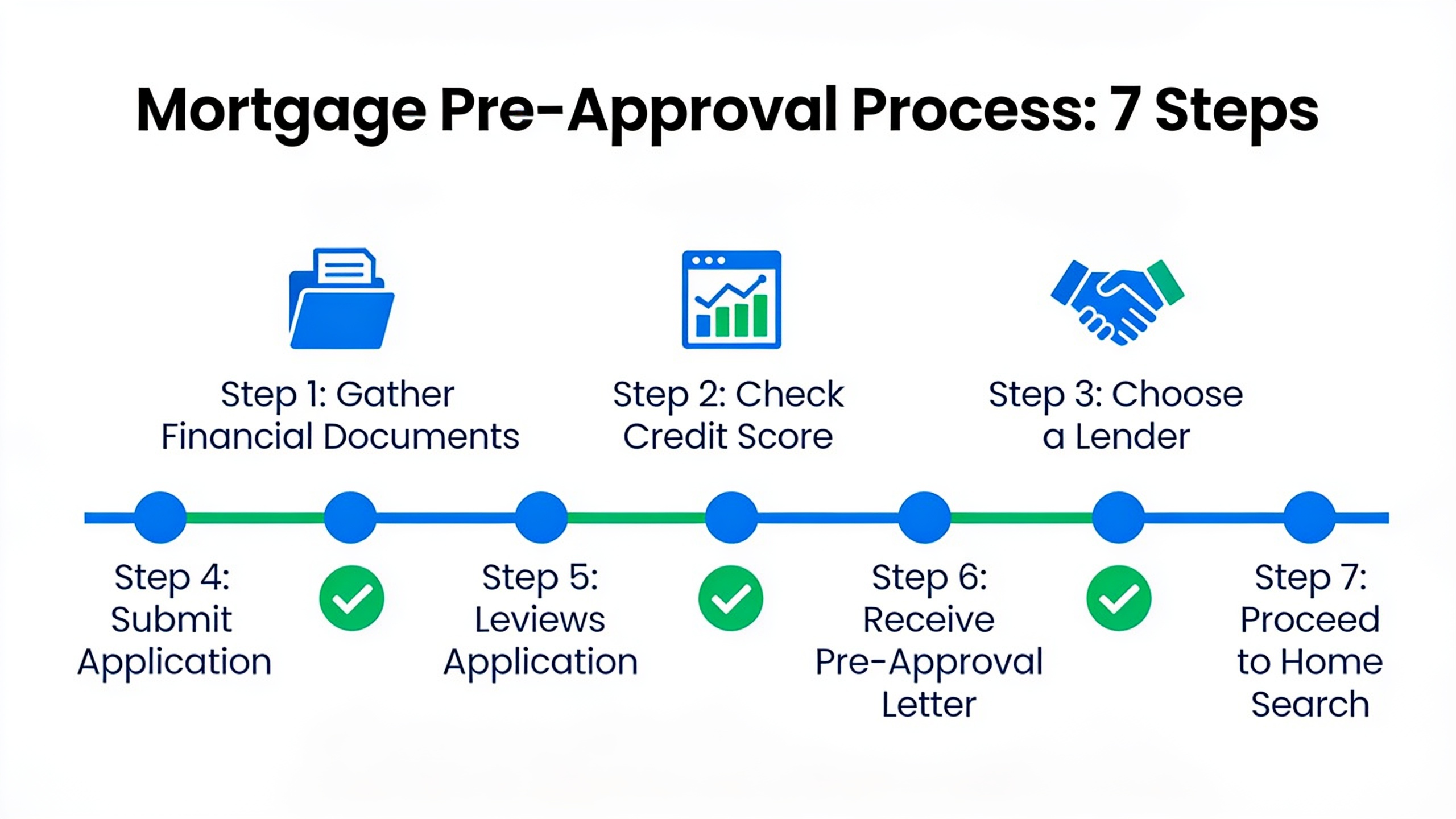
Step 7: Get your letter. Once you’re approved, you’ll receive a letter with your max loan amount, estimated rate, and expiration date. Now you can attach it to offers.
The one thing I’ll hammer on here: patience. Rushing your document collection is the number one reason files bounce back from underwriting. It adds days or weeks to something that should be quick if you just get organized up front.
Pre-Approval vs. Pre-Qualification: What’s the Difference?
Pre-qualification is a quick, informal estimate based on numbers you report yourself. Pre-approval involves verified documents and an actual credit check, which makes it a far stronger signal to sellers. People mix these up constantly, and the confusion can literally decide whether your offer gets taken seriously.
| Feature | Pre-Qualification | Pre-Approval |
|---|---|---|
| Verification | Self-reported, unverified | Documents and credit verified |
| Credit Check | Sometimes soft pull, sometimes none | Hard credit pull |
| Time to Complete | Minutes | 1-14 days |
| Reliability for Sellers | Low | High |
| Typical Validity | No formal expiration | 60-90 days |
| Use Case | Early budget estimate | Ready to make offers |
If you’re just kicking tires and want a ballpark, pre-qualification is totally fine. But the second you’re serious about touring homes and writing offers, pre-approval is what agents and sellers expect. No way around it.
Common Mortgage Pre-Approval Mistakes to Avoid
The mistakes that trip people up almost always fall into three camps: making financial changes mid-process, showing up with incomplete paperwork, and applying with only one lender. Dodge those and your timeline stays predictable.
The classic blunder? Opening new credit or making a big purchase between pre-approval and closing. A car. A whole living room set. It happens more than you’d think because people get excited. But even something as innocent as furnishing your future place too early, say a bulk order of appliances or décor from a wholesale supplier like t7b, needs to wait until after closing. New debt can nudge your debt-to-income ratio just enough to blow up your approved amount. Not worth it.
Another one is dropping a big, undocumented pile of cash into your account right before you apply. Underwriters flag unexplained deposits above a certain threshold and they will ask you to prove where it came from. Mystery deposits are one of the top reasons files stall out. Buyers also love to underestimate closing costs, which run 2% to 5% of the purchase price according to Freddie Mac, and then forget to keep reserves on top of the down payment. And finally, plenty of first-timers just apply with one lender because it’s easy, and miss out on a better rate that could’ve saved them thousands over a 30-year loan. Laziness has a price tag here.
What Happens After You’re Pre-Approved?
Once you’re pre-approved, you can start touring homes, making offers, and moving toward a purchase agreement with real confidence. Just remember it’s not a guarantee of final approval. The lender still has to verify the specific property and re-check your finances before closing. But this is where the fun part starts.
Letter in hand, go browse listings that fit your budget. This is a great moment to lean on Viviendalista’s search filters to sort by price, square footage, school zones, or how far you’ll be from work. And if you’re a family weighing a suburban move, it’s worth circling back to something like Best Suburbs for Families in 2025 to shortlist neighborhoods before you start scheduling showings.
Now, the boring but crucial part. Keep your finances boring during this stretch. No job changes, no big purchases, no new credit inquiries. Lenders typically re-verify employment and re-pull your credit right before closing, and any surprise there can delay or even unravel your loan. Keep an eye on that expiration date too. Most letters last 60 to 90 days, so if your search drags on, you’ll need to refresh your documents.
And once you’ve found the place, made your offer, and you’re sitting in that weird limbo of underwriting and appraisal, take a breath. This is genuinely a milestone worth marking. If you’re house hunting in North Texas, a relaxed dinner somewhere like Palate Garden in Saginaw is a small, well-earned reward while you wait for the final documents to line up.
FAQ
How long does mortgage pre-approval actually last?
Usually 60 to 90 days. If your home search runs past that, your lender will want fresh pay stubs, updated bank statements, and a new credit pull before they reissue the letter.
Will getting pre-approved hurt my credit score?
A little, yeah. Pre-approval means a hard credit inquiry, which can knock a few points off temporarily. The good news is that multiple mortgage inquiries inside a short window (usually 14 to 45 days depending on the scoring model) get counted as a single inquiry. So shopping around with a few lenders won’t stack the damage.
Can I get pre-approved with bad credit?
It’s possible, though your choices and your rate will be tighter. FHA loans, for instance, allow credit scores as low as 580 with a 3.5% down payment per the Federal Housing Administration’s guidelines, which makes them a pretty common route for people rebuilding their credit.
What’s the actual difference between pre-approval and final loan approval?
Pre-approval confirms you can borrow a certain amount. Final approval comes after you’ve picked a specific property and the lender finishes the appraisal, title search, and final underwriting review. Final approval is the one that actually clears you to close.
How much does pre-approval cost?
Usually free or close to it. Some lenders charge a small application fee, anywhere from $0 to around $500, and that fee often gets credited back toward your closing costs if you go with them.
Wrapping Up
Getting pre-approved isn’t just busywork. It’s the foundation that makes every other part of buying a home faster, more confident, and more competitive. Gather your documents early, compare your lenders honestly, and get crystal clear on the difference between pre-qualification and real pre-approval. Do that and you’ll walk into your search with a solid number in your head and a letter that sellers actually respect.
And after that? The search becomes the fun part. Scrolling listings, comparing neighborhoods, mentally arranging your couch in a place that’s finally, actually within reach.