
You’ve probably noticed it too. Scroll through listings for more than five minutes and “ADU potential!” starts jumping out at you like a car salesman. It’s not a coincidence. Accessory dwelling units have quietly become one of the most talked-about things in residential real estate, and honestly, for pretty good reason. They can add living space, rental income, and resale value to a property you already own, all without buying a bigger lot or uprooting your life. This guide is my attempt to walk you through what these things actually are, how your local zoning either blesses or blocks the whole idea, what they cost (spoiler: more than the internet tells you), and how they might pay you back over time. Doesn’t matter if you’re a first-time buyer eyeing a duplex-ish setup, an investor chasing yield, or a retiree who wants a smaller place with a little rent money on the side.
One big caveat up front: ADU rules, costs, and financing swing wildly from city to city. So think of this as the thing you read before you start calling contractors or wading into your local planning department’s website. The foundation, not the finish work.
Table of Contents
- What Is an Accessory Dwelling Unit?
- Types of ADUs You Can Build
- ADU Rules and Zoning: What Determines If You Can Build One
- ADU Cost and Rules: How Much Should You Budget?
- How Much Does an ADU Actually Cost to Build?
- Does an ADU Increase Property Value?
- ADUs as a Rental Income Strategy
- Financing an ADU: Your Options
- Frequently Asked Questions
What Is an Accessory Dwelling Unit?
An accessory dwelling unit, or ADU, is a secondary, self-contained home that sits on the same lot as your primary single-family house. That’s the whole idea. It’s got its own entrance, kitchen, bathroom, and a place to sleep, which is exactly what separates it from a finished basement or a bonus room that still leans on the main house for the important stuff.
You’ll hear these things called all sorts of names depending on where you grew up. Granny flats. In-law suites. Backyard cottages. Laneway houses. Secondary suites. The vocabulary is a mess, but the concept underneath never really changes: it’s a smaller, independent living space that’s either attached to, detached from, or carved out of an existing home. People use them for aging parents who want their own space but not a three-hour drive away, adult kids who aren’t quite ready to launch, a home office that could become a real apartment someday, or just plain old rent money.
So why did these blow up over the last few years? Two things collided. Housing got brutally expensive, and a lot of state and local governments (especially in the pricey markets) started loosening the rules to encourage what planners like to call “gentle density.” Basically, adding more housing without bulldozing the character of single-family neighborhoods. That policy shift is the whole reason your local rules matter so much before you drop a dime on design and permits.
Types of ADUs You Can Build
There are three broad flavors of ADU, and which one makes sense comes down to your lot size, your budget, and how much construction chaos you can stomach.
Detached ADUs are the standalone ones, usually tucked into the backyard. Backyard cottage, granny flat, whatever you want to call it. These give everybody the most privacy since there’s no shared wall or shared front door, but they’re almost always the priciest route. You’re building a whole structure from scratch: foundation, roof, utility hookups, the works.
Attached ADUs share at least one wall with the main house, kind of like a really committed addition. They usually cost less than detached units because they can piggyback on existing utility lines and part of the structure that’s already standing. Trade-off? Less separation, less privacy.
Then there are conversion ADUs, sometimes called internal ADUs. These are what you get when you remodel space you already have, like a basement, attic, or attached garage, into a real self-contained unit. Cheapest option on paper, since the shell already exists. But (and this is a big but) older basements and garages love to fail code in expensive ways. Egress windows, ceiling height, insulation, plumbing. That “cheap” conversion can get real once someone opens up a wall.
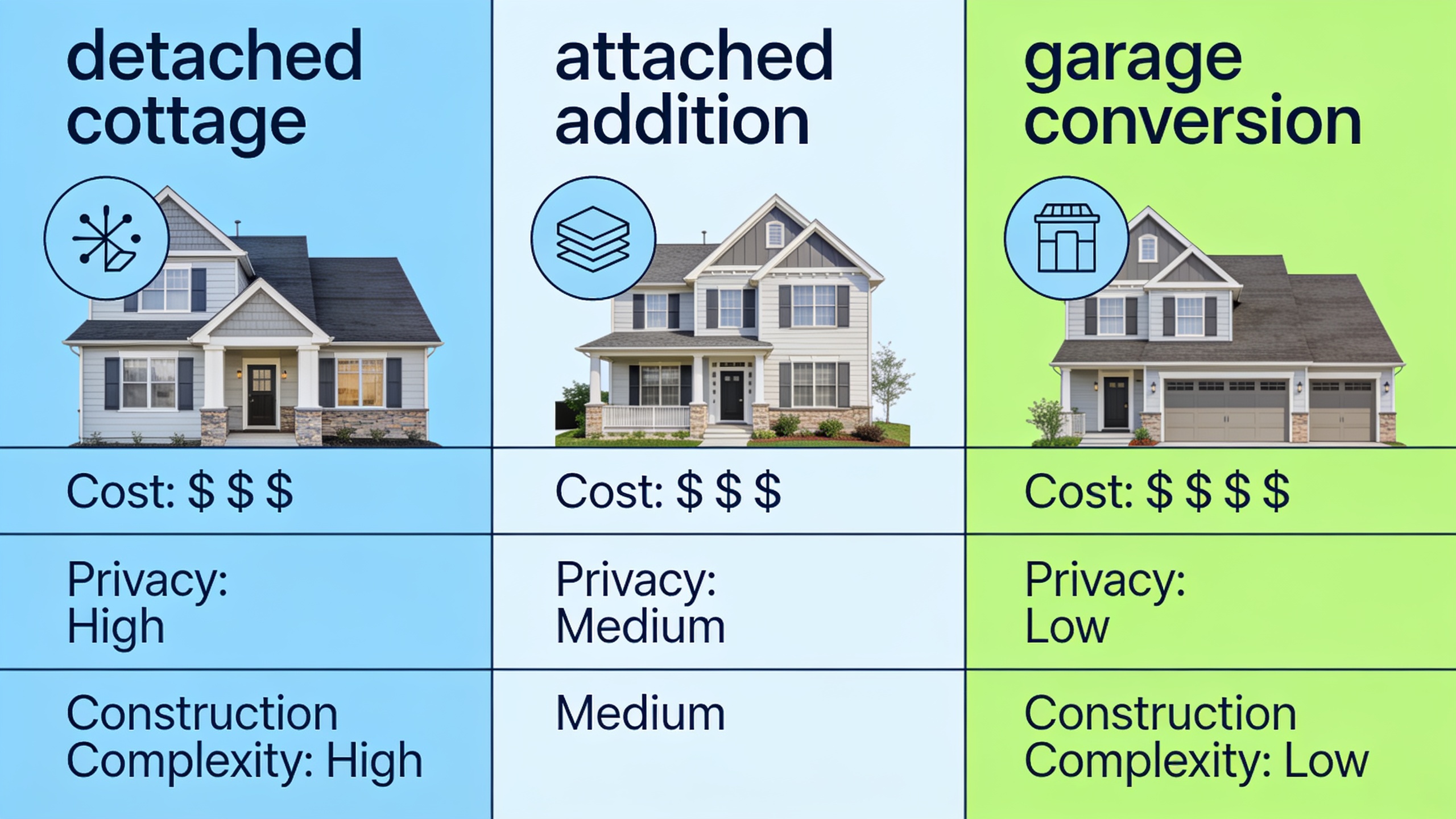
| ADU Type | Typical Privacy Level | Relative Cost | Best For |
|---|---|---|---|
| Detached (backyard cottage) | High | Highest | Rental income, in-laws, long-term guests |
| Attached (addition) | Medium | Moderate | Homeowners wanting proximity with separation |
| Conversion (garage/basement) | Medium | Lowest | Budget-conscious homeowners with existing structures |
ADU Rules and Zoning: What Determines If You Can Build One
Whether you’re even allowed to build one, and how big, how tall, and what you can use it for, comes down almost entirely to your city or county’s zoning ordinance. Zoning is just the pile of local rules that dictate how land and the buildings on it can be used, and ADU rules usually get stacked on top of whatever base zoning your lot already carries.
The usual suspects that decide your fate: minimum lot size, a cap on unit square footage (often expressed as some percentage of your main home), setback requirements from the property lines, height limits, parking demands, and owner-occupancy rules that might force you to live in either the main house or the ADU itself. Some places also limit how many ADUs you can cram onto one lot, or they’ll let you rent long-term but ban short-term rentals entirely.
Before you assume anything, call your local planning or building department. Actually call them. These ordinances change all the time and can literally shift block by block depending on overlay districts, historic designations, or floodplain rules. And if you’re in an HOA community, city approval is only half your problem. You’ve still got to square things with your association’s covenants, because plenty of HOAs slap their own restrictions on secondary structures no matter what the city says is fine. If HOA rules make your eyes glaze over, our piece on HOA fees and what every home buyer should know is a decent place to get your bearings before you go too deep on ADU planning.
ADU Cost and Rules: How Much Should You Budget?
ADU cost and rules are basically joined at the hip, because the regulations in your area quietly shape what you’ll spend. A tougher parking mandate, a bigger required setback, a mandatory sprinkler system, any one of these can pile on thousands of dollars before a single stud goes up.
Permitting fees deserve a special callout, because this is where people get blindsided. Depending on your city, you might get hit with separate charges for the building permit, plan review, utility connection or capacity fees, and impact fees that go toward local infrastructure. Some cities have deliberately cut or waived ADU fees to get more of them built. Others still charge you like you’re putting up an entire new single-family home. There’s no way around confirming this one locally.
Design requirements bolted onto zoning sneak up on you too. Say your rules require the ADU’s exterior to match your main house, or a height restriction forces you into some fussy, complicated roofline. Your architect and your contractor will both need more of your money. Same goes for owner-occupancy rules or deed restrictions. If those apply, get a real estate attorney or a sharp local agent to read the fine print before construction starts, especially if there’s any chance you’ll sell later. You want to know exactly what you’re signing up for.
How Much Does an ADU Actually Cost to Build?
ADU construction costs are all over the map depending on unit type, size, finish level, and what labor and materials run in your area, but the general rule holds: conversions are cheapest, detached new builds are the priciest. Because per-square-foot numbers swing so hard by region, don’t lean on national averages. Get at least three local contractor bids. Three.
And then there’s the stuff nobody warns you about. Architectural and engineering plans. Permit and impact fees. Utility upgrades, since a detached ADU might need its own electrical panel, water line, or sewer hookup. Site work like grading or yanking out a tree. And a contingency fund for the gremlins that show up the second you open a wall or start digging. The rule of thumb I hear from contractors and design-build folks is to set aside 10 to 20 percent of your total budget as contingency, because older homes especially love to reveal ancient wiring, sketchy plumbing, or a structural surprise once the work actually begins.
How you finance it changes your real cost, too. Pay cash and you’ve got no interest but you’ve locked up a chunk of liquidity. Use a home equity loan or construction loan and you’re paying interest, but you keep your cash free. Either way, the only reliable path is a real, itemized estimate from a licensed contractor. Not a ballpark per-square-foot figure someone rattles off over the phone.
Does an ADU Increase Property Value?
A legally permitted ADU can absolutely bump your resale value, mostly because it adds usable square footage plus income potential that appraisers and buyers can actually put a number on. How much value it adds depends on local demand for multi-generational or rental-flexible housing, the quality of the build, and, crucially, whether the thing is fully legal and permitted instead of built on the sly.
That last part matters more than people think. Unpermitted ADUs, the “bootleg” units, usually don’t add the same value and can genuinely torpedo a sale. A buyer’s lender may demand proof of permits, and some jurisdictions require sellers to disclose unpermitted structures anyway. This is exactly why every agent worth their salt begs you to go through proper zoning and permitting instead of building quietly and hoping to sort it out later. The shortcut can cost you more at resale than it ever saved you during construction.
Appraisers don’t all handle ADUs the same way, either. In markets with plenty of comparable ADU sales, they’ll value the unit off direct comps. But in areas where ADUs are still new or rare, they lean harder on the income approach, essentially pricing part of your property on the rent that ADU could pull in. So if you’re shopping for a place with an existing or potential ADU, ask your agent how appraisers in that specific market have handled similar additions. It affects both your purchase financing and what you can realistically expect at resale.
ADUs as a Rental Income Strategy
An ADU can throw off rental income by working as a long-term rental to a tenant, or as a separate unit for family paying reduced or market rent, and for investors, that income is usually the whole point. Because the unit sits on the same lot as your house, you can become a landlord without buying a second property, taking on a second mortgage, or managing a unit across town.
For investors specifically, the appeal is pretty clear: a second income stream on a single-family property, which can juice your overall return compared to a plain old standalone rental. But let’s be real about the other side. Being a landlord, even in your own backyard, is work. Tenant screening, leases, the 11pm call about a leaking pipe, and staying compliant with local landlord-tenant law plus any rent control your city might have. Some places also ban short-term rentals of ADUs (yes, even if long-term is allowed), so nail down exactly how your local rules define permitted use before you build around a specific income plan.
If an ADU purchase or build is part of a bigger home search, it helps to lean on some of the newer research tools instead of trusting an agent’s gut alone. Our guide to AI-powered tools changing how people search for homes runs through how predictive pricing models and property-matching algorithms can help you compare ADU-friendly properties and ballpark potential value faster. Genuinely useful when you’re juggling a bunch of listings across neighborhoods that all play by different zoning rules.
Financing an ADU: Your Options
Most homeowners fund an ADU build through home equity loans, HELOCs, cash-out refinances, construction loans, or plain old savings, and the right pick depends on how much equity you’re sitting on, where rates are, and how you feel about taking on more debt. A home equity loan or HELOC lets you borrow against equity you’ve already built in your primary home. A cash-out refinance swaps your current mortgage for a bigger one and hands you the difference in cash.

Construction loans are the ones built specifically for building projects. They dole out money in stages as the work gets done, then typically roll into a permanent mortgage once the ADU is finished. Worth knowing: some lenders and government-backed programs have started counting projected ADU rental income when they underwrite, which can help you qualify for more. But eligibility and terms bounce around a lot lender to lender, so have that conversation early with a mortgage pro instead of assuming it applies to you.
Whatever route you take, run the full numbers first. Total project cost, permitting, contingency, all of it, before you lock in a loan amount. Underestimating the budget halfway through construction is how you end up scrambling for extra financing on terms you’d never have accepted with a clear head.
Staying Informed on Housing Trends
Housing policy around ADUs keeps shifting as more cities test out density-friendly reforms, and staying current on that stuff can directly change what’s possible on your lot. Keeping half an eye on broader housing and lifestyle coverage, like the trend pieces over at Newsrum, is a decent supplement to your local planning department’s official updates. Sometimes the wider coverage flags a policy shift before it ever trickles down to neighborhood-level news.
Frequently Asked Questions
Do I actually need a permit to build an ADU?
In nearly every jurisdiction, yes. A permitted ADU is one that’s gone through your local building and zoning department’s official gauntlet: plan review, inspections, and a final sign-off before anyone can live in it. Skip the permit and you’re inviting legal exposure, insurance headaches, and resale trouble down the road. It’s not a corner worth cutting, even when the process feels agonizingly slow.
Can I rent my ADU out short-term, like on a vacation rental app?
Depends entirely on your local ordinance. Some cities are fine with it, some flat-out ban it and only allow long-term tenants, and some require you to live in either the main house or the ADU as a condition of approval. Confirm the specific restrictions on your permit before you assume any short-term rental plan is a go.
Is a detached ADU always more expensive than a garage conversion?
Usually, yeah. A detached unit means a whole new structure: foundation, framing, roof, full utility connections. A garage conversion reuses a shell that’s already there. That said, real costs hinge on the condition of that garage and your local labor and material prices, so a full renovation of a genuinely wrecked garage could still surprise you on the high side.
Will building an ADU definitely increase my home’s resale value?
Nope, not automatically. A legal, well-built ADU in a market where buyers actually want rental or multi-generational flexibility tends to add value. But an unpermitted unit, sloppy construction, or a location where nobody’s clamoring for ADUs can shrink that upside or wipe it out entirely. Local market conditions matter every bit as much as the unit itself.
How long does it take to get ADU plans approved?
Wildly variable, city to city, and heavily dependent on how backed up your permitting office is. There’s no national standard, so treat this as a strictly local question. Call your planning department directly, or ask a local architect who’s recently finished ADU projects in your area. Either will give you a far more honest timeline than any generic estimate I could throw out here.
Look, whether you’re thinking about an ADU to keep family close, pad your rental income, or just add resale value to a house you already love, the whole game is doing your homework at the local level before you commit to design and construction. Zoning, permitting costs, financing, all of it varies enough that what worked for your neighbor two blocks over might have zero bearing on your lot. So a phone call to your planning department and a real conversation with a lender who knows their stuff? Two of the best first moves you can make.