
Sell an investment property the normal way and you’ll hand the IRS a fat slice of your profit in capital gains tax. A 1031 exchange is the workaround. Named after Section 1031 of the tax code, it lets real estate investors sell one investment property and roll the money into another “like-kind” property, and defer the capital gains tax that would otherwise come due the moment you sell. It doesn’t make the tax disappear. It kicks the can down the road, potentially forever, as long as you keep playing by the rules.
And for anyone building a rental portfolio, that distinction matters a lot. We’re talking about the difference between growing your holdings and watching 15 to 20% of your equity evaporate every single time you trade up. Below, I’ll walk through how this actually works in practice, who qualifies, the deadlines that will absolutely wreck you if you miss them, the different ways to structure a deal, and the mistakes that catch even people who’ve done this before.
Table of Contents
- What Is a 1031 Exchange, Explained Simply?
- How Does a 1031 Exchange Work Step by Step?
- Who Qualifies for a 1031 Exchange?
- What Are the 1031 Exchange Deadlines?
- Types of 1031 Exchanges Compared
- Common Mistakes That Cost Investors Their Tax Deferral
- Is a 1031 Exchange Right for Your Investment Strategy?
- Frequently Asked Questions
What Is a 1031 Exchange, Explained Simply?
A 1031 exchange, sometimes called a like-kind exchange, lets you defer capital gains taxes on real estate by rolling the money from a property you sold straight into a new investment property instead of pocketing the cash. Nobody’s forgiving the tax. It just sits there, deferred, until you eventually sell without doing another exchange, or until you pass the property to your heirs (who may get a stepped-up basis, but that’s a whole other conversation).
The logic the IRS uses is actually kind of elegant. They treat the whole thing as one continuous investment rather than a cash-out and a fresh purchase. You never got to spend the gain, so in their eyes you never really “realized” it, and no taxable event happened. But this only works for property held for investment or business use. Your primary home doesn’t count. Neither does a vacation house you just enjoy, or a flip you’re holding to resell.
The name is just the section number, which is why investors, agents, and accountants all throw around “1031” like it’s a household word. Search around for how this works and you’ll notice every explanation lands on the same three-part idea: sell investment real estate, buy investment real estate of equal or greater value, and use a neutral third party to hold your money in between so you never actually touch it. That last part is more important than it sounds. More on that in a second.
How Does a 1031 Exchange Work Step by Step?
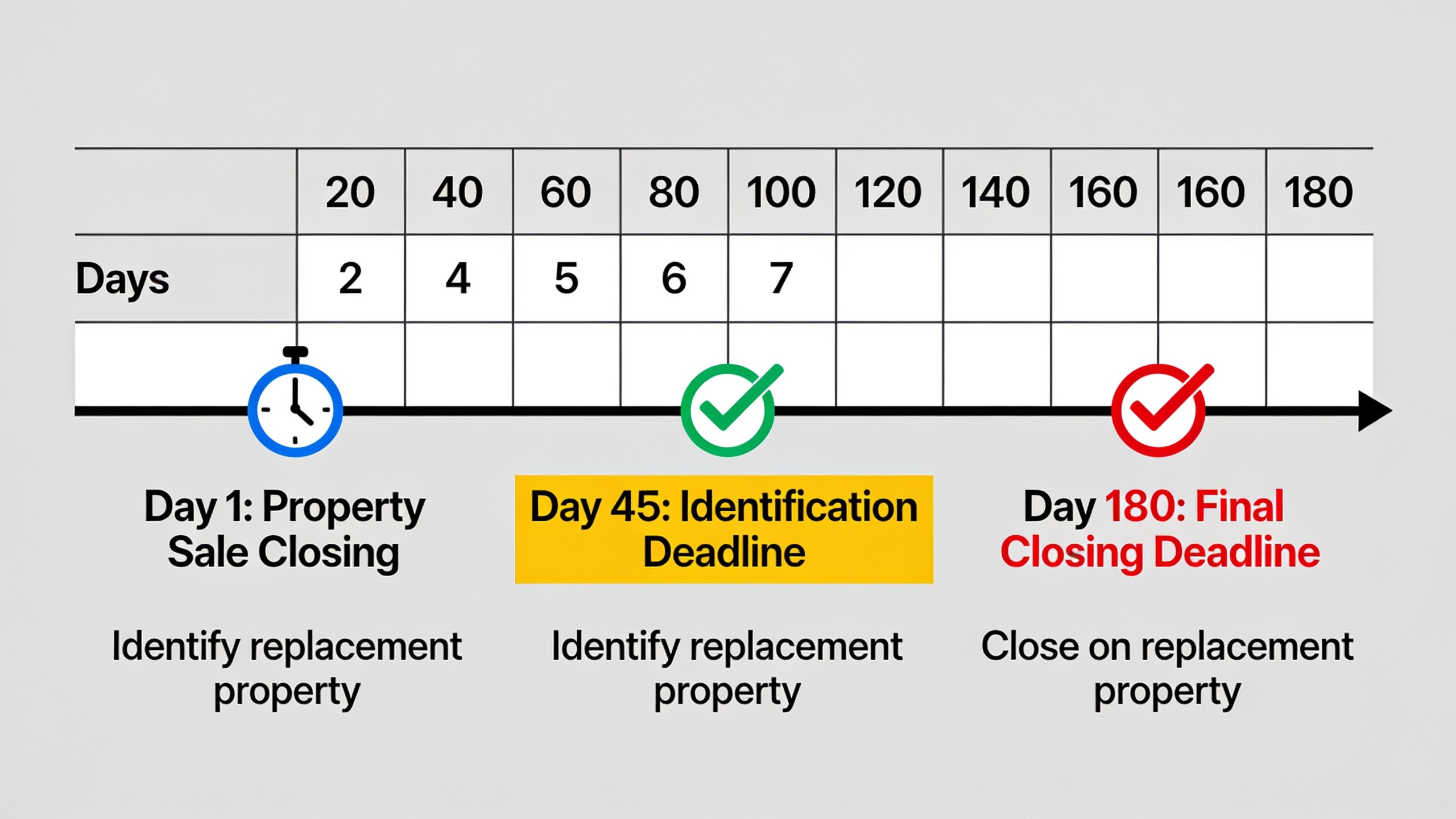
A 1031 exchange works by selling your old property (the “relinquished” one), sending the proceeds to a qualified intermediary, identifying a replacement property within 45 days, and closing on it within 180 days of that original sale. Botch any one of those steps and the whole thing can unravel, dropping the full tax bill right back in your lap.
The Person Who Holds Your Money
A qualified intermediary, or QI, is a neutral outside party who holds your sale proceeds during the exchange so that you never have actual or “constructive” receipt of the cash. This is not some optional bit of paperwork you can skip. If that money lands in your personal account, even for an afternoon, the IRS calls it a regular sale and your deferral is gone. Just like that.

Here’s a catch a lot of people don’t see coming: your real estate attorney, accountant, or title company usually can’t be your QI if they’ve acted as your agent in some other capacity in the past two years. So most investors just hire a dedicated exchange company that does nothing but this all day long.
What “Like-Kind” Actually Means
“Like-kind” is way broader than first-timers assume. You don’t have to swap a duplex for another duplex. Under the current rules it has to be real property (that part changed a few years back), but within real estate you’ve got enormous freedom. Trade raw land for an apartment building. Swap a strip mall for a handful of single-family rentals. Turn a warehouse into a vacation rental. As long as both properties are held for investment or business and both sit inside the United States, you’re good.
That flexibility is honestly what makes this such a useful tool. It lets you completely change strategy, say, escaping the grind of active rental management for something more passive, without getting taxed on the way out.
Equal or Greater Value
To defer 100% of your gain, the replacement property generally has to be worth as much or more than the one you sold, and you need to reinvest all the net proceeds. Pull any cash out along the way (that leftover is called “boot”) and that chunk gets taxed, even if everything else was done perfectly. And a friendly warning here: if you’re still getting your footing with rentals, read 10 Questions to Ask Before Buying an Investment Property first. A 1031 only makes sense if the replacement property is a genuinely good deal on its own. A tax break on a bad investment is still a bad investment.
Who Qualifies for a 1031 Exchange?
To qualify for a 1031 exchange, both the old and new properties have to be held for investment, business, or income purposes, and the whole deal has to follow the IRS structure and timeline exactly. Personal residences, vacation homes you use for fun, and anything held mainly for quick resale (inventory, basically) don’t make the cut.
Individuals, partnerships, LLCs, trusts, corporations, they can all do this, as long as the entity that sold the old property is the same entity that buys the new one. This “same taxpayer” rule trips people up more than almost anything else. Say your property is titled to an LLC but you want to hold the new one in your own name. That mismatch can kill the exchange unless you restructure it ahead of time with a pro who knows what they’re doing.
Rentals are far and away the most common thing people use for this, which is why it comes up constantly for landlords who want to jump to a new market, roll several small headaches into one bigger property, or just get out from under a single high-maintenance nightmare. If you’re new to the income-property world in general, Rental Property Investing 101: A Beginner’s Roadmap covers picking, financing, and managing rentals before you ever get to the tax stuff.
What Are the 1031 Exchange Deadlines?
The two hard deadlines are 45 days to formally identify potential replacement properties and 180 days total, from the closing of your original sale, to actually close on the new one. Both clocks start the same day, the day your old property sale closes. And they count calendar days. Weekends, holidays, all of it. No mercy, no ordinary extensions.
The 45-Day Clock
Within 45 calendar days of selling, you have to hand your QI a written list of properties you might buy. The IRS usually lets you name up to three no matter what they’re worth, or more than three under specific value rules (like the 200% rule, where everything you list can’t add up to more than 200% of what you sold). Forty-five days sounds like plenty. It isn’t. Between competitive markets, financing contingencies, and inspection periods, that window disappears faster than almost anyone expects.
The 180-Day Clock
Then you’ve got until the earlier of 180 calendar days after the sale, or your tax return due date for that year (extensions included), to close on one or more of the properties you named. There’s no pause button. A slow lender, a title snag, doesn’t matter, the clock keeps ticking. This is exactly why smart investors line up their financing and due diligence before the first property even closes.
Types of 1031 Exchanges Compared
Not every exchange follows the tidy sell-then-buy order. The IRS recognizes a few different structures, and the right one comes down to your timing, your financing, and whether you’ve already found your next place before letting go of the current one.
| Exchange Type | How It Works | Best For | Key Risk |
|---|---|---|---|
| Delayed (Forward) Exchange | Sell relinquished property first, then identify and close on replacement within 45/180-day windows | Most common scenario; investor sells before buying | Running out of time to find or close on a suitable replacement |
| Simultaneous Exchange | Relinquished and replacement properties close on the same day | Investors with a confirmed swap already lined up | Coordinating two closings on the exact same date without delay |
| Reverse Exchange | Replacement property is purchased first, held by an exchange accommodation titleholder, then the original property is sold within 180 days | Hot markets where the ideal replacement property might disappear | Requires significant capital or financing to buy before selling |
| Improvement (Construction) Exchange | Exchange funds are used to build or improve the replacement property while it’s held by an intermediary, within the 180-day window | Investors who want to upgrade a property using exchange equity | Construction must be substantially complete within the 180-day limit |
Delayed exchanges make up the overwhelming majority, mostly because they mirror how people naturally behave. You sell, then you go shopping. Reverse and improvement exchanges are the specialized cousins. They demand more cash upfront or a lender who’s comfortable with the weirdness, so you tend to see them with seasoned investors rather than folks doing their first one.
Common Mistakes That Cost Investors Their Tax Deferral
The fastest ways to lose your deferral are touching the sale proceeds yourself, blowing past the 45-day deadline, or misreading what counts as “like-kind” and “equal or greater value.” What kills me about all of these is that they’re completely preventable. Which is also exactly what makes them so infuriating when they happen.
Touching the money, even for a second. The single quickest way to detonate an exchange is letting the proceeds hit your own account before they get to the QI. One day is too long. The IRS doesn’t care whether you meant to keep it. Constructive receipt ends the exchange, period.
Assuming 45 days is a lot of time. People kick off their property search only after closing, figuring they’ve got weeks to spare. Then reality hits. Touring places, negotiating, getting a signed purchase agreement, all inside 45 days? That’s genuinely tight in any competitive metro. The pros I know start scouting replacements before the “for sale” sign even goes up.
Buying “down” and not realizing what it costs you. If your new property is cheaper than what you sold for, the difference gets taxed as boot, even if the rest of the deal is flawless. A surprising number of investors think any reinvestment defers the whole gain. Nope. Partial reinvestment, partial deferral. That’s it.
Titling that doesn’t match. Like I said earlier, the same taxpayer or entity that sold has to buy. So if you want to bring in a business partner, move title into a fresh LLC, or split things up among family, you plan that before closing. Not after. After is too late.
Cheaping out on professional help. A QI fee is peanuts next to the capital gains bill you’ll eat if the exchange collapses on some technicality. And honestly, people also underestimate the sheer legwork of finding the right replacement fast enough. If you’re trying to market a property for sale or lease during that same crunch, resources like the ones over at Sukhweb can help you understand how to get a listing seen online quickly. The digital marketing basics, SEO, content strategy, all of it applies to real estate listings just as much as anything else.
Is a 1031 Exchange Right for Your Investment Strategy?
A 1031 exchange makes the most sense for people who plan to stay in real estate for the long haul and want to reshuffle their portfolio without bleeding equity to taxes every time. If you genuinely want out of real estate for good, it’s less compelling, because that deferred tax eventually comes home to roost, unless you hold the property until you die.
What’s Great About It
Compounding, mostly. By deferring the capital gains hit at every trade-up, you keep more of your equity actually working across multiple properties over the years instead of losing a cut at each sale. The industry loves the phrase “exchanging up,” and it’s a decent description: you move from small, management-heavy properties into bigger or more hands-off ones over time, and defer the tax the whole way. That adds up to serious money over a couple of decades.
The Annoying Parts
Complexity and rigidity, basically. Those deadlines are brutal, and an exchange can fail through absolutely no fault of your own. A lender drags their feet, closing slips past day 180, and boom, it’s a taxable sale. There are also ongoing costs, the QI fees, plus the legal or tax help you’ll want if entities, partnerships, or improvement exchanges are in play. And this is the big one: you have to actually want the replacement property as a long-term hold. Chasing some mediocre building purely to dodge taxes almost never works out. I’ve watched people do it. It rarely ends well.
Frequently Asked Questions
Can I do a 1031 exchange on my own house?
No. The rules only cover property held for investment, business, or income. Your primary residence has its own separate perk (the capital gains exclusion), but it doesn’t qualify for a like-kind exchange. And a second home you mostly use for vacations generally won’t either, unless you’re truly running it as a rental with only limited personal use.
How many of these can I do in my lifetime?
There’s no cap. Plenty of long-term investors chain exchanges together over decades, continually deferring gains as they trade into bigger or different properties, right up until they either sell outright and pay the piper, or leave the property to their heirs with a stepped-up basis.
What if I can’t find a replacement in time?
If you don’t identify something within 45 days or close within 180, the exchange fails and it’s treated as a plain old taxable sale. Your QI returns the money to you, and you owe capital gains tax on the sale that year, exactly as if you’d never tried to exchange at all.
Do I need both an agent and a QI?
Yep, and they do totally different jobs. Your agent finds and negotiates the replacement property. The qualified intermediary is the required, independent party holding your proceeds and keeping the deal IRS-compliant. You’ll usually need both working together, plus a tax advisor who actually understands the guts of Section 1031.
Is this the same thing as an Opportunity Zone investment?
No, and it’s an easy mix-up. A 1031 defers your gains by reinvesting into like-kind real estate. Qualified Opportunity Zone investments are a different animal, with tax incentives tied to putting money into economically distressed areas. Separate programs, separate rules, separate timelines. Which one fits (or whether some structures let you combine them) really depends on your goals, so talk to a tax pro before you commit to either.
A 1031 exchange isn’t a loophole. It’s a deliberate, decades-old tool that rewards people who plan ahead, move fast inside tight windows, and treat the replacement property as a real decision instead of a box to tick. Whether you’re rolling a few rental units into something bigger, jumping into a new market, or just trying to keep more of your own equity in the game, understanding how this works before you list is what separates a smooth exchange from a frantic, expensive scramble at the finish line.