
So you’re thinking about buying a rental property. Maybe you watched one too many YouTube videos about “financial freedom,” or you’ve been scrolling Zillow during lunch like it’s a slot machine. Or maybe a friend keeps bragging about the checks that show up in their account every month, and you’re quietly wondering why that isn’t you. Whatever got you here, good. Rental property is genuinely one of the more accessible ways regular people build wealth, and no, you don’t need a finance degree or a rich uncle.
But let me be straight with you: it’s not the passive money-printing machine the gurus make it out to be. You don’t just buy a house and cash checks forever. There’s math involved, some of it uncomfortable, and a bunch of stuff that’ll go wrong the exact moment you feel confident. This guide walks through what actually matters, from cash flow to the parts of being a landlord nobody warns you about, so your first deal isn’t a very expensive lesson.
Table of Contents
- Why Real Estate Still Holds Up
- Cash Flow: The Thing That Actually Keeps You in the Game
- The Numbers You Can’t Skip
- Getting the Money (aka Financing)
- Picking a Property Without Losing Your Mind
- Being a Landlord, For Real This Time
- Mistakes That’ll Cost You
- Turning One Property Into Several
Why Real Estate Still Holds Up
People always ask: why property instead of just dumping money into stocks or crypto? Fair question. And honestly, for a lot of folks, index funds are the smarter, lower-hassle move. But real estate does a few things other investments just can’t.
For one, it pays you two ways at once. There’s the monthly rent your tenants hand over, and then there’s the property quietly appreciating in the background. The Federal Reserve’s long-term data has national home values climbing somewhere around 3 to 5% a year, and in the hotter metro areas over the past decade? A lot more than that. Toss in the tax perks (depreciation, writing off mortgage interest, the 1031 exchange that lets you roll gains into a new property tax-deferred) and you’ve got an asset that rewards you from a few directions at the same time.
Then there’s leverage, which is the part that makes real estate feel almost unfair. With stocks, you buy $50,000 worth of shares with $50,000. With property, you can control a $300,000 house with maybe $60,000 to $75,000 down and let the bank cover the rest. Your returns get calculated against the whole asset, not just your cash. That amplifies your gains. It also amplifies your losses, so don’t get drunk on it.
And the last thing, which I think gets underrated: control. You can renovate a bathroom to bump the value. You can raise rents when the market moves. You can pick your tenants (please, pick carefully). Try doing any of that with a share of Apple. That hands-on quality is a big part of why so many first-timers gravitate toward real estate. You’re actually driving.
Cash Flow: The Thing That Actually Keeps You in the Game
If you take one idea away from this whole article, make it this one. Cash flow is the money left in your pocket every month after every bill is paid. Positive cash flow means the property is a little business that pays you. Negative cash flow means you are the one feeding the property out of your own savings, month after month, and hoping the appreciation fairy shows up eventually.
The basic math looks like this:
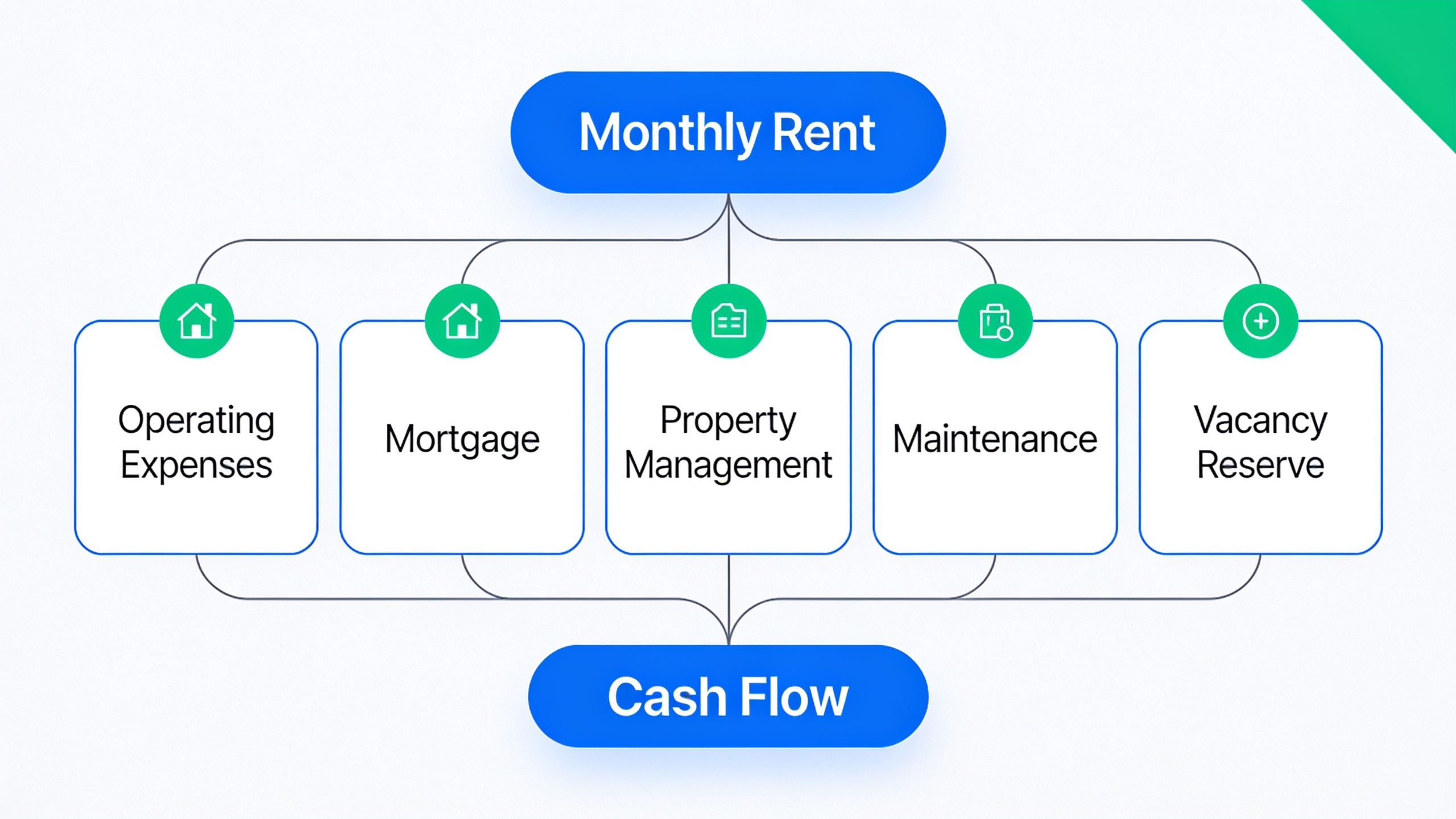
Monthly Rent − Operating Expenses − Mortgage = Cash Flow
Simple enough. The trap is in that “operating expenses” line, because beginners love to forget half of it. Your real costs include property taxes and insurance, sure. But also property management (figure 8 to 10% of rent if you hire it out), maintenance and repairs (budget 1 to 2% of the property’s value every year), and a vacancy reserve for the months the place sits empty (5 to 8% of rent is a reasonable cushion). If there’s an HOA, that’s on the list too. And if you’re covering any utilities, don’t pretend those are free.
Here’s where people get wrecked: they run the numbers using only the mortgage and taxes, the deal looks amazing, they buy it, and then the water heater dies in month three and the tenant moves out in month five. Suddenly that “cash-flowing” property is bleeding money.
Seasoned investors use a shortcut called the 50% Rule to sanity-check deals fast. The idea is that roughly half your gross rent will get eaten by operating expenses (not counting the mortgage). It’s not gospel, and it’ll be off for plenty of specific properties, but when you’re screening ten listings on a Tuesday night it keeps you honest.
One more thing, because people argue about this endlessly. Appreciation is fun to daydream about, but it’s speculative. You don’t control the market, and you can’t spend equity you haven’t cashed out. Cash flow you can actually touch. It pays your bills, builds your reserve, and keeps you afloat when the economy hiccups. Buy for cash flow. Let appreciation be the bonus, not the plan.
The Numbers You Can’t Skip
Okay, some math. This is the part where new investors either freeze up or just… skip it entirely and buy on vibes. Don’t be that person. A couple of calculations can save you from a five-figure mistake.
The cap rate tells you a property’s return based purely on what it earns versus what it costs, with financing left out of the picture completely.
Cap Rate = Net Operating Income ÷ Property Price
So a place pulling $18,000 in annual NOI that costs $300,000 has a 6% cap rate. Cap rates swing wildly by market. Hot urban areas might sit at 3 to 5% because buyers are paying up for future growth, while slower secondary markets might hand you 8 to 10% because investors want more cash flow to make up for less appreciation.
Then there’s cash-on-cash return, which I’d argue matters more for most beginners since almost nobody pays cash for their first rental. This one measures the return on the actual money you put in (down payment, closing costs, initial fix-up), factoring in your mortgage.
Cash-on-Cash Return = Annual Pre-Tax Cash Flow ÷ Total Cash Invested
Here’s a quick reference so you’re not juggling all this in your head:
| Metric | What It Measures | Best Used For | Typical Beginner-Friendly Range |
|---|---|---|---|
| Cap Rate | Return based on price, no financing | Comparing properties across markets | 5% – 10% |
| Cash-on-Cash Return | Return on actual cash invested | Evaluating financed deals | 8% – 12% |
| Gross Rent Multiplier (GRM) | Price relative to gross rental income | Quick screening | 8 – 12 |
| Debt Service Coverage Ratio (DSCR) | NOI relative to mortgage payment | Lender approval, risk assessment | 1.2 or higher |
Just don’t lean on any single number. A property can have a gorgeous cap rate and still be a dud if it’s parked in a neighborhood that’s quietly emptying out. Or great cash-on-cash but a DSCR so thin it barely covers its own mortgage, meaning one bad month sinks you. These numbers work as a group, not solo acts.
Getting the Money (aka Financing)
This is usually where new investors get a splash of cold water. Lenders do not treat a rental the way they treat the house you live in, and knowing that upfront saves you a lot of confused phone calls.
Expect to put 20 to 25% down on a non-owner-occupied investment property. Compare that to the 3 to 5% you might get away with on a primary residence and yeah, it stings. Interest rates run higher too, usually half a point to three-quarters of a point above what a homeowner would get, because the bank figures you’re more likely to walk away from an investment than the roof over your own head. They’re not wrong.
If that down payment feels out of reach, look into house hacking. It’s easily one of the best entry points for anyone short on capital. You buy a duplex, triplex, or fourplex, live in one unit, and rent out the rest. Because you actually live there, you can qualify for owner-occupant financing, sometimes an FHA loan with as little as 3.5% down, while your tenants basically cover your mortgage. I know several people who started exactly this way and later moved out, kept the whole building as a rental, and did it again. It’s a cheat code, honestly.
Once you outgrow your first place and want to keep buying, traditional financing based on your personal income gets tricky (most lenders cap how many mortgages they’ll give one person). That’s when DSCR loans enter the picture. These qualify you based on the property’s rental income instead of your W-2, which is exactly why investors building bigger portfolios love them.
Picking a Property Without Losing Your Mind
Not every market works for rentals, and not every property works even in a good market. The “right” choice really does depend on your goals, your budget, and how much risk lets you sleep at night.
Before you fall for any specific house, zoom out and look at the market. Is the population growing? Are jobs coming in or leaving? Areas with rising employment tend to have steady, reliable rental demand, which is exactly what you want. Check the rent-to-price ratio too, comparing median rents against median home prices; a higher ratio usually points to better cash flow. Low vacancy rates are a green flag. And if you’re going after families or long-term tenants, decent school districts and nearby amenities matter more than you’d think.
On property type, there’s a real trade-off. Single-family homes attract longer-term tenants, they’re easier to finance, and they’re easier to sell when you want out, but the cash flow per unit tends to be thinner. Duplexes and small multifamily buildings usually cash flow better and give you a bit of built-in insurance (one unit empty doesn’t mean zero income), though they’re more of a headache to manage and finance. Condos can look tempting because they’re cheaper, but HOA fees eat into returns and some HOAs flat-out ban renting. Check the HOA’s rental policy before you get attached. I cannot stress this enough.
Now, local versus out-of-state. Most first-timers buy locally, and honestly that’s a smart default. You can walk the property yourself, meet contractors, actually know the area. But if your hometown has sky-high prices and rents that don’t come close to justifying them, some investors chase cash flow in more affordable markets elsewhere. Just know that going out-of-state means more homework, a trustworthy local team, and almost certainly a property manager to bridge the gap. It’s doable. It’s not casual.
Being a Landlord, For Real This Time
Own a rental and congratulations, you’re running a small business now, whether you feel like it or not. You don’t have to love that part, but you can’t ignore it.
First decision: manage it yourself or pay someone? Doing it yourself saves that 8 to 10% fee, which adds up. But it costs you time, availability, and the emotional bandwidth to field a “the toilet’s overflowing” call at 11pm. A property manager costs money but buys back your evenings and puts a buffer between you and your tenants, which is worth a lot if you’ve got a demanding job or you’re managing from three states away.
Here’s the breakdown:
| Factor | Self-Management | Professional Property Manager |
|---|---|---|
| Monthly Cost | $0 | 8% – 10% of rent |
| Time Commitment | High | Low |
| Tenant Screening | You handle it | Manager handles it |
| Maintenance Coordination | Direct responsibility | Managed via vendor network |
| Best For | Local, hands-on investors | Busy investors or out-of-state owners |
Whatever you decide, do not cut corners on tenant screening. A bad tenant can cost you thousands in unpaid rent, torched-up drywall, and the special hell that is an eviction. Run credit checks. Verify income (a common rule is gross income of at least three times the monthly rent). Call previous landlords. Do the background check. The temptation to skip all this just to fill a vacancy fast is real, and it’s exactly how new landlords get burned.

You also need to actually know your local landlord-tenant laws, because “I didn’t know” isn’t a defense anyone will accept. Security deposits, eviction procedures, required disclosures, habitability standards, all of it varies by state and often by city. Either study your local rules until you know them cold or work with a property manager or real estate attorney who already does.
And set up a maintenance reserve. Separate from your regular cash flow. This is the account you don’t touch until the roof goes or the HVAC dies in July (it always dies in July). Setting aside 1 to 2% of the property’s value each year is the usual guideline, though bump it up for older places. The point is that a $6,000 repair should be an annoyance, not a crisis.
Mistakes That’ll Cost You
Learning from other people’s screwups is a lot cheaper than making your own, so here’s what trips up new investors over and over.
The big one is underestimating expenses. People forget vacancy, capital expenditures, and management fees, run rosy numbers, buy the place, and then watch it quietly hemorrhage money that looked like profit on the spreadsheet.
Close behind is buying on emotion. That gorgeous renovated kitchen means nothing if the rent-to-price ratio doesn’t work. You’re not moving in. Fall in love with the numbers, not the backsplash.
A few others worth burning into your memory: never waive the inspection just to win a bidding war (that’s how you inherit a cracked foundation you didn’t budget for). Don’t over-leverage yourself across a bunch of properties with no cash reserves, because one vacancy or one busted HVAC can bring the whole thing down like dominoes. And have some idea of your exit, even if you plan to hold forever. Knowing how you’d sell, refinance, or hand it off keeps you from feeling trapped later.
Turning One Property Into Several
Once your first rental is stable and actually cash-flowing, something clicks. You’ve got equity, you’ve got experience, and suddenly the second one feels a lot less scary. Plenty of investors tap that first property’s equity through a cash-out refinance or a HELOC to fund the next deal.
This is where the BRRRR method (Buy, Rehab, Rent, Refinance, Repeat) starts making sense. The whole idea is recycling the same chunk of capital across deal after deal instead of grinding to save a fresh down payment every single time. As you grow, spreading across different property types and even different markets can cushion you against a downturn or some nasty new regulation in one particular city.
The real shift, though, is mental. Treat this like a business, not a hobby. Keep clean records. Track how each property’s performing. Reinvest with a plan instead of on a whim. And keep learning, because markets and laws don’t sit still. The people who do well here aren’t the ones who got lucky. They’re the ones who kept showing up and running the numbers.
Frequently Asked Questions
How much money do I actually need to get started?
Depends heavily on your market and how you finance it, but a decent benchmark is a 20 to 25% down payment plus 3 to 6 months of reserves. In cheaper markets that might be $30,000 to $50,000 all in; in pricey metros, a lot more. House hacking with an FHA loan can drag that number way down, sometimes under $20,000, which is why it’s such a popular first move.
What’s a good cash flow number to aim for?
Lots of experienced investors want at least $200 to $300 in positive monthly cash flow per unit after everything’s paid, but honestly that varies a ton. What matters more than hitting some magic figure is that the property comfortably covers itself with room to spare. Don’t chase an arbitrary number off the internet.
Should I manage it myself or hire someone?
If you’re local, have the time, and don’t mind rolling up your sleeves, self-managing saves real money. If you’re out of state, slammed at your day job, or you just want a more hands-off life, paying a manager 8 to 10% is usually worth every penny for the peace of mind alone.
Does this even work with today’s higher interest rates?
It does, but you’ve got to underwrite way more carefully than people did during the cheap-money years. Focus on deals that show strong cash-on-cash returns even at current rates. Lean toward house hacking or small multifamily. And whatever you do, don’t buy something that only “works” if appreciation shows up to save it.
How many properties do I need to retire?
Comes down to how much monthly income you want and how much each property nets. If you need $5,000 a month and each place clears $500, that’s roughly ten properties. But most people I know set smaller goals first, like replacing a chunk of their salary, rather than fixating on some big round number.
At the risk of sounding like every other article you’ve read: rental property rewards the people who do the boring homework, run honest numbers, and treat their first deal as a learning experience instead of a lottery ticket. Start small. Know your market cold. And use whatever tools make the search less painful, because the habits you build on that first property will shape every single decision you make after it.
You Might Also Find Useful
- Vivienda Lista – A comprehensive platform for finding your ideal home to buy or rent, featuring curated listings, property comparisons, and expert guidance.
- Cryptocoinsjournal – News, insights, and market analysis on cryptocurrencies and blockchain for investors exploring digital assets alongside traditional real estate.
- Vidbox – An Indonesian social media portal offering free registration, games, movies, forums, blogs, and marketplace tools for online learning and business.
Leave a Reply