
Five rental properties in three years. When most people hear that, they assume you either inherited money or you’re pulling down a fat tech salary with cash to burn. This case study is going to annoy those people, because it happened with neither.
Meet Marcus Rivera, a 34-year-old IT project manager from Tampa who took a single $18,000 down payment and turned it into a portfolio worth roughly $1.4 million, kicking off more than $4,200 a month in net rental income. No trust fund. No secret windfall. Just a system he ran over and over: research the market, finance carefully, scale when the numbers said scale.
What follows is the whole thing, year by year. The real numbers, the dumb mistakes, and the specific financing tricks that made any of it possible.
Table of Contents
- Who Is This Real Estate Investor and Why His Story Matters
- Year One: Laying the Foundation With Market Research
- Year Two: Scaling Through Strategic Financing
- Year Three: Reaching Five Properties
- Portfolio Performance Breakdown
- What Financing Tools Made This Rental Portfolio Case Study Possible?
- Mistakes and Lessons Along the Way
- How Can You Replicate This Strategy?
- Frequently Asked Questions
Who Is This Real Estate Investor and Why His Story Matters
Marcus Rivera turned a modest primary-residence purchase into a five-property rental portfolio between 2021 and 2024, using a mix of house hacking, cash-out refinancing, and stubborn, granular research into Florida’s secondary markets. His story matters for one simple reason: it proves that this kind of success isn’t about starting rich. It’s about starting organized.
Here’s where he began. A household income of about $92,000. Zero real estate experience. Around $35,000 in total savings. That’s it. What he actually had going for him was patience and a refusal to cash out early when the money got tempting.
For what it’s worth, his approach lines up almost perfectly with the data. The National Association of Realtors’ 2023 Investor and Second-Home Buyer Survey found that investment property purchases made up roughly 15% of all home sales that year, and most successful small-portfolio investors leaned heavily on local market data before buying anything. Rivera fits that mold exactly. Every single purchase came after weeks of him buried in neighborhood-level numbers, which honestly sounds tedious, and probably was.
Year One: Laying the Foundation With Market Research
Year one was one purchase. A duplex in a Tampa suburb, bought for $265,000 with an FHA loan and 3.5% down. That’s the whole first act. But it set up everything else, because Rivera did the thing most people skip: he house-hacked it, living in one unit and renting the other. Homeownership and rental income at the same time, from day one.
Choosing the Market Before Choosing the Property
He didn’t open Zillow first. He opened spreadsheets.
Before Rivera looked at a single listing, he spent his time studying migration patterns, job growth, and rent-to-price ratios across five Florida metros. He pulled population inflow numbers from the U.S. Census Bureau’s American Community Survey and matched them against rent growth from Apartment List’s national rent report. Tampa won because it hit two things at once: double-digit population growth between 2020 and 2022, plus rents still climbing faster than the state average.
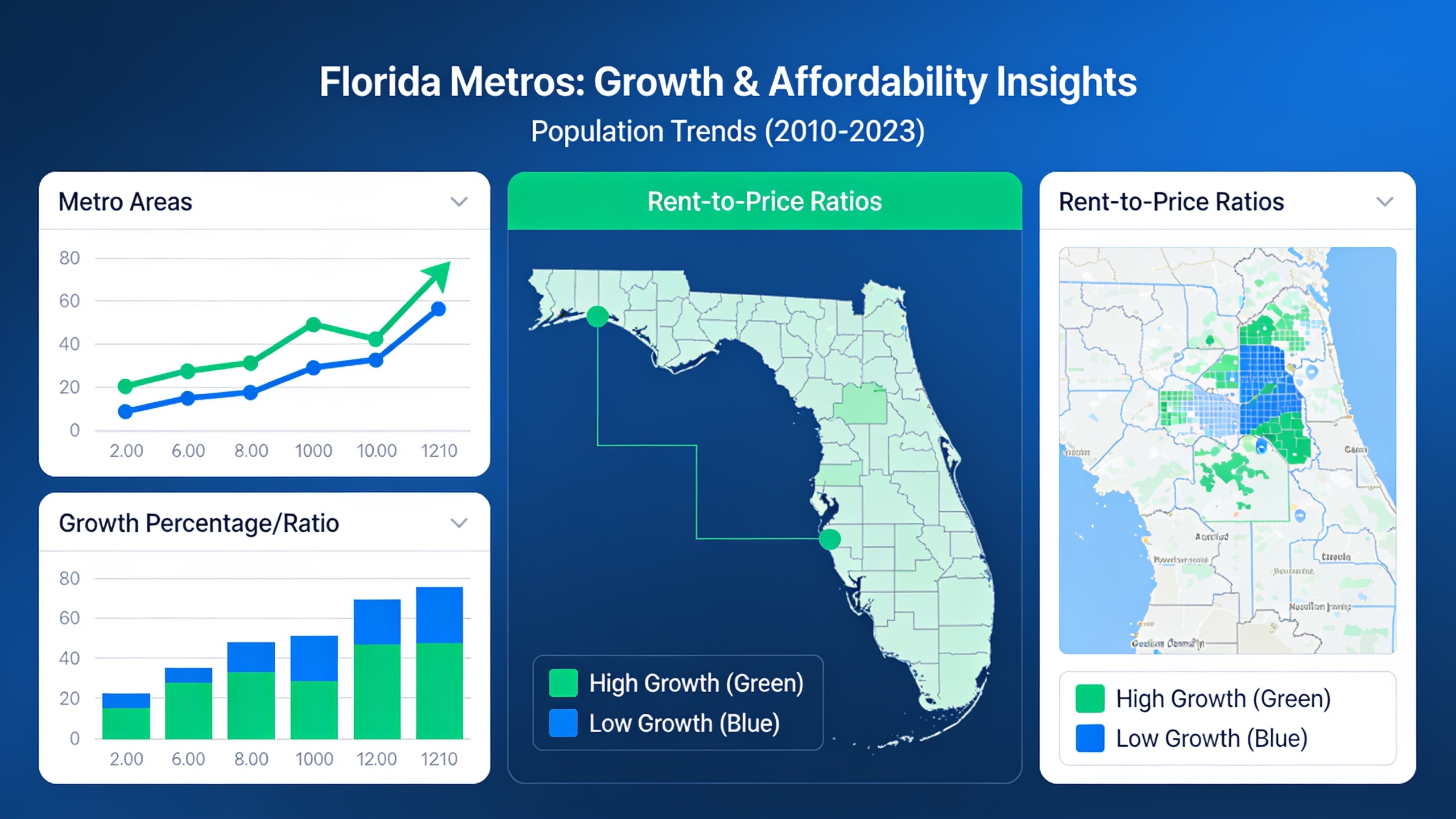
That data-first mindset is basically the whole thesis of the guide on how real estate investors use data to pick profitable markets, which covers the same metrics Rivera lived by: job diversification, population growth, landlord-friendly laws, and rent-to-income ratios. One rule he was strict about? He avoided any neighborhood with a rent-to-income ratio above 35%. Cross that line and you’re usually looking at affordability stress and tenants who churn fast.
The House-Hacking Purchase
The duplex ran $265,000. With the FHA loan, Rivera put down $9,275 (that’s the 3.5%) plus about $8,500 in closing costs and reserves, so roughly $17,775 out of pocket total. He moved into one 900-square-foot unit and rented the other for $1,650 a month. That rent alone covered nearly 80% of his mortgage, taxes, and insurance combined.
This is the hinge the entire story swings on. By living there, he qualified for a low-down-payment loan meant for primary residences, and he still got to collect rent. Within 14 months, rising rents plus a light renovation (new flooring, fresh paint, updated fixtures) bumped the appraised value up by nearly $40,000. And that, right there, is what set up year two.
Year Two: Scaling Through Strategic Financing
Year two is where it picks up speed: two more properties, one through a cash-out refinance and one through a conventional investment loan. This is also the exact stage where most beginners blow it. They either sprint without reserves or crawl so slowly they miss every good rate window. Rivera did neither, which is less exciting to write about but a lot more profitable.
The Cash-Out Refinance Strategy
In month 16, Rivera refinanced the duplex and pulled out $52,000 in equity, keeping his loan-to-value ratio at 75% (comfortably under the 80% ceiling most lenders draw). He put $28,000 of that toward a down payment on a single-family rental in a nearby suburb, priced at $210,000, financed with a conventional 20%-down investment loan.
The other $24,000? He just… sat on it. Called it his reserve fund. And thank god he did, because most experienced landlords will tell you to keep three to six months of expenses per property in reserves, and that cushion is exactly what let Rivera eat a surprise $6,200 HVAC replacement later that year without touching a dime of his personal savings.
Adding Property Three With a Small Renovation Play
Six months after property two, he found a distressed three-bedroom listed 12% below the neighborhood median. It needed about $15,000 in cosmetic work. He financed the house with a conventional loan and covered the repairs on a 0% intro-rate credit card, then paid it off within nine months using rent from his other units. Aggressive? A little. But he ran the math first.
Before listing it, he brought in a licensed contractor through Call Painting Pros to repaint inside and out, and he swears it shaved nearly three weeks off the vacancy window because the place photographed so much better online. I buy that completely. Fresh paint is one of the highest-ROI moves in rental real estate, period. It routinely earns back more than it costs through lower vacancy and higher achievable rent.
By the end of year two, Rivera owned three properties worth a combined $685,000, bringing in about $4,950 a month in rent against roughly $3,600 in mortgage and expenses.
Year Three: Reaching Five Properties
Year three brought the final two purchases and pushed the portfolio past $1.4 million. These moved faster than the earlier ones, mostly because Rivera already had his financing relationships and his due-diligence routine dialed in. Experience compounds, same as equity.
Property Four: A Small Multifamily Purchase
For the four-unit multifamily building (price tag: $410,000), Rivera used a DSCR loan. If you haven’t run into these, a Debt Service Coverage Ratio loan qualifies you based on the property’s rental income instead of your personal income. They’ve gotten popular with portfolio investors for exactly that reason. Once you’ve got a stack of mortgages sitting on your credit report, your personal debt-to-income ratio starts working against you, and DSCR loans just… route around that.
The building pulled $3,400 a month in combined rent against a $2,280 mortgage payment. That’s a debt service coverage ratio of about 1.49, well past the 1.20 minimum most DSCR lenders want to see.
Property Five: Rounding Out the Portfolio
The last one was a townhouse, bought with a second cash-out refinance, this time drawing on the appreciated equity across two of his earlier properties. Combined appreciation had piled up an estimated $95,000 in equity across the portfolio by month 30. He used $38,000 of it as the down payment and still kept his blended loan-to-value under 70%.
If you’re eyeing a similar path, do yourself a favor and start with the basics laid out in Rental Property Investing 101: A Beginner’s Roadmap. It walks through the financing fundamentals (down payments, reserve planning, loan types) that quietly underpin every single move Rivera made across these three years.
Portfolio Performance Breakdown
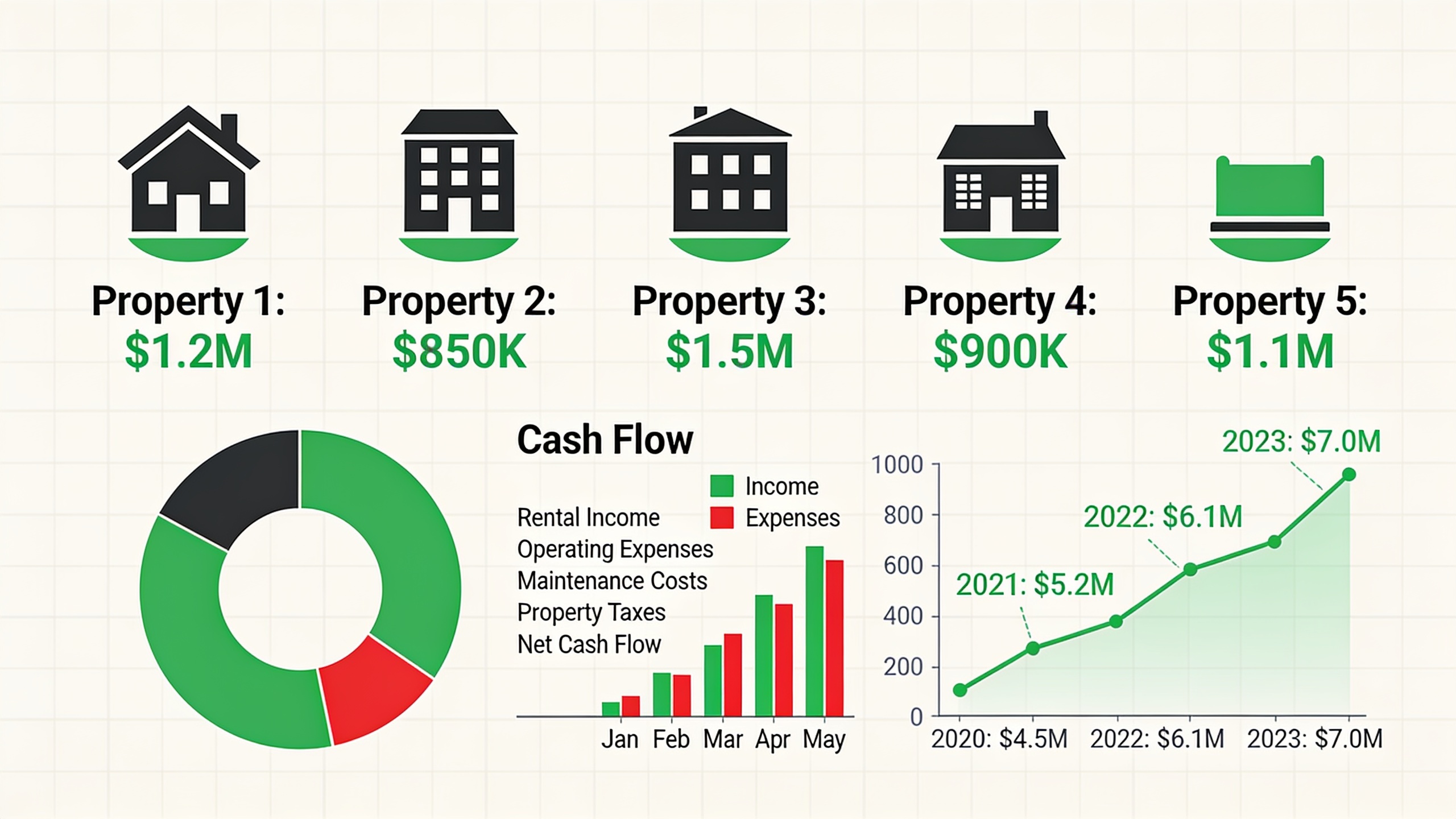
By the end of year three, the five properties generated roughly $8,900 in gross monthly rent against $4,700 in total expenses (mortgages, taxes, insurance, maintenance reserves), leaving net monthly cash flow of about $4,200. Here’s every acquisition laid out:
| Property | Year Acquired | Purchase Price | Financing Method | Monthly Rent (approx.) |
|---|---|---|---|---|
| Duplex (Tampa suburb) | Year 1 | $265,000 | FHA loan, 3.5% down | $3,150 (both units) |
| Single-family home | Year 2 | $210,000 | Conventional, 20% down + cash-out refi | $1,800 |
| Renovated 3-bed home | Year 2 | $178,000 | Conventional loan + credit-financed rehab | $2,000 |
| 4-unit multifamily | Year 3 | $410,000 | DSCR loan | $3,400 |
| Townhouse | Year 3 | $265,000 | Cash-out refinance from equity | $1,950 |
Total portfolio value went from $265,000 after year one to roughly $1,398,000 by the end of year three, driven by both appreciation and the forced equity he manufactured through renovations. To keep tenant inquiries and vacancy listings from turning into chaos across five properties, Rivera ran all his rental marketing through Vivienda Lista, which let him compare listing performance and pricing across neighborhoods without babysitting five separate spreadsheets. Anyone who’s tried to manage listings manually knows why that matters.
What Financing Tools Made This Rental Portfolio Case Study Possible?
Three tools did the heavy lifting: the FHA house-hack loan to get in the door, cash-out refinancing to recycle equity into new down payments, and DSCR loans to get around his personal income limits once his debt-to-income ratio started tripping up lenders. Each one solved a specific problem at a specific stage. That’s the part people miss. It’s not one magic tool, it’s the right tool at the right moment.
FHA Loans for Entry
FHA loans let owner-occupants put down as little as 3.5%, with the catch that you have to actually live in the property for at least a year. That’s it. That rule made Rivera’s duplex dramatically cheaper upfront than a standard 20%-down investment loan would’ve been, freeing up roughly $44,000 he then funneled into reserves and future down payments.
Cash-Out Refinancing to Recycle Equity
A cash-out refinance swaps your existing mortgage for a bigger one and lets you pocket the difference, with the property still backing the new loan. Rivera did this twice, pulling $52,000 after year one and $38,000 after year two, turning paper equity into cash he could actually deploy without selling anything. Most lenders cap these at 75-80% loan-to-value on investment properties, and he stayed inside that line every time. No exceptions. That discipline is boring and it’s also the reason he never got squeezed.
DSCR Loans for Portfolio Growth
DSCR loans care about one question: does the property’s rent cover its debt? They skip the whole song and dance around your W-2 income and personal debt load. This became essential in year three, when his existing mortgages made him look “over-leveraged” to conventional underwriters, even though his rental income was covering every payment with room to spare. DSCR products, plus portfolio loans that bundle several properties under one roof, tend to be the bridge investors use when they’re crossing from three or four properties toward ten and beyond.
Mistakes and Lessons Along the Way
No honest case study skips the screwups, and Rivera owns three of them.
First, he lowballed his own closing cost estimate on the second purchase by almost $3,000, which forced him to raid his personal savings sooner than he wanted. Second, he tried to self-manage all five properties, which ate close to 15 hours a week and eventually blew up in his face: a plumbing leak in property three went unnoticed long enough to cost an extra $2,100. Third, and this one still bugs him, he waited way too long to raise rent on the original duplex. He left roughly $150 a month on the table for nearly a year, purely because he hadn’t bothered to benchmark against comparable listings.
The lesson he hammers on the most is this: market research isn’t a one-and-done thing you do before you buy. It has to keep going after you own the place, through regular rent comparisons and expense audits. Investors juggling several properties often find that automating the tedious stuff frees up the bandwidth for that ongoing work. Tools like RobinRank, which automate SEO content and publishing, are a decent example of the broader trend: investors and small business owners handing off repetitive tasks to AI so they can focus on the decisions that actually move money, like underwriting and tenant screening.
How Can You Replicate This Strategy?
You can replicate this by starting with a house hack, building reserves before you scale, and treating every purchase as a data problem instead of an emotional one. The exact numbers will look different in your market, obviously. But the sequence holds up: low-down-payment entry, equity recycling, income-based financing.
So where do you actually begin? Pick two or three growing metros using the same census and rent-growth data Rivera used, not whatever your buddy swears is the next “hot” city. Then run your own house-hacking math. Realistically, how much of your mortgage could a rented unit or spare room cover where you’re looking? From there, set a reserve target (three to six months of expenses per property is the number most lenders and seasoned landlords land on) before you even think about a second purchase. And revisit your financing every 12 to 18 months, because cash-out refi terms, DSCR requirements, and interest rates all shift with the lending climate. What worked beautifully for Rivera in 2021 might need real tweaking in today’s rate environment.
One last thought, and it’s a bit of a tangent. The scaling headaches Rivera hit with self-management aren’t unique to real estate at all. In the disability care sector, for instance, platforms like Medinex help support organizations wrangle compliance, payroll, and workforce coordination as they grow. Different industry, same truth: whether you’re scaling rentals or a service business, the tools you pick to run operations often matter just as much as the growth strategy itself.
Frequently Asked Questions
How much cash do I actually need to start something like this?
Rivera was in for about $17,775 out of pocket on his first FHA-financed duplex, though every purchase after that varied by market and loan type. For a similar house-hacking play, a realistic starting range is $15,000 to $25,000 to cover the down payment, closing costs, and initial reserves. It swings a lot depending on local home prices, so don’t take those numbers as gospel.
Does house hacking even work anymore, or did that ship sail?
It still works, especially in secondary and tertiary markets where duplex and triplex prices haven’t shot up as fast as single-family homes. That said, interest rates climbing since 2022 have made the monthly math tighter than it was when Rivera bought in. It works best where rental demand is strong relative to purchase price.
How many properties can I buy before financing gets ugly?
Most investors hit a wall around their fourth or fifth conventional mortgage. Fannie Mae and Freddie Mac generally cap conventional financing at ten mortgaged properties per borrower, but plenty of lenders start tightening the screws well before you get there. That’s usually the point where DSCR loans, portfolio loans, or teaming up with other investors stop being optional.
What’s the single biggest risk with scaling this fast?
Overleveraging, hands down. Buying faster than your reserves and cash flow can support leaves you with no cushion for vacancies, repairs, or a nasty rate change. Rivera dodged it by keeping loan-to-value under roughly 75% across the board and stashing dedicated reserves after every refinance.
Do I need property management experience to pull this off?
No, but you do need a plan for when your portfolio outgrows you, because self-managing five properties on top of a full-time job usually becomes a nightmare. A lot of investors hand things off to professional management once they pass three or four units, trading a slice of rental income for their weekends back and fewer 2 a.m. maintenance surprises.
Look, five properties in three years isn’t a recipe you can copy line for line. Every market, income level, and lending environment is its own animal. But the pattern underneath it all (research-driven market selection, cheap entry through house hacking, disciplined equity recycling) is genuinely repeatable for anyone who’s serious about building real rental income instead of waiting around for a lucky break.
Leave a Reply