
If you’ve been scrolling through listings for a condo, townhouse, or a place in one of those planned communities, you’ve seen those three letters everywhere: HOA. And you’ve probably squinted at that monthly number wondering what on earth it actually buys you. So let’s sort it out. This guide walks through what that fee covers, how it gets calculated, the warning signs that should make you slow down before making an offer, and how to actually work the number into your real budget instead of pretending it doesn’t exist. Doesn’t matter if you’re a first-timer eyeing a downtown condo, an investor crunching rental numbers, or someone hunting for a low-maintenance spot to retire. Getting a handle on HOA fees before you buy can save you from a genuinely nasty surprise a few months in.
Table of Contents
- What Are HOA Fees, Exactly?
- HOA Fees Explained: What Do They Actually Cover?
- How Are HOA Fees Calculated?
- How Much Do HOA Fees Cost? A Comparison by Property Type
- Red Flags to Watch for Before You Buy
- How to Budget for HOA Fees When Evaluating a Property
- HOA Fees Explained: Special Assessments and Fee Increases
- Frequently Asked Questions
What Are HOA Fees, Exactly?
HOA fees are recurring payments (usually monthly, sometimes quarterly or annual) that homeowners in a managed community pay to a homeowners association to keep shared property maintained, fund future repairs, and enforce the community rules. The HOA itself is a private governing body made up of residents. It’s typically run by an elected board, and more often than not there’s a professional management company doing the day-to-day work behind the scenes. This whole setup covers condo buildings, townhouse rows, and single-family subdivisions alike.
Here’s a number worth sitting with: there are more than 350,000 community associations across the United States, according to the Community Associations Institute (CAI), and a huge share of American homeowners now live under one. That’s a big slice of the housing market. Which is exactly why this stuff deserves as much of your attention as your mortgage rate does.
And once you buy in, the fee isn’t a “maybe.” It’s a legal obligation tied to the property, written into the community’s governing documents, and skipping payments can eventually lead to liens or, in some states, foreclosure. That’s the deal you’re signing up for. You get shared amenities and a managed environment, but you also inherit a fixed monthly cost and a rulebook you didn’t get to write.
HOA Fees Explained: What Do They Actually Cover?
In plain terms, HOA fees cover the shared costs of keeping a community working, safe, and decent-looking: landscaping, building insurance, amenity upkeep, and a reserve fund for the big repairs down the road. What’s actually included, though, swings wildly depending on whether you’re buying into a high-rise, a townhouse, or a suburban subdivision with a community pool.
In a typical condo or townhouse association, the fee usually handles the exterior stuff you can’t fix yourself: roofs, siding, common walls, plus landscaping for shared lawns and walkways. It also covers the master insurance policy on the building structure (not your stuff inside, more on that in a second), trash removal, and often water or sewer. Then there are the amenities. Pools, gyms, clubhouses, elevators, security gates. And a chunk of your fee should be going into a reserve fund for the expensive future headaches, like a new roof or repaving the parking lot.
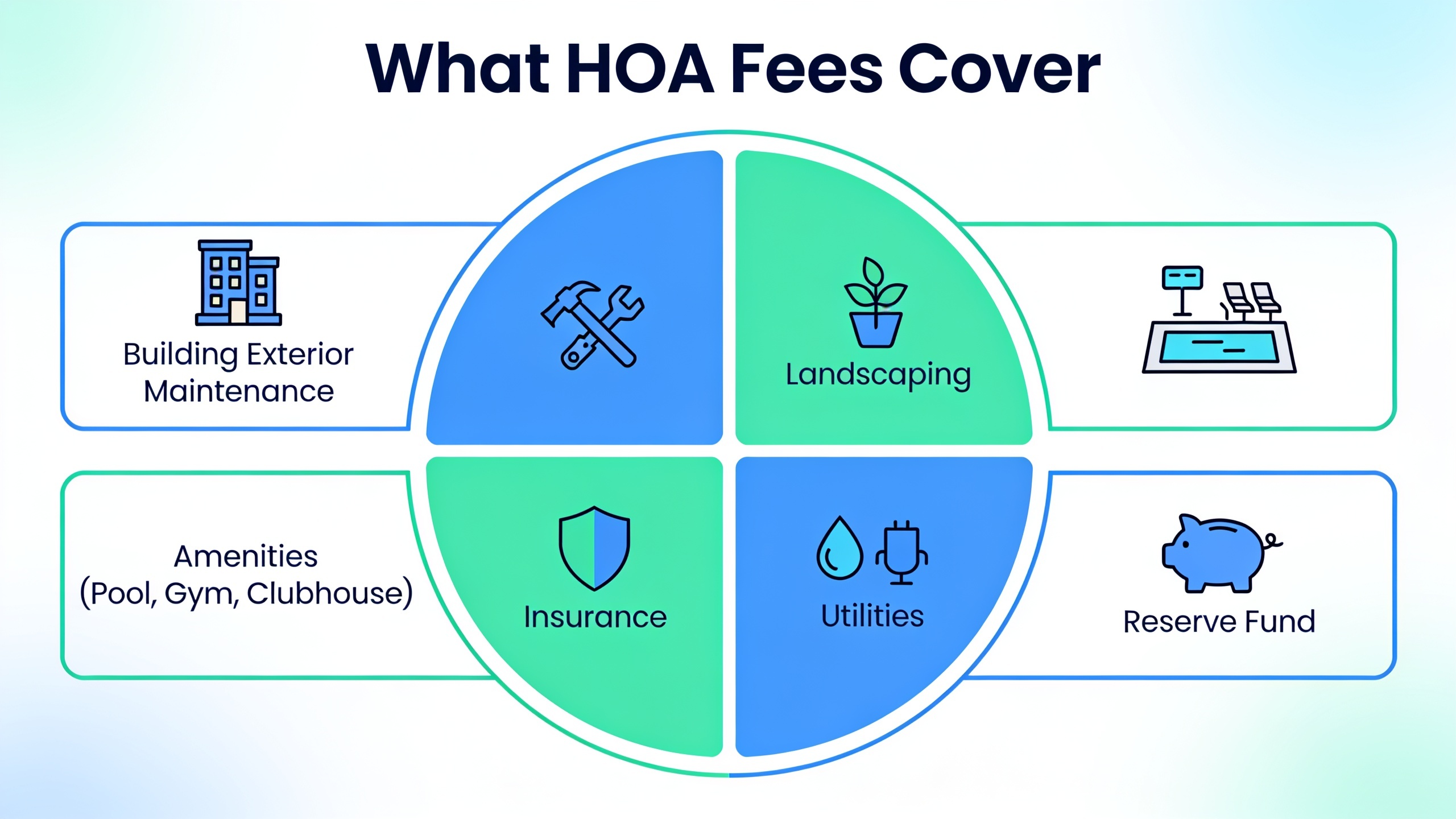
Single-family subdivisions are a lighter lift, cost-wise, because there’s no shared building to insure or maintain. Your fee there mostly goes toward common area landscaping, the fancy entrance sign, neighborhood parks, and maybe a clubhouse or pool. In gated communities, it might also cover private road maintenance. Plus the administrative costs of running the association itself.
What HOA fees almost never touch is anything inside your own four walls or on your own lot. Your interior plumbing, your appliances, your personal landscaping, your homeowner’s insurance policy? All yours. It’s easy to forget that even after the shared spaces are handled, the personal side of making a place feel like home is still entirely on you. Furnishing a living room, or picking out something as small as hand-poured soy candles to warm up a new space, none of that shows up on your HOA statement. It just quietly lives in your own budget.
How Are HOA Fees Calculated?
HOA fees get calculated by taking the community’s total annual operating budget, adding in reserve contributions, and dividing it across all the units or lots, often weighted by square footage or unit type. The board and management company put together an annual budget estimating what maintenance, insurance, utilities, staffing, and reserves will run, then set dues to cover it with a little cushion on top.
A handful of things push that number around.
The biggest one is amenities. A building with a rooftop pool, a 24-hour concierge, and a fitness center is going to carry heavier dues than a small townhouse row with a bit of shared landscaping. Elevators are the sneaky expense here. They’re brutal to insure and maintain, which is a big reason mid-rise and high-rise condos run so much higher than garden-style places.
Age matters too. Older buildings just need more work, and associations sitting on aging roofs, elevators, or plumbing have to budget more aggressively for repairs that are coming whether anyone likes it or not.
Then there’s the health of the reserve fund, which honestly might be the thing I’d look at first. A well-funded reserve (ideally covering a meaningful share of anticipated future replacement costs, per CAI’s guidance for healthy associations) spreads big expenses out predictably over years. An underfunded one? That’s where the sudden special assessments and steep fee hikes come from.
The number of units plays in as well. More owners means the costs get spread thinner, which can lower your per-unit fee, though bigger communities often have more amenities to feed, which cancels some of that out. And finally, management structure. Self-managed associations run entirely by volunteer boards sometimes have lower fees than those paying a professional company. But cheaper isn’t always better. Self-management can also mean spotty enforcement and slow responses when something breaks.
How Much Do HOA Fees Cost? A Comparison by Property Type
There’s no single national number for HOA fees, because they hinge so heavily on location, amenities, and building type. That said, the patterns are pretty consistent across property categories. The table below lays out the general ranges buyers tend to run into, based on typical market patterns reported by real estate professionals and community association data.
| Property Type | Typical Monthly Fee Range | What Usually Drives the Cost |
|---|---|---|
| Suburban single-family home HOA | $50–$150 | Common area landscaping, neighborhood entrance upkeep, occasional pool or park |
| Townhouse community | $150–$350 | Shared roofs/exteriors, landscaping, limited amenities |
| Mid-rise condo (no elevator) | $200–$450 | Building insurance, exterior maintenance, small amenity package |
| High-rise condo with amenities | $400–$1,000+ | Elevators, concierge staff, pool, gym, higher insurance premiums |
| Luxury or gated community | $500–$1,500+ | Extensive amenities, private security, golf courses, resort-style features |
Treat these as rough patterns, not promises. Always confirm the actual current fee and what it includes straight from the HOA’s financial documents. A listing description is not a source of truth.
Red Flags to Watch for Before You Buy
The scariest HOA red flags are chronically underfunded reserves, a habit of frequent special assessments, ongoing lawsuits, and a bunch of owners behind on their dues. Any of those means today’s tidy little fee might not stay tidy for long. So before you get all starry-eyed about a place, dig into the association’s paperwork the same way you’d pore over a home inspection report.
Start with the reserve study. That’s a professional analysis of how long the major shared components (roofs, elevators, parking structures) are expected to last and what they’ll cost to replace. If it shows the reserve fund is way underfunded against those projected needs, take that as a loud hint that a special assessment or a fat dues increase is on its way.

Next, look at the assessment history. One special assessment years back for a one-time storm repair? Normal. Life happens. But three special assessments in the last five years is a pattern, and patterns don’t lie. Ask directly. And if you can get your hands on the board meeting minutes, read them, because they’ll often reveal the ongoing disputes and deferred maintenance that haven’t made it into any official notice yet.
Delinquency rates matter more than people think. If a meaningful chunk of owners are behind on dues, the association just has less money to work with, budget be damned. Lenders actually flag this during condo mortgage approvals, especially for loans backed by Fannie Mae or Freddie Mac, both of which scrutinize a condo association’s finances before they’ll approve financing.
Then there’s pending litigation, which is one of the most overlooked things busy buyers skip right past. A lawsuit against the HOA (a contractor dispute, a construction defect claim, an owner suing the board) can eventually land on your doorstep as higher fees or assessments. Catching that early is exactly the kind of thing that separates a smart buyer from a stressed one. It’s part of a bigger pattern I keep seeing, and it comes up again in 5 First-Time Home Buyer Mistakes (And How to Avoid Them), where skipping the document review under time pressure shows up over and over as an expensive shortcut.
One last thing: if the CC&Rs (that’s covenants, conditions, and restrictions) haven’t been touched in decades, or the board can’t cough up a current budget when you ask, that’s loose governance. And loose governance today tends to become reactive, expensive decision-making tomorrow.
How to Budget for HOA Fees When Evaluating a Property
Treat HOA fees as a fixed monthly housing cost, plain and simple. Add them right onto your mortgage payment, property taxes, and insurance when you’re figuring out what you can genuinely afford. Not as some minor footnote. Lenders already think this way. Most mortgage underwriting folds HOA dues into your debt-to-income calculation, which means a hefty fee can shrink how much home you qualify for, even when the purchase price by itself would’ve been fine.
Here’s the trick I’d use to compare two similar places: build out the full monthly cost, not just the sticker price. A $350,000 condo with a $450 monthly HOA fee can actually cost you more per month than a $370,000 townhouse with a $150 fee, once you run both through a mortgage calculator. Same instinct applies to closing costs. The number on the listing is never the whole story, and HOA dues are just one more line that belongs in the real picture from the start, not something you stumble onto after your offer’s already in.
When you’re comparing listings, ask for this stuff before you get too attached:
- The last 12 months of HOA financial statements
- The most recent reserve study
- Meeting minutes from the past year
- The current CC&Rs and any recent amendments
- A record of past special assessments, if there are any
Once you’ve got real numbers, run three scenarios. Today’s fee. A modest annual bump (most associations nudge dues up a small percentage each year just to keep pace with rising insurance and maintenance). And a worst case that includes a possible special assessment. If that worst case would genuinely wreck your finances, that’s really good information to have now. Before you sign. Not after.
And don’t kid yourself that HOA dues replace your own homeowner’s insurance, or a maintenance fund for stuff inside your unit, or just the everyday cost of living somewhere. Budget for all of that separately, and leave a little breathing room for the small personal touches that turn a place into your place.
HOA Fees Explained: Special Assessments and Fee Increases
A special assessment is a one-time extra charge the HOA slaps on top of your regular dues, usually to cover something unexpected or underfunded, like a roof replacement, a structural repair, or storm damage the reserves just can’t fully swallow. Regular fee increases are a different animal: those are the routine, usually annual adjustments boards make to keep dues in step with rising costs.
For a buyer, the whole difference comes down to predictability. A modest annual increase is expected and easy to plan around. A special assessment can show up with almost no warning and sometimes runs into the thousands per unit, due either as a lump sum or over a short payment plan. Ouch. This is precisely why chewing through the reserve studies and assessment history before closing matters so much. An association that’s been quietly underfunding its reserves for years is far more likely to hand you a big, sudden bill.
Some states have started forcing more transparency here. A number of legislatures have passed or beefed up laws requiring condo associations to run regular reserve studies and disclose their funding levels to prospective buyers, often after high-profile building failures put a spotlight on deferred maintenance in aging condo stock. If you’re buying somewhere with those disclosure rules, use them. And if you have no idea whether your state has them, just ask your real estate agent or a real estate attorney straight out.
Frequently Asked Questions
Can I write off my HOA fees on my taxes?
Usually, no. HOA fees generally count as a personal living expense, so they’re not deductible on a primary residence. There are exceptions. If you’ve got a home office, or the property’s a rental, a portion of the fee might be deductible as a business expense. But please confirm your own situation with a tax professional instead of just assuming it works in your favor.
Can HOA fees go up every single year?
Yep. Most governing documents let the board raise dues annually, often within a percentage cap written into the CC&Rs, without needing a full owner vote. Bigger increases, or ones above a certain threshold, sometimes do require a membership vote depending on the bylaws.
What actually happens if I stop paying?
It escalates. Associations can pile on late fees and interest, and if the debt keeps growing, many have the legal power to put a lien on your property and, in the more extreme and drawn-out cases, pursue foreclosure. It’s a big reason lenders and title companies check for HOA liens before closing on any purchase or refinance.
Do all condos and townhouses come with HOA fees?
The overwhelming majority do, since shared structures and common areas need some way to get funded and managed collectively. A few very small or older buildings run informally without a formal HOA, but that’s getting rarer, and honestly it can create its own mess around who’s on the hook for shared repairs.
Is a high HOA fee automatically a red flag?
Not really. A higher fee that reflects a well-kept building, a healthy reserve, and amenities you’ll genuinely use can be a totally fair trade. The real warning sign isn’t a big number on its own. It’s a big number sitting next to vague financials, a thin reserve, or a recent streak of surprise assessments.
Bringing It All Together
HOA fees aren’t just some line to skim past on a listing. They’re a real, recurring part of your housing cost, and they deserve the same hard look you’d give a mortgage rate or an inspection report. Ask for the financials. Actually read the reserve study. Run the full monthly numbers before you go falling in love with a place. Build those habits early, and the HOA fee stops being a black box and turns into just one more predictable number in a purchase you actually understand.
Leave a Reply