
If you’re over 55 and thinking about moving into something smaller, you already know this isn’t just a real estate transaction. It’s about lifestyle. It’s about money, sure. But it’s also about family memories, and figuring out what “home” even means for the next stretch of your life. Maybe you’re picturing a condo a few blocks from the grandkids. Maybe it’s a little lake cottage. Either way, downsizing is this weird mix of emotional reckoning and spreadsheet math, and both sides deserve your attention long before you’re calling movers.
At viviendalist.co, we talk to retirees going through exactly this all the time. And honestly? The difference between a nightmare move and an exciting new chapter usually comes down to how well people prepared. So this guide covers the whole thing, the sentimental stuff about letting go and the cold financial calculations too. Let’s get into it.
Table of Contents
- Why Retirees Choose to Downsize
- The Emotional Side of Downsizing for Retirement
- Financial Benefits and Considerations
- Choosing the Right Type of Home
- Timing Your Downsizing Move
- Practical Steps for a Smooth Transition
- Common Mistakes to Avoid
- FAQ: Downsizing for Retirement
Why Retirees Choose to Downsize
Nobody wakes up one day and decides to sell the family home for one single reason. It builds up. A few different things pile on top of each other until moving just starts to make sense. A 2023 survey from the National Association of Realtors found that about 55% of home sellers 65 and older wanted to be closer to friends or family, and nearly a third said their house had simply gotten too big for them. Which, if you’ve ever cleaned four bedrooms you never set foot in, tracks.
The maintenance thing is huge. A smaller place or a condo usually means no more weekend yard battles, fewer surprise repairs, and utility bills that don’t make you wince. Then there’s the equity. A lot of retirees are basically sitting on a pile of money locked inside a house they bought decades ago, and selling frees that cash up for travel or healthcare or investments. Some people just want a different life, trading the quiet suburb for a walkable city apartment or a beach condo. And for others it’s about health, plain and simple, because stairs and big properties and out-of-the-way locations get harder to deal with over time.
One thing worth saying, though: downsizing doesn’t have to mean shrinking into a shoebox. Plenty of people “right-size” instead. They swap a five-bedroom money pit for a smart, well-laid-out two-bedroom that’s actually more pleasant to live in. Smaller footprint, better everything.
The Emotional Side of Downsizing for Retirement
This is the part people wildly underestimate. A family home isn’t just walls and a roof. It’s decades of birthdays and holidays and lazy Sunday mornings with the newspaper. Letting that go can hit you with real grief, even when the move is completely voluntary and financially brilliant.
Acknowledging the Loss
You’re allowed to feel two things at once. Excited about a fresh start, and genuinely sad about leaving. Those aren’t contradictory, they just live side by side. There’s actually a term for this, “anticipatory grief,” which is basically mourning something before it’s even gone, and it shows up a lot in people getting ready to sell a long-time home. Pretending you only feel the happy part doesn’t make the sad part disappear. It just ambushes you later.
Involving Family in the Process
Here’s something that surprises people: your adult kids often have strong feelings about the house too, even if they moved out fifteen years ago. Bringing them into the conversation early tends to smooth things over, as long as everyone understands the final call is yours. Some families do a little farewell gathering before the move, one last get-together in the old place so everyone can say goodbye properly. It sounds sappy. It also really helps.
Deciding What to Keep
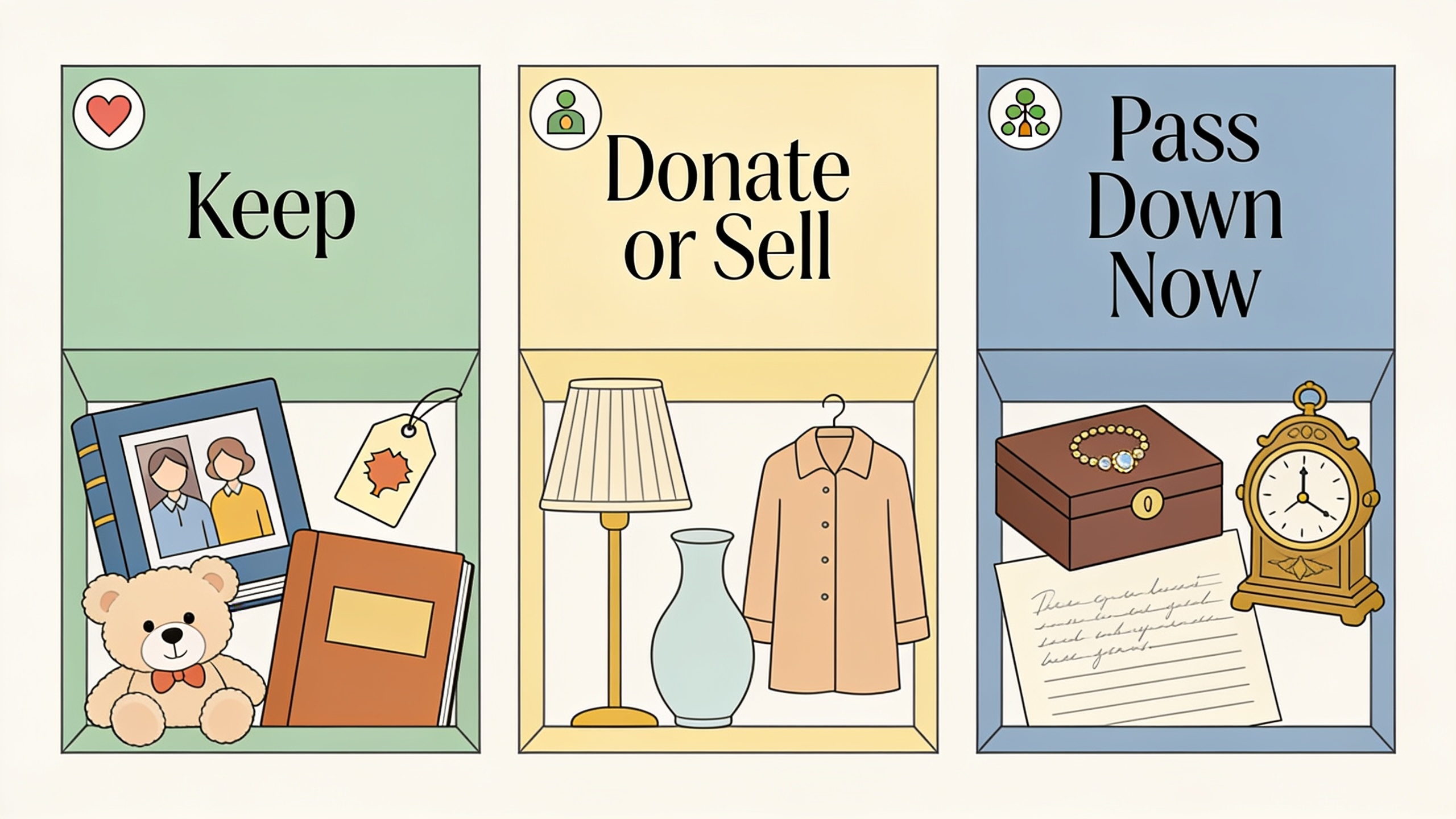
Sorting through decades of stuff is exhausting, and not just physically. One approach that works well is the three-box method: keep, donate-or-sell, and pass-down-now. That last one matters more than people think. Give the heirlooms to your kids while you’re around to see them enjoyed, rather than boxing everything up “for later.” The whole point is to break a giant overwhelming task into a bunch of small, doable decisions so you’re not paralyzed halfway through.
Financial Benefits and Considerations
Downsizing usually gets pitched as a money move, and fair enough, the numbers can look great. But you’ve got to see the full picture, not just the sale price flashing in your head.
Where the Money Goes
When you sell a big house and buy something smaller, that price difference isn’t free money landing in your lap. A bunch of costs nibble away at it. Here’s a rough breakdown of what actually moves the needle:
| Factor | Impact on Finances |
|---|---|
| Home sale proceeds | Often the largest source of new capital, but taxes and selling costs (typically 6-10% of sale price) reduce the net amount |
| New home purchase price | Even a modest condo or cottage can cost $200,000–$500,000+ depending on location |
| Property tax changes | Some states offer senior exemptions; others may increase taxes if moving to a more desirable area |
| HOA or condo fees | Common in smaller communities and can range from $150 to $800+ per month |
| Moving and renovation costs | Often underestimated; can run $5,000–$20,000 depending on distance and needed updates |
| Ongoing maintenance savings | Smaller homes typically cut utility and upkeep costs by 20-40% |
Tax Implications
In the US, you can usually exclude up to $250,000 in capital gains if you’re single, or $500,000 if you’re married filing jointly, from the sale of your primary residence. Catch is, you need to have lived there for at least two of the last five years. For anyone who’s owned their home for decades and watched it balloon in value, that exclusion is a big deal. It can be the difference between a tidy windfall and an unpleasant tax bill.
Using Proceeds Wisely
Don’t blow it all at once. I know, easier said than done when there’s suddenly a chunk of cash sitting there. But most advisors will tell you to spread it out. People typically put it toward paying off any remaining mortgage, topping up an emergency fund, buying income-generating assets, covering future healthcare or long-term care, or funding the fun stuff (travel, hobbies) without raiding their retirement accounts.
If you’re not sure how to line all this up, a financial planner is worth every penny. It also doesn’t hurt to poke around knowledge-sharing communities like Qastme, where regular people swap real retirement-planning stories and you get perspective from folks who’ve actually lived through it, not just read about it.
Choosing the Right Type of Home
There’s no single “retiree house.” What’s right for you depends on what you actually care about. Being near family, climate, healthcare, the kind of daily life you want. All of it matters.
Condos and townhomes are popular for a reason: the HOA handles the landscaping, the roof, the snow. You’re basically outsourcing all the chores you’re sick of. The trade-off is the monthly fee and less say over shared spaces. Then you’ve got single-level homes, which a lot of people go for specifically to dodge stairs down the road. Smart move, but be warned, they’re in high demand and often come with a price bump in the good areas.
55+ active adult communities are their own thing. Pools, fitness centers, social clubs, the works. If you’re moving away from a long-established friend group, that built-in social scene can be a lifesaver, because making friends at 70 in a strange town is harder than anyone admits.
And then there’s my favorite quiet trend: people flipping the whole model. Instead of hanging onto the vacation home as a second property, they sell the family house and just move into the vacation spot full-time. This can be genuinely wonderful, but only if the place actually works year-round. Check that it’s not a ghost town in February and that there’s real healthcare nearby, not just a tourist strip that shutters after Labor Day.
Whatever you pick, think about your actual day-to-day there. The little routines matter more than you’d guess. Some retirees moving to smaller coastal or desert towns look up local spots for things like tanning, say Tantopia, because keeping familiar small pleasures alive is one of the fastest ways to make a new place feel like home instead of a hotel you’re stuck in.
Timing Your Downsizing Move
There’s no magic age. But there are smarter windows, and it’s worth thinking about which one fits you.
Doing it before you retire means you can lean on your paycheck to absorb moving costs and renovations. Doing it after gives you all the time in the world, but you’re budgeting on a fixed income, so you’ve got to be careful. Neither is wrong, they just have different pressures.
Market timing is real, too. Real estate goes up and down, and when you sell can genuinely affect your take-home. Spring and early summer usually bring out more buyers in most US markets, which tends to mean better offers. That said, don’t lose your mind chasing the “perfect” market. A slightly softer sale price is almost always worth it if the timing lines up with when you’re actually ready to move, emotionally and logistically.
And here’s the one people ignore until it’s too late: your health. Wait too long and a move can turn from “exciting project” into “urgent scramble.” If mobility or health takes an unexpected turn, suddenly you’re rushing, and rushing this stuff is miserable. Most retirement counselors say the same thing, make the call while you’re still spry enough to handle the logistics yourself, rather than waiting until circumstances force your hand.
Practical Steps for a Smooth Transition
Once you’ve decided to actually do this, chopping it into stages keeps it from swallowing you whole.
Start by getting a realistic sense of what your current home is worth. Talk to a local agent, or dig into updated listings and estimates on platforms like viviendalist.co, so you’re working with real numbers instead of what your neighbor swears he sold his place for.
Then build a downsizing budget. And be honest with yourself here. Factor in moving costs, renovations on the new place, agent commissions, and closing costs on both transactions. That last part sneaks up on people.

Decluttering should start months out, not weeks. Do one room at a time so you don’t burn out, and hand meaningful things to family members now so they get used instead of gathering dust in a box. As for scoping out neighborhoods, don’t just do the one polished afternoon visit. Go back at different times, weekdays and weekends, morning and evening. Check the grocery stores, the medical facilities, the restaurants. Honestly, grabbing a meal somewhere local like Suysmexicanrestaurant1 tells you more about whether a neighborhood fits your vibe than any brochure ever will.
A couple of final things. Book your movers early, especially in peak season (late spring through summer), and consider a staging service if you’re selling a bigger home. It genuinely pulls stronger offers. And when you set up the new place, resist the urge to just recreate the old layout. This is your chance to design for the life you have now. Fewer unused guest rooms, smarter storage, better lighting for reading. Build the space around how you actually live.
Common Mistakes to Avoid
Even careful people trip over the same few things. The biggest one is underestimating the emotional pull of your stuff, then rushing the decluttering and regretting what you tossed. Slow down on that.
Buying too small is another classic. Some folks downsize so aggressively they leave no room for hobbies, guests, or a home office, and then they’re moving again three years later. Related to that: ignoring future mobility. That charming two-story cottage might be a nightmare in a decade, so think about aging-in-place features like walk-in showers and minimal stairs before you fall in love with the staircase.
Two more that bite people. First, glossing over HOA rules and fees, because some communities have surprisingly strict restrictions on renovations, pets, or rentals, and you don’t want to find out after you’ve signed. And second, skipping the tax professional. Capital gains exclusions, state-to-state tax differences, retirement account withdrawals, they all tangle together in ways that are honestly worth paying an expert to untangle for you.
FAQ: Downsizing for Retirement
Is downsizing for retirement always the smartest financial move?
Nope, not always. A lot of retirees come out ahead thanks to lower maintenance costs and freed-up equity, but it really depends on your local market, the gap between your old and new home prices, and ongoing costs like HOA fees. Run the numbers with a financial advisor before you commit. Seriously.
What’s the ideal home size for retirees?
There’s no magic number. That said, a lot of people land on one or two bedrooms plus a flexible room, something that can flip between guest space, hobby room, or home office. You want to cut the wasted square footage without giving up comfort.
How do I decide what to keep when downsizing?
Keep the stuff you actually use and the stuff that genuinely means something to you. Pass heirlooms to family now rather than hoarding them “for later.” And a warning: storage units are almost never the answer. They just become a monthly bill for things you’ll never look at again.
Should I downsize before or after selling my current home?
Ideally, line up your new place, or at least a solid plan, before you sell, so you’re not stuck between houses. If the two transactions won’t quite sync up, bridge loans or a short-term rental can bridge the gap.
Can downsizing help with retirement income, not just savings?
It can, yeah. Some people downsize specifically to slash their monthly expenses, which is basically the same as giving themselves a raise in disposable income. Lower utility bills, smaller property taxes, cheaper insurance, it all adds up to real money every month.
At the end of it, downsizing is a deeply personal call that mashes together hard financial strategy and genuine emotional work. There’s no one right way. Some people cross the country to be near the grandkids. Others just swap a big suburban house for an easy condo a few miles away. What actually matters is giving yourself time to sit with the emotional side, being honest about the numbers, and picking a place that fits the life you want, not the one you’re leaving. And if you’re ready to start seeing what’s actually out there, browsing current listings on viviendalist.co is a solid way to get a feel for what’s realistic in your area and budget.
Leave a Reply