
Buying a home costs way more than the number you see on the listing. And a lot of first-time buyers don’t find that out until they’re staring at a settlement statement wondering where an extra ten grand came from. This guide walks through the fees, taxes, and prepaid stuff you’ll need to have ready before you sign anything. Doesn’t matter if you’re a first-timer chasing a downtown condo, an investor closing on a rental, or a family trading up to more square footage in the suburbs. Knowing these numbers ahead of time is the difference between a smooth closing and an awkward scramble.
So how much are we talking? Closing costs usually run 2% to 5% of the loan amount, per the Consumer Financial Protection Bureau. On a $350,000 home, that’s anywhere from $7,000 to $17,500 in extra fees. Yeah, that’s a huge range. Where you actually land depends on your loan type, your state, your lender, and frankly, how much haggling you’re willing to do.
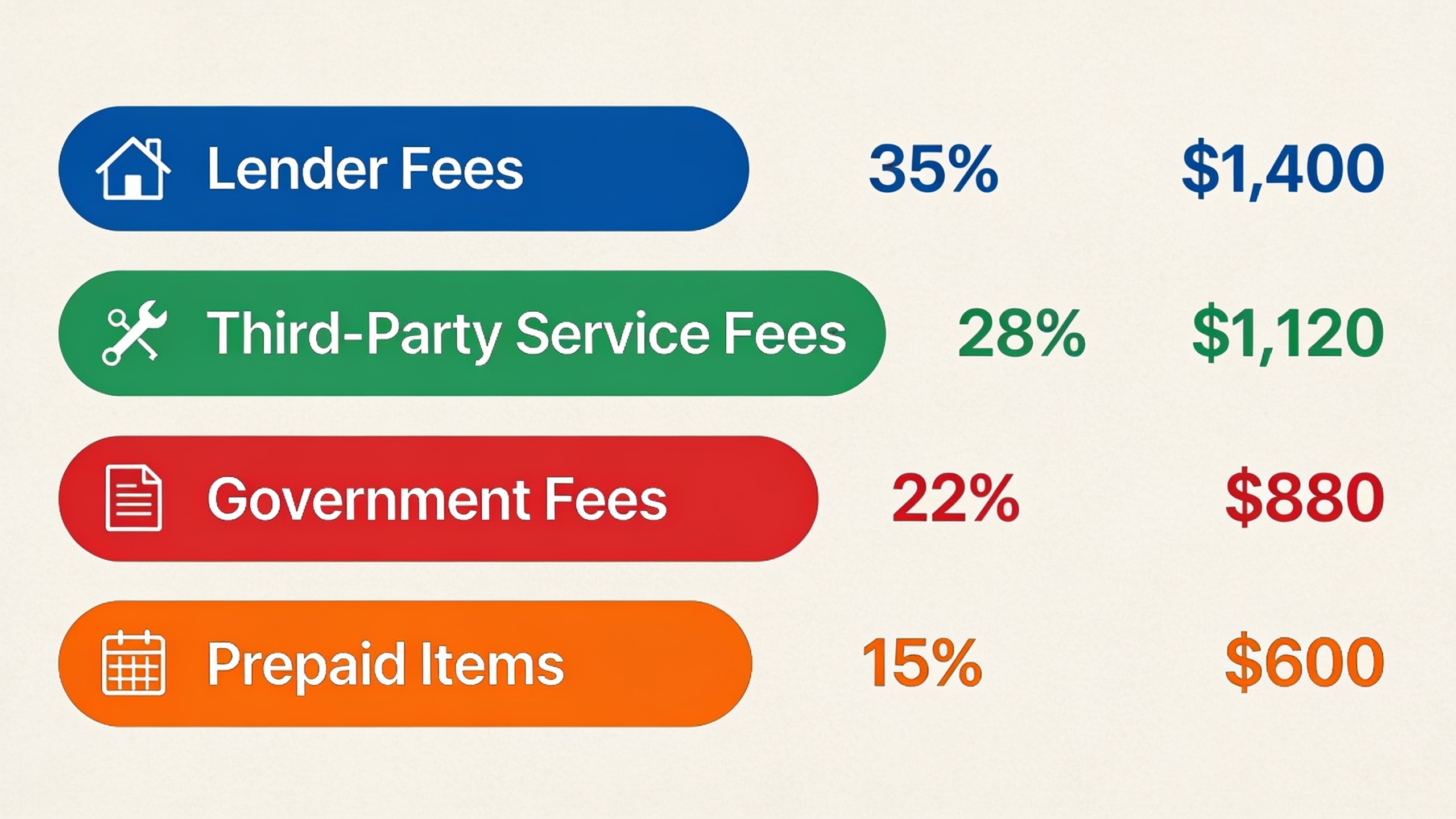
Table of Contents
- What Are Closing Costs, Exactly?
- The Main Categories, Broken Down
- Who Pays What? Buyer vs. Seller
- How Much Should You Actually Budget?
- How to Estimate Your Costs Before You Buy
- Ways to Knock Down Your Costs
- Closing Costs by Loan Type
- Frequently Asked Questions
What Are Closing Costs, Exactly?
Closing costs are the fees and prepaid expenses needed to finalize a real estate deal, and they’re completely separate from your down payment and the home’s price. Think of them as the cost of all the administrative, legal, and financial machinery that has to grind through before ownership actually changes hands.
You pay them at “closing,” which is the final step where the property officially becomes yours and money moves around. Now, here’s where people trip up: closing costs are NOT your down payment. Your down payment is the equity you’re putting into the house itself. A lot of first-time buyers mash the two together in their heads and show up underfunded when it’s time to sign, which is one of the messier mistakes we get into over in our piece on 5 First-Time Home Buyer Mistakes (And How to Avoid Them).
The good news is you won’t be flying blind. Federal law makes lenders show their hand early. You’ll get a Loan Estimate within three business days of applying for your mortgage, and a Closing Disclosure at least three business days before closing, thanks to the Consumer Financial Protection Bureau’s TILA-RESPA Integrated Disclosure rule. My honest advice? Sit down and compare those two documents line by line. It’s boring. Do it anyway. Any sneaky last-minute fee bumps will jump right out at you.
The Main Categories, Broken Down
Closing costs sort into four rough buckets: lender fees, third-party service fees, government fees, and prepaid items. Once you see how they split up, that scary total dollar figure gets a lot less scary.
Lender Fees
These are the charges your mortgage company slaps on for processing, underwriting, and originating your loan. The big ones you’ll see are the origination fee (usually 0.5% to 1% of the loan, just for handling your application), the underwriting fee (they’re verifying your income, assets, and whether you actually pay your bills), and sometimes a flat application fee just to submit your paperwork. Some lenders love that one.
Then there are discount points, which are optional. You pay a fee upfront to buy down your interest rate. Each point runs about 1% of the loan and knocks the rate down roughly 0.25%. Whether that’s worth it is a whole separate math problem, and it depends entirely on how long you plan to stick around.
Third-Party Service Fees
This is money that goes to everyone outside the lender who does real work on your deal. The appraisal usually runs $300 to $600 (National Association of Realtors), then you’ve got the home inspection, title search and title insurance, attorney fees in states that require a lawyer at the table, and survey fees if someone needs to confirm exactly where your property lines are.
Government Fees
Your local and state governments want their cut too. Recording fees pay to officially log the deed and mortgage in public records, and transfer taxes kick in whenever ownership changes hands. And these vary wildly. Texas charges no transfer tax at all. Meanwhile Pennsylvania and Delaware can hit you for over 1% combined between state and local rates. Location, location, location, right?
Prepaid Items and Escrow
These aren’t really “fees” so much as bills you’re paying ahead of time. You’ll cover the first year of homeowners insurance, some prepaid property taxes, the mortgage interest that piles up between your closing date and the end of that month, plus an initial deposit into your escrow account. That account is what your lender dips into going forward to pay your taxes and insurance for you.
Who Pays What? Buyer vs. Seller
Buyers and sellers usually split the costs, but the exact breakdown depends on local custom, your loan type, and whatever gets hammered out in the contract. As a rule, buyers eat most of the lender and loan-related fees, while sellers typically pay the real estate commission and, in a lot of markets, the owner’s title insurance and transfer taxes.
Here’s roughly how things shake out, with the giant caveat that every contract is its own animal:
| Cost Item | Typically Paid By | Notes |
|---|---|---|
| Loan origination and underwriting fees | Buyer | Tied directly to the mortgage |
| Appraisal fee | Buyer | Required by the lender |
| Home inspection fee | Buyer | Optional but strongly recommended |
| Lender’s title insurance | Buyer | Protects the lender’s interest |
| Owner’s title insurance | Seller (varies by state) | Protects the buyer’s ownership interest |
| Real estate agent commissions | Seller (historically) | Structures are shifting post-2024 NAR settlement |
| Transfer taxes | Varies by state/local custom | Sometimes split 50/50 |
| Recording fees | Buyer | Small flat fee per document |
| HOA transfer or estoppel fees | Seller or buyer | Depends on local practice and contract |
| Prorated property taxes | Both | Split based on closing date |
Who pays for what is genuinely negotiable, and that’s a lever a lot of buyers forget they’re allowed to pull, especially in a slow market where sellers are sweating a bit. If you want the actual tactics for pushing more of these costs onto the seller, our guide on how to negotiate home price goes way past the sticker price and gets into things like asking for seller-paid closing cost credits.
One more thing worth flagging: the whole commission picture shifted after the National Association of Realtors’ 2024 settlement, which changed how buyer-agent commissions get disclosed and negotiated. In some deals now, buyers may be on the hook for negotiating and paying their own agent directly instead of having it quietly folded into the seller’s side of the deal. So yeah, clear that up with your agent early. Like, first-conversation early.
How Much Should You Actually Budget?
Plan on 2% to 5% of your loan amount, though the real number swings hard depending on your state, loan type, and the price of the place. On a $300,000 mortgage that’s roughly $6,000 to $15,000. On a $500,000 mortgage, you’re looking at more like $10,000 to $25,000.
And location matters more than almost anyone expects. According to data that ClosingCorp (now part of CoreLogic) publishes from time to time, states like New York, Delaware, and Washington D.C. tend to have some of the priciest average closing costs, mostly thanks to steep transfer taxes and title insurance rates. Meanwhile Missouri, Indiana, and Wyoming tend to run cheaper. City buyers, especially the growing crowd going after condos and co-ops, have their own list of extras: move-in deposits, condo questionnaire fees, reserve fund contributions. None of which a single-family buyer ever sees.
Retirees downsizing or grabbing a vacation home should really watch the prepaid escrow numbers, because a second home or vacation property often comes with pricier insurance in flood- or wildfire-prone areas, and that jacks up the escrow deposit you owe at closing. Investors buying rentals, take note too. Plenty of lenders charge fatter origination fees or demand bigger reserves for non-owner-occupied loans, which can bump your closing cost percentage noticeably above what a regular owner-occupied buyer would pay.
How to Estimate Your Costs Before You Buy
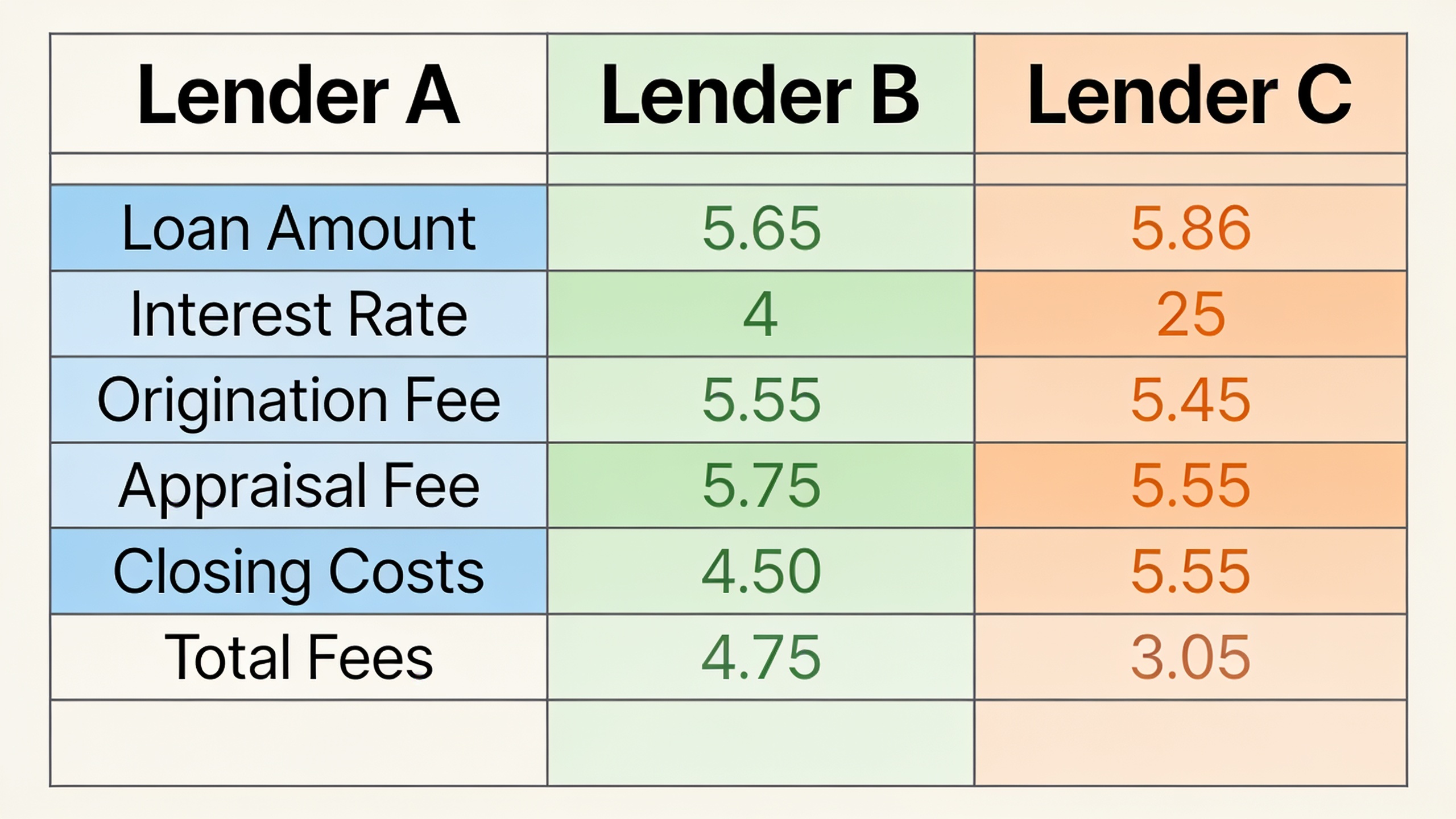
Get Loan Estimates from at least three lenders, then compare the “Loan Costs” and “Other Costs” sections side by side. That document is standardized by federal law, so every lender lays it out the same way. That makes a real apples-to-apples comparison actually possible, which is rare in this business.
Start by getting pre-qualified with a few lenders early, before you’ve fallen in love with a specific house and lost all objectivity. That gives you real numbers instead of national averages that mean nothing for your situation. Then ask your agent for a buyer-adjusted “net sheet” style breakdown. A lot of agents keep spreadsheets from recent local closings, and those beat the pants off generic online calculators. And the second you’re under contract, request a preliminary title report, because title insurance premiums (plus any lurking judgment or lien issues) tend to be one of the bigger, twitchier line items.
Honestly, just build yourself a simple worksheet. Write down your loan amount, multiply it by 2% and by 5% for your range. Add estimated prepaid property taxes (the county assessor’s website has the home’s current tax bill). Add a first-year homeowners insurance quote, and get that BEFORE you’re under contract, not after. Then tack on your state’s transfer taxes, which you can usually dig up on the state department of revenue site. The whole thing takes maybe 20 minutes and gets you way closer to reality than any lazy rule-of-thumb percentage.
And if you’re weighing a few listings across different markets, say a suburban place with good schools against a downtown condo, run this worksheet for each one before you make an offer. You might find the “cheaper” house on paper isn’t actually cheaper to close on, particularly if it sits in a county with brutal transfer taxes or mandatory attorney involvement.
Ways to Knock Down Your Costs
You can shrink your out-of-pocket closing costs by negotiating seller credits, shopping around for lenders, asking about lender credits, and digging into first-time buyer assistance programs. Not one of these means blowing up the deal. They just mean asking the right questions at the right moment.
Seller concessions are the most direct move. In a buyer’s market, it’s totally normal to ask the seller to kick in 2% to 3% of the purchase price toward your closing costs instead of just chopping the sale price. And here’s why that can be smarter: it cuts the cash you need right now, which matters a lot more than shaving a couple grand off a balance you’ll be paying down over 30 years anyway.
Lender credits do something similar but come from the mortgage company. You accept a slightly higher interest rate, and in exchange they hand you cash toward closing. This works if you’re not planning to camp out in the home long enough for that higher rate to cost you more than you saved upfront. Definitely run that breakeven math with your loan officer before you commit.
Don’t sleep on assistance programs either. Tons of states and cities offer down payment and closing cost help for first-time buyers, usually through state Housing Finance Agencies. A lot of them come as forgivable or deferred second loans earmarked specifically for closing costs, and eligibility usually rides on income limits and price caps. Check your state HFA’s website before you assume you’re too “rich” to qualify. The income thresholds are often higher than people think, especially in expensive metros.
Oh, and timing your closing date can quietly save you money too. Because you pay per-diem interest from your closing date through the end of that month, closing early in the month means a bigger prepaid interest charge, while closing late in the month shrinks it. Catch is, closing late also shortens the gap before your first full mortgage payment hits. So it’s a trade-off, not free money.
Closing Costs by Loan Type
Your closing costs shift depending on whether you’re using a conventional, FHA, VA, or USDA loan, mostly because of how each one handles mortgage insurance and government guarantee fees. Here’s the quick comparison:
| Loan Type | Typical Upfront Fee | Ongoing Mortgage Insurance | Best Suited For |
|---|---|---|---|
| Conventional | None mandatory, but PMI applies below 20% down | Private mortgage insurance (PMI), cancellable | Buyers with good credit and 5%+ down |
| FHA | 1.75% upfront mortgage insurance premium | Annual MIP, often for life of loan | Buyers with lower credit scores or smaller down payments |
| VA | Funding fee (varies by service history and down payment) | None | Eligible veterans and active-duty service members |
| USDA | 1% upfront guarantee fee | Annual fee (0.35% of loan balance) | Rural and some suburban buyers meeting income limits |
VA loans, backed by the U.S. Department of Veterans Affairs, also cap certain closing costs and, in some cases, flat-out prohibit veterans from paying specific fees like the appraisal. That’s a big reason people call them the most cost-efficient option out there for those who qualify. FHA loans, insured by the Federal Housing Administration, are easier to get with shakier credit, but the mortgage insurance premiums usually stick around for the life of the loan when your down payment is under 10% (per HUD guidelines). That’s the tradeoff. USDA loans, guaranteed by the U.S. Department of Agriculture, are a solid pick for buyers eyeing eligible rural or suburban areas who want to keep those upfront mortgage insurance costs low.
A Few Final Notes Before You Sit Down at the Closing Table
Read your Closing Disclosure carefully and hold it up against your original Loan Estimate. I’ll say it again because it’s the single best habit a buyer can have in those final days. The fees shouldn’t leap between the two documents. If they do, you’ve got every right to make your lender explain themselves, and in some cases it’s worth delaying to sort out the discrepancy before you sign.
Treat your closing cost homework like you’d treat any big money decision. Just as folks over at Cryptocoinsjournal might pore over market data before dropping cash into crypto, home buyers come out ahead by lining up multiple lender quotes, title company estimates, and insurance quotes side by side before pulling the trigger. A few hours of comparing paperwork can genuinely save you thousands.
And once it’s all signed and you’ve got keys in your hand? Go enjoy it. Plenty of new homeowners mark a closing with a nice dinner out, and if you happen to be up in North Texas, Palate Garden in Saginaw is a favorite for exactly that kind of night. Relaxed dine-in vibe, good for celebrating something big.
If tracking all of this by hand sounds like a headache, well, that’s what a lot of newer platforms are trying to fix. Browsing curated listings and comparing homes side by side on something like Vivienda Lista helps you shortlist properties in a market before you’ve even started collecting Loan Estimates, which saves you time once you’re deep in the comparison weeds. And on the research and content side, tools like RobinRank show how even dense, detail-heavy stuff (like breaking down closing costs across loan types and states) can get organized and published without losing accuracy, which is honestly part of why a guide like this can stay current as the rules and averages keep shifting.
Frequently Asked Questions
Wait, are closing costs the same thing as my down payment?
Nope, totally separate. The down payment is the chunk of the purchase price you’re not financing, while closing costs are the fees for services, taxes, and prepaid items needed to finish the deal. Both are due at closing, but you budget for them independently.
Can I just roll closing costs into the mortgage?
Usually not on a conventional purchase. In most cases you’ve got to pay closing costs in cash at the table, and you can’t just tack them onto the loan balance, though some lenders allow limited financing of certain costs on refinances. If you’re trying to dodge a big cash hit, seller concessions or lender credits are the way people go. Both shift the cost without piling it onto your principal.
Do closing costs differ between a condo and a single-family home?
Yeah, they do. Condos tack on fees you won’t see with a house, like HOA document review fees, move-in deposits, and lender-required condo questionnaire fees, which can pile a few hundred extra dollars onto your total. Single-family homes, on the flip side, sometimes hit you with higher survey or inspection costs depending on the lot size and the property’s history.
What if I just don’t have enough cash for closing costs?
Don’t panic and don’t walk away yet. You can negotiate seller credits into your offer, ask your lender about a lender credit in exchange for a slightly higher rate, or hunt down state and local first-time buyer programs built specifically to cover closing costs. Bailing on a deal purely over a closing cost shortfall is almost never necessary once you’ve talked through these options with your lender and agent.
How soon before closing will I know exactly what I owe?
Federal rules make lenders hand you a Closing Disclosure at least three business days before your closing date, and that document lists your final, itemized costs. Compare it line by line against your earlier Loan Estimate and flag any surprise jumps with your loan officer right away. There’s still time to ask questions before you sign, so use it.
Look, closing costs are probably the least thrilling part of buying a home. But if you treat them as a real, budgeted line item instead of an afterthought, you walk into closing day in a far stronger spot. Build the worksheet, collect a few competing lender quotes, and don’t be shy about asking for seller credits. Do that and most buyers can sit down at that table with zero surprises and a clear sense of exactly what they’re paying for, and why.
Leave a Reply