
So you’re hunting for a good family suburb this year. Join the club. Between mortgage rates finally chilling out and hybrid work sticking around way longer than anyone predicted, millions of households are rethinking where they want to raise their kids. And the data backs it up: 47% of recent buyers put “quality of the neighborhood” and “convenience to schools” in their top three reasons for buying, according to the National Association of Realtors’ 2024 Profile of Home Buyers and Sellers. That single stat is basically dictating where builders break ground and where families end up planting roots.
What follows is a look at seven kinds of suburbs with real momentum going into 2025. I pulled from school ratings, safety stats, inventory trends, and the boring-but-critical stuff like whether there’s actually a pediatrician within a reasonable drive.
Whether you’re a first-timer finally escaping your downtown apartment, an investor sniffing around for long-term rental demand, or a family that just plain outgrew your square footage, think of this as a real starting point. Not a glossy brochure.
Table of Contents
- What Makes a Suburb Great for Families in 2025?
- Top 7 Suburbs for Families This Year
- How Do These Suburbs Compare?
- What Should Families Prioritize When Choosing a Suburb?
- How Much Does It Cost to Live in These Family-Friendly Neighborhoods?
- Tips for Touring and Settling Into a New Suburb
- Frequently Asked Questions
What Makes a Suburb Great for Families in 2025?
The best family suburbs in 2025 tend to share four things: strong public schools, low violent crime, walkable amenities, and enough housing variety that you can actually move up when the family grows. None of this is fluffy or subjective, either. It shows up in the numbers, whether that’s GreatSchools ratings, FBI Uniform Crime Report figures, or a plain old Walk Score.
Here’s what’s genuinely changed in the last two years, though. Families care way more about flexibility now. Since hybrid work isn’t going anywhere, a lot of households have stopped demanding a sub-20-minute commute and will happily settle for something 30 to 45 minutes out from a major job hub, per a 2024 Redfin survey of remote and hybrid workers. That shift alone has cracked open the “second-ring” suburbs, the ones a little farther from downtown, where you get bigger lots and newer builds without the eye-watering prices of the closer-in neighborhoods.
The other thing worth watching? Infrastructure spending. Suburbs that recently added a splash pad, expanded the library, or broke ground on a new elementary school tend to appreciate faster, because builders and buyers read those projects as a town betting on itself. If you’re still torn on whether suburb life beats city life at all, our breakdown of urban vs. suburban living and which fits your lifestyle digs into the tradeoffs a lot deeper.
Top 7 Suburbs for Families This Year
Quick note before we get into it. Specific suburb names change wildly by region, so I’ve grouped these into seven types instead of naming towns you’ve probably never heard of. Think of them as archetypes. The traits I’m describing hold up across most major metros, and they’re all currently beating national averages on schools, crime, price trends, and family stuff like parks and youth sports.
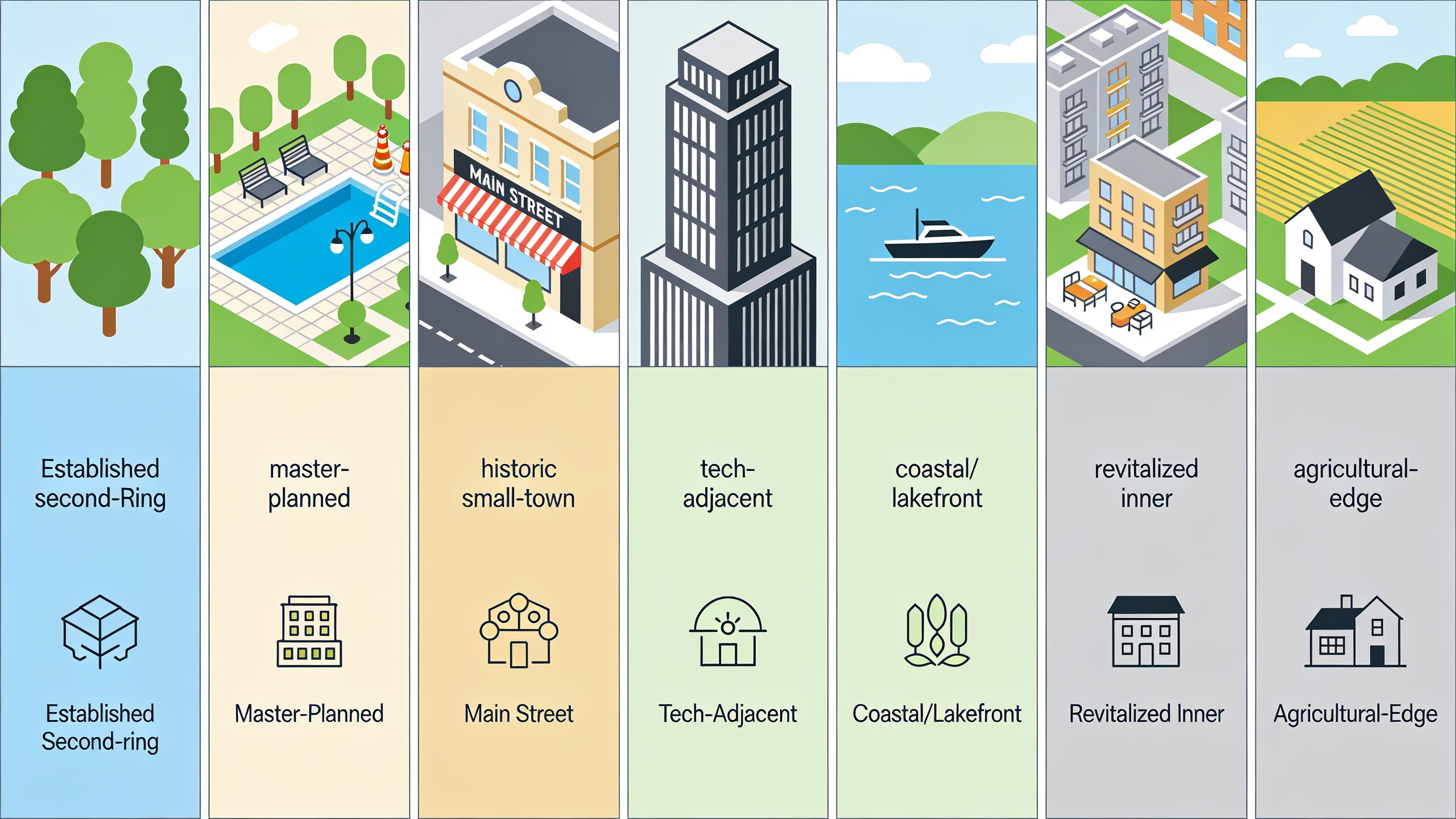
1. The Established Second-Ring Suburb
This is the classic. Usually 20 to 35 minutes from downtown, these places have quietly matured over the last 15 years into family magnets. You’ll find homes built roughly between 2005 and 2015, three to five bedrooms, sitting on lots that average about a quarter-acre, and school districts often posting GreatSchools ratings of 7 out of 10 or higher. What makes them interesting in 2025 is inventory. Unlike the older first-ring suburbs where everything’s a resale, these still get the occasional new-construction release, which means you’ve got a bit more room to negotiate on price and finishes.
2. The Master-Planned Community
Then you’ve got the master-planned communities, the ones built around some central attraction like a lake, a golf course, or a giant rec center. Families love these for the built-in social infrastructure. There’s usually an HOA maintaining the shared pools, tennis courts, and walking trails, which honestly is a huge deal for parents who want cheap, supervised stuff for the kids within walking distance. The catch is the fees. In 2025 those HOA dues run somewhere between $150 and $450 a month depending on how loaded the amenities are, according to data compiled by the Community Associations Institute.
3. The Historic Small-Town Suburb
Not every great family suburb is shiny and new. Some of the most sought-after ones are old small towns that got swallowed by a growing metro decades ago but kept their walkable downtowns. Picture a real Main Street with local shops, a farmers market on Saturday, and an elementary school most kids can bike to. The downside is the age of the housing. Older homes mean you’re budgeting for updates, and this is exactly where a solid local contractor earns their keep. Companies like Dmplumbingheating are a good example of the plumbing and heating help families end up needing when they’re dragging a decades-old house into the modern era.
4. The Tech-Adjacent Growth Corridor
Suburbs sitting near booming tech or healthcare corridors have seen some of the fastest population growth in the whole country. Zillow’s 2024 migration data flagged a bunch of metro-adjacent suburbs near biotech and logistics hubs as top landing spots for buyers fleeing pricey coastal cities. These areas usually come with newer schools, higher per-pupil funding, and a younger crowd, which is catnip for families in their 30s and early 40s still climbing the career ladder.
5. The Coastal or Lakefront Suburb
If your family basically lives outdoors, coastal and lakefront suburbs stay popular year after year, even with flood insurance getting more expensive. You’ll often find strong elementary schools paired with youth sailing, swim, or rowing programs, and they hold their value well because, well, they’re not making more waterfront lots. Just go in clear-eyed about the higher insurance and maintenance. Run a real cost comparison against inland options before you fall in love with a dock.
6. The Revitalized Inner Suburb
Some inner suburbs, the ones right up against the urban core rather than way out, have had a real glow-up over the past five to eight years. Older houses renovated or torn down and rebuilt, new mixed-use retail popping in. These are for families who want suburban square footage but refuse to give up walking to dinner or hopping on transit. If you’re stuck deciding between a compact urban condo and more room in one of these transitional neighborhoods, our guide on condo versus single-family home living can help you figure out what actually fits your household.
7. The Agricultural-Edge Suburb
Way out on the metro fringe, old farmland is getting carved into new subdivisions. These offer the biggest lots and the newest construction on this whole list, frequently 15% to 25% cheaper than comparable homes closer in, per regional MLS data. The trade? Commute time, obviously, and sometimes a stretch where there’s just not much retail or dining while the area fills out. If space and a new-construction warranty matter more to you than walkability, this is your zone.
How Do These Suburbs Compare?
None of these is objectively “the best.” They each serve a different family priority, and the right one depends on your budget, how much commute you can stomach, and what your daily life actually looks like. Here’s the quick-glance version.
| Suburb Type | Typical Commute | Median Home Price Range | Best For | Key Tradeoff |
|---|---|---|---|---|
| Established Second-Ring | 20–35 min | $425,000–$600,000 | Families wanting mature landscaping and strong schools | Limited new construction |
| Master-Planned Community | 25–40 min | $450,000–$700,000 | Families who want built-in amenities and structure | Higher HOA fees |
| Historic Small-Town | 15–30 min | $500,000–$800,000 | Families who value walkability and character | Older homes need updates |
| Tech-Adjacent Growth Corridor | 15–25 min | $550,000–$900,000 | Career-focused families near major employers | Higher price growth, more competition |
| Coastal/Lakefront | 30–50 min | $600,000–$1.2M+ | Outdoor-recreation families | Higher insurance costs |
| Revitalized Inner Suburb | 10–20 min | $500,000–$850,000 | Families wanting space plus walkability | Smaller lots than outer suburbs |
| Agricultural-Edge | 35–55 min | $350,000–$525,000 | Budget-conscious families wanting new builds | Longer commute, developing retail |
What Should Families Prioritize When Choosing a Suburb?
Focus on school district performance, the real commute, and long-term resale value. Not the fresh paint or the trendy backsplash. It’s so easy to get seduced by a perfectly staged model home, but three or four years in, the neighborhood fundamentals are what you’ll actually be living with.
Start with the school data, and I mean actual data. Pull it from GreatSchools or the National Center for Education Statistics, not from an agent waving vaguely at “great schools nearby.” Ratings can swing hard between two elementary schools just a few miles apart in the same district. Then map your commute at rush hour, not the fantasy version your map app shows you at 2pm on a Tuesday. A suburb that reads as 25 minutes on paper can balloon into a 50-minute crawl when everyone’s actually driving.
Safety stats deserve the same scrutiny. The FBI’s annual crime data plus your local police department dashboards will show you three-to-five-year trends instead of one random snapshot, and trends tell you whether a place is getting better or quietly sliding. And finally, think about resale. Suburbs with a healthy mix of starter homes, move-up homes, and bigger executive homes tend to hold value better through a full market cycle, because they can pull in buyers at a bunch of different income levels. A neighborhood stuck at one price tier doesn’t have that cushion.
How Much Does It Cost to Live in These Family-Friendly Neighborhoods?
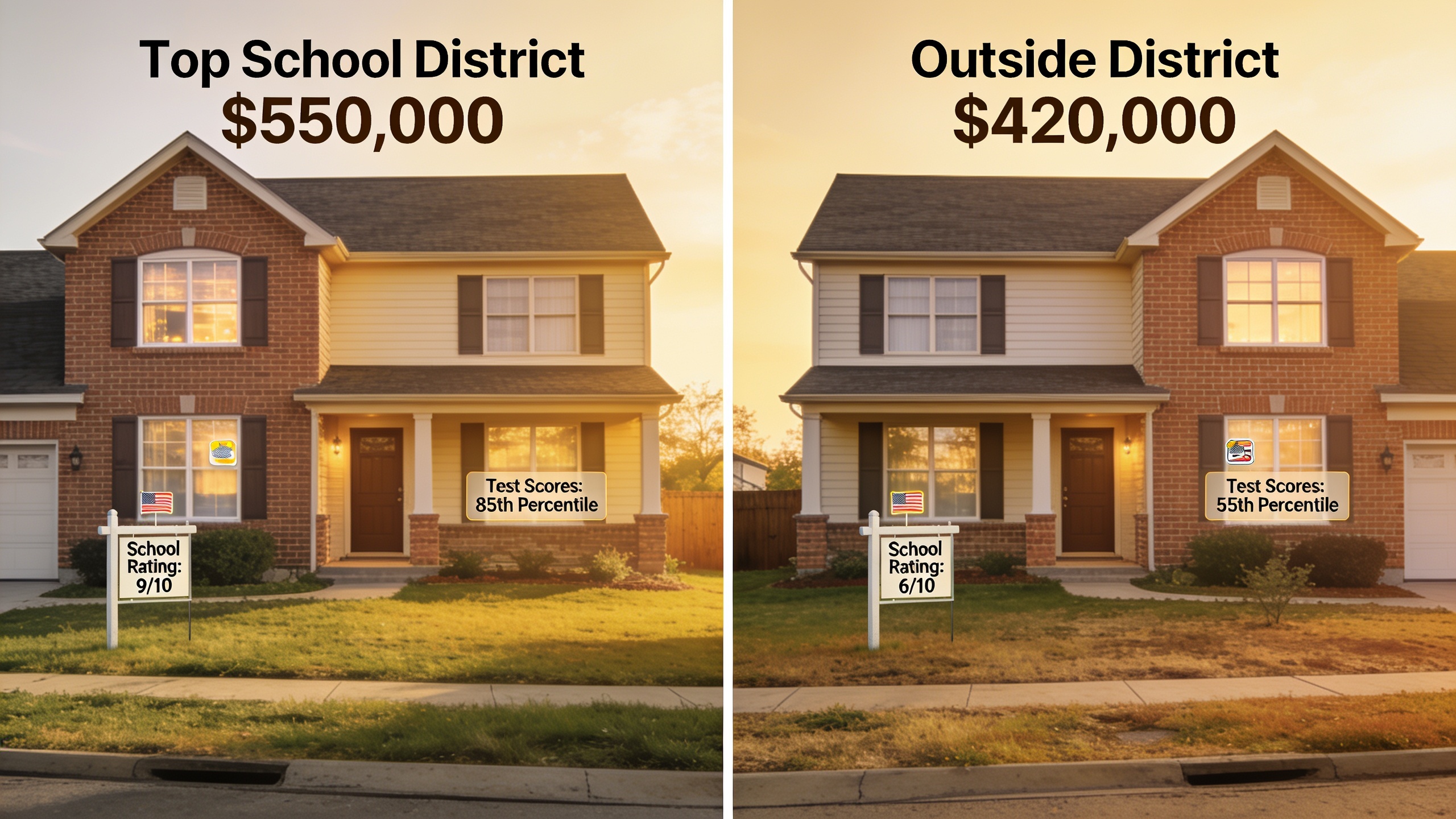
Expect to pay roughly 10% to 30% more than the surrounding metro average in a top family suburb, and it’s mostly the school district reputation and lot size driving that, not the age or size of the house itself. The National Association of Home Builders’ 2024 cost survey found buyers cough up a real, measurable “school district premium” that can tack tens of thousands of dollars onto otherwise identical homes sitting just across a district line. Wild, but true.
And the sticker price is only the start. Property taxes tend to run higher in the best school districts because those local levies are literally funding the schools. HOA fees pile on another recurring cost in master-planned communities, usually $150 to $450 a month like I mentioned. Insurance is all over the map depending on where you land. Coastal and lakefront homes can carry flood premiums that add anywhere from $1,000 to $3,000 or more a year, depending on your flood zone, according to FEMA’s National Flood Insurance Program rate tables.
Oh, and don’t forget the stuff nobody budgets for: the actual move. If you’re relocating a long way, or even internationally for a job, sorting out local transportation ahead of time makes a huge difference. The same way travelers lean on a service like Ricaritranslombok to line up reliable transport and logistics in a place they don’t know, planning that piece early can save you a lot of grief during those first chaotic weeks in a new town.
Tips for Touring and Settling Into a New Suburb
Best way to size up a suburb before you buy? Show up at different times. A weekday morning during school drop-off, a Saturday afternoon at the park, a weeknight commute home. One tidy weekend showing tells you almost nothing. Visiting at odd hours reveals the traffic, the noise, the actual rhythm of the place in ways no listing photo ever will.
Once you’ve got it down to a short list, talk to people who live there. Local parent Facebook groups, neighborhood association meetings, even a chatty barista at the coffee shop, they’ll spill things that never make it into an MLS listing. Stuff like an upcoming school boundary change or a strip mall about to get built behind the elementary school. Some families even start connecting with future neighbors before they move. The way Vidbox works as a social and community platform where people connect, swap info, and browse local marketplace listings, plenty of suburbs now have their own apps or forums (Nextdoor being the obvious one) that are worth joining early.
After you’ve actually moved in, give it a real six months before you decide whether the place is home. Sign the kid up for a youth sports league, hit a school open house, show up for a community cleanup. Those little commitments are what turn a “great suburb on paper” into somewhere you actually belong. And if you’re on the professional side of this, an agent or investor trying to spot trending suburbs before the public data catches up, tools like RobinRank can help you surface and publish localized market content faster, which is a real edge when you’re trying to catch an emerging family-friendly neighborhood before prices fully reflect it.
Frequently Asked Questions
Okay, so what actually are the best suburbs for families in 2025?
They mostly fall into a handful of buckets: established second-ring suburbs with mature schools, master-planned communities loaded with amenities, revitalized inner suburbs where you can still walk places, and those fast-growing tech-adjacent corridors near big employers. Which one’s right for you comes down to your budget, how far you’re willing to commute, and whether you’d rather have new construction or a place with some history and character.
How do I know if a suburb’s schools are actually any good?
Skip the agent’s “great schools!” line and go straight to the independent sources: GreatSchools.org, the National Center for Education Statistics, and your state’s department of education report cards. Look at multi-year trends in test scores, grad rates, and student-teacher ratios. And triple-check exactly which elementary, middle, and high schools serve the specific address you’re eyeing, because attendance zones can literally change from one block to the next.
Is buying in an HOA neighborhood worth it?
Depends what you want. HOAs keep up the shared pools, parks, and landscaping, and that consistent upkeep can genuinely protect your property value. But you’re paying $150 to $450 a month for the privilege, plus living with rules about what you can do to your own house. Families who like structure and shared amenities usually think it’s worth it. Folks who want total control over their property? Probably not.
How much more do homes in top school districts really cost?
There’s a measurable premium compared to similar homes just outside the district line, according to National Association of Home Builders survey data from 2024. How big that premium gets depends heavily on the metro, ranging from a modest bump to a serious percentage jump. So before you assume a district’s reputation alone justifies the price, compare a couple of comparable homes on either side of that boundary. The numbers might surprise you.
Closer to the city or farther out for more space?
It’s really just how you weigh commute against size and price. Revitalized inner suburbs get you shorter commutes and walkability but smaller lots and a higher price per square foot. Agricultural-edge suburbs flip that: way more space and newer builds for less money, as long as you can live with the drive. Our comparison of urban vs. suburban living can help you think through which tradeoff actually fits your day-to-day.
Bottom line, picking a family suburb in 2025 is about matching a place’s real strengths to your family’s real life, not falling for how good it looks in the listing photos. Visit at weird hours, dig into the actual school and crime numbers, and talk to people who already live there. Do that, and you’ll have a much clearer read on whether a neighborhood is genuinely a long-term home or just a pretty face.
Leave a Reply