
This might be the single biggest lifestyle call you’ll make in retirement, and it touches everything. Your monthly costs, sure. But also how often you’ll actually see your grandkids, whether you’ll have a built-in bridge club or have to go build one yourself, and how much of your Saturday gets eaten by yard work.
The short version? An age-restricted community hands you social structure, low-maintenance living, and a bunch of curated amenities on a silver platter. A regular neighborhood gives you more freedom, a wider mix of neighbors, and usually smaller ongoing fees. Neither one wins across the board. It really does come down to your health, your budget, how social you are, and how close you want to be to family.
So let’s actually get into the real differences, the ones nobody tells you at the open house.
Table of Contents
- What Is a 55+ Community, Exactly?
- 55+ Communities vs. Neighborhoods: Key Differences at a Glance
- Amenities and Lifestyle: What You Actually Get
- Social Life and Community: Which Setting Fits Your Personality?
- How Much Does It Cost to Live in a 55+ Community vs. a Standard Neighborhood?
- Health, Safety, and Long-Term Considerations
- Resale Value and Real Estate Investment Potential
- How to Decide: A Practical Retirement Community Comparison Checklist
What Is a 55+ Community, Exactly?
A 55+ community (you’ll also hear “age-restricted” or “active adult” community) is a residential development where at least 80% of occupied homes have to include at least one resident aged 55 or older. That rule comes from the Housing for Older Persons Act of 1995, and it’s the federal exemption that lets these places legally restrict who lives there by age. A normal neighborhood can’t do that.
But the range here is wild. Some are tiny gated spots with maybe 100 homes and a single clubhouse. Others, like The Villages in Florida, sprawl across tens of thousands of homes with golf courses, town squares, and their own bus system. It’s basically a small city that happens to have a minimum age. According to the U.S. Census Bureau’s 2021 American Housing Survey, roughly 3.6 million U.S. households reported living in age-restricted communities, and that number’s been climbing steadily as boomers retire. The homes are usually single-story and low-maintenance, and a lot of them are built with wider doorways and step-free entries. Basically, they’re designed with your future knees in mind.
A standard neighborhood is just… a neighborhood. No age rules. You’ve got families, young professionals, and retirees all mixed together. No HOA-mandated activity calendar, no age-verification paperwork, just an ordinary residential area with regular zoning and maybe a voluntary homeowners association if you’re unlucky.
55+ Communities vs. Neighborhoods: Key Differences at a Glance
The quickest way to get your head around this is to line them up side by side on the stuff retirees actually care about: cost, maintenance, social life, and flexibility. Broadly, age-restricted communities win on convenience and instant social life. Standard neighborhoods win on affordability, resale flexibility, and being closer to the messy, wonderful chaos of multigenerational family life.
| Factor | 55+ Community | Standard Neighborhood |
|---|---|---|
| Monthly HOA fees | Typically $200–$800+, often covers lawn care, amenities, and sometimes exterior maintenance | Often $0–$150, or none at all outside a voluntary HOA |
| Home maintenance | Largely handled by community management (landscaping, exterior repairs in many cases) | Owner is fully responsible for all upkeep |
| Social structure | Built-in clubs, events, and activity calendars organized by staff | Informal; depends on personal effort and existing relationships |
| Age diversity | Restricted, at least 80% of units require a resident 55+ | Fully mixed ages, families, young professionals, retirees |
| Resale pool | Smaller, limited to buyers 55+ (or households meeting HOPA rules) | Larger, open to any buyer demographic |
| Proximity to grandkids/family | Often farther from schools and family-oriented suburbs | Frequently closer to family-friendly suburbs |
| Healthcare access on-site | Some communities offer wellness centers or partnerships with home health services | Rare, relies on nearby hospitals and clinics |
| Typical home style | Single-story, low-maintenance, often smaller footprint | Wide range, including multi-story homes and larger lots |
That table doesn’t cover everything, but it explains why so many people agonize over this. If you want low-maintenance living and an instant social circle, the 55+ model pulls at you. If you want to stay planted in a diverse, mixed-age area, a regular neighborhood usually feels more like home.
Amenities and Lifestyle: What You Actually Get
Age-restricted communities generally give you more centralized, resort-style amenities than a standard neighborhood does. The catch? You pay for all of it through your HOA dues whether you ever set foot in the pool or not. Standard neighborhoods lean on public or nearby private facilities, so you get more variety but way less consistency.
The Amenity Buffet in 55+ Communities
Most of these communities are built around a central clubhouse or “lifestyle center.” You’ll usually find swimming pools, fitness centers set up for low-impact stuff, pickleball and bocce courts, craft rooms, card rooms, and an actual on-staff event coordinator who plans everything from wine tastings to day trips. The bigger places throw in golf courses, marinas, sometimes even on-site medical offices. And because it’s all funded collectively, it tends to be well-kept and reliably open, which is a genuine draw if you hate the idea of juggling a separate gym membership plus country club dues plus whatever else.
What You Get in a Standard Neighborhood
In a regular neighborhood, your amenities are whatever happens to be nearby. Maybe you’re a short walk from a great public library, a YMCA, a farmers market, or a solid school district. But nobody’s curating your social calendar. And honestly, that’s a pro or a con depending entirely on who you are. You get total freedom to pick your own gym, church, or hobby group. You also have to go build that network from scratch instead of having it handed to you the day you move in.
If you’re still figuring out whether a dedicated retirement property or a more flexible second home makes more sense for where you are in life, it’s worth reading a deeper look at a vacation home versus a retirement home, which digs into how your lifestyle goals should drive the kind of property you buy, not just the neighborhood type.
Social Life and Community: Which Setting Fits Your Personality?
If you want an active, ready-made social calendar, 55+ communities are hard to beat. If you’d rather have relationships that stretch across age groups, standard neighborhoods usually feel better. And I’d argue this is the single most important factor in the whole decision. More than square footage. More than price, even.
Why Built-In Community Matters More Than You’d Think
Loneliness in older adults isn’t just sad, it’s a genuine health risk. The National Institute on Aging has noted that social isolation is associated with an increased risk of health problems in seniors. 55+ communities are basically engineered to fight that, putting similarly-aged, like-minded neighbors within arm’s reach and stacking the calendar with dozens of activities a month. For someone who recently lost a spouse, moved far from lifelong friends, or just doesn’t know how to meet people at this stage, that structure can be genuinely life-changing. There are clubs for everything. Woodworking, mahjong, travel groups, you name it. New residents almost never have to search hard for their people.

The Case for a Mixed-Age Street
But some retirees don’t want that at all. They want younger neighbors, kids playing outside, the ordinary hum of a mixed-age block. Age segregation just isn’t for everybody, and I’ve heard more than a few people describe feeling “boxed in” by an all-senior environment after a couple of years. Standard neighborhoods also make it a lot easier to stay near adult kids and grandchildren if they’ve settled in family-oriented suburbs, since those areas almost never overlap with age-restricted zoning.
And here’s something people forget: a lot of retirees today aren’t fully retired. Plenty pick up part-time consulting, seasonal work, or launch some little venture to stay engaged and pad the income. If that’s part of your plan, living in a standard neighborhood closer to commercial hubs, or even poking around part-time openings on a site like Jobwatch, makes continued work a lot more practical than being tucked away in a remote, purely residential 55+ development.
Staying connected doesn’t have to mean in-person clubs, either. A lot of retirees round out their local social life with online communities and forums where they swap hobbies, ask questions, or even dabble in a small side business. Platforms like Vidbox have social and marketplace features that some folks use to stay engaged digitally alongside whatever they’ve got going on in the real world.
How Much Does It Cost to Live in a 55+ Community vs. a Standard Neighborhood?
On average, 55+ communities cost more per month once you fold in the HOA dues, even though the base home price can be similar or occasionally lower thanks to the smaller footprint. What that extra money buys is convenience: landscaping, amenity access, and often exterior maintenance that homeowners in standard neighborhoods have to pay for separately, out of their own pocket, on their own time.
Breaking Down the Real Numbers
In a typical 55+ community, HOA fees usually run somewhere between $200 and $800 a month depending on how loaded the amenities are, based on figures widely reported by national real estate associations and community developers. That fee often bundles in lawn care, trash service, common-area insurance, and access to the clubhouse and pools. In a standard neighborhood, unless there’s a voluntary HOA (usually $0 to $150 a month for basic upkeep of shared spaces), you’re on the hook for your own lawn, your own repairs, your own everything, either with your hands or your wallet.
Home prices themselves swing more by region than by community type. But 55+ homes skew smaller on average, often single-story two-bedrooms, so the price per square foot can look better even when the total price lands right next to a comparable neighborhood home. Property taxes, by the way, don’t care whether a community is age-restricted. They just track local assessment rates.
The Costs Nobody Warns You About
There are two hidden expenses that sneak up on people. First, special assessments. If a 55+ community needs to repave its roads or slap a new roof on the clubhouse, residents can get hit with a one-time fee on top of the regular dues. That can sting. Second, resale friction. Since 55+ homes can only be sold to buyers who meet HOPA’s age rules, the buyer pool is smaller, which sometimes means the home sits longer or you end up negotiating harder than you would on a standard-neighborhood house that literally anyone can buy.
For retirees who are also eyeing their property as an income source, whether that’s renting out a former home or picking up a small rental unit, it pays to run the numbers carefully. The ultimate checklist for comparing rental investment properties is genuinely handy if you’re planning to hang onto a previous home as a rental while you downsize into a 55+ community or a smaller neighborhood house.
Health, Safety, and Long-Term Considerations
55+ communities are generally built with aging in mind: single-story layouts, wider hallways, sometimes on-site wellness services. Standard neighborhoods are all over the map on accessibility depending on how old the housing is. If you’re over 70, this part should carry serious weight in your decision. Maybe more than anything else.
The Accessibility Stuff That’s Already Built In
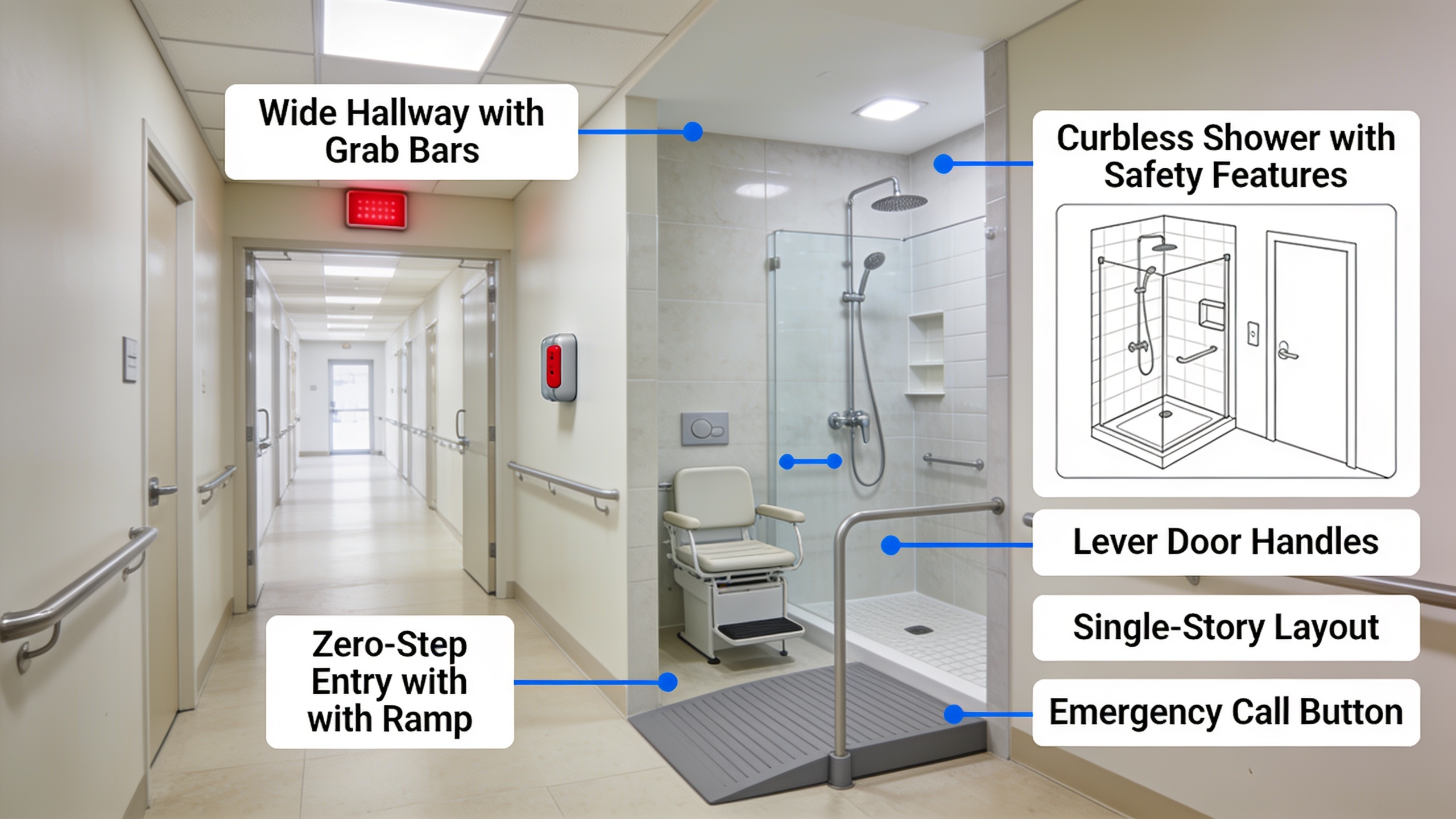
A lot of 55+ homes come with zero-step entries, lever door handles, curbless showers, and single-level floor plans as standard features, not expensive retrofits you’ll be paying for later. Some communities also have security patrols, gated entries, and emergency call systems wired straight into the clubhouse or management office. If you’re managing a chronic condition or dealing with mobility limits, those features quietly cut down on daily friction and fall risk in a way that’s easy to underestimate until you need it.
What You’d Have to Handle Yourself
Standard neighborhoods don’t guarantee any of that. But they’re not inherently unsafe, either. Tons of suburban neighborhoods sit close to hospitals, urgent care, and established home health agencies, and you can always retrofit a home with grab bars, ramps, or a walk-in tub when the time comes. The tradeoff is that all of that is on you, financially and logistically, whereas in a 55+ community a chunk of it is baked into the original build and the shared infrastructure.
One thing I’d push back on: don’t just assume the community type tells you how safe you are. Check emergency response time and proximity to major medical centers block by block. A well-located standard neighborhood five minutes from a hospital can honestly be a safer bet than a 55+ community that’s 40 minutes from the nearest ER.
Resale Value and Real Estate Investment Potential
Homes in standard neighborhoods generally have broader resale appeal because literally anyone can buy them, while 55+ community homes are legally limited to households meeting HOPA’s age threshold, which shrinks the buyer pool and can affect how fast a home moves. This matters even if you’re not planning to move again anytime soon, because life has a way of changing your plans, and flexibility has real financial value.
That said, well-run 55+ communities in the sunbelt, think parts of Florida, Arizona, and the Carolinas, have historically held their value nicely thanks to steady demand from the huge and still-growing wave of retiring boomers. Communities with good reputations, active amenity programs, and financially healthy HOAs tend to resell faster than the ones with deferred maintenance or an association that’s quietly broke. Before you buy, look at the HOA’s reserve fund and recent meeting minutes. Most listing platforms and agents can help you get your hands on that.
If you’re comparing a bunch of properties across both community types, using a platform that lets you filter, compare, and size up listings side by side saves you a ridiculous amount of time. Vivienda Lista has curated property listings and comparison tools that make it easier to weigh a 55+ unit against a comparable neighborhood home without juggling five different tabs. That’s especially useful if you’re relocating to a city or state you don’t know, where you can’t just lean on local market knowledge you don’t have yet.
Oh, and one more thing worth knowing: real estate marketing has changed a lot. Plenty of 55+ developers and neighborhood HOAs now lean on digital content and search visibility to reach buyers, using tools like RobinRank to run their SEO content and community outreach. Which is part of why you can now find so much searchable comparison content, reviews, and virtual tours before you ever set foot on the property.
How to Decide: A Practical Retirement Community Comparison Checklist
The smartest way to choose is to honestly score your own priorities instead of leaning on a single visit or your neighbor’s glowing review. This turns a fuzzy, emotional decision into a structured one, which is exactly what you want when there’s this much money and this much life on the line.
Questions to Ask Yourself First
Rank these in order of what actually matters to you: proximity to family, monthly budget flexibility, appetite for organized social activities, tolerance for HOA rules, your health and mobility needs over the next decade, and whether you want to keep working part-time or start something new. Someone who puts “organized social activities” and “low home maintenance” at the top is going to lean 55+. Someone who ranks “proximity to grandkids” and “budget flexibility” highest will usually lean toward a standard neighborhood. It’s rarely a mystery once you see your own list.
The Trial Run Nobody Bothers With (But Should)
Before you commit, if you can swing it, rent short-term in both settings. A month in a 55+ rental, a month in a standard-neighborhood rental in the same general area. This shows you the day-to-day stuff a weekend tour never will: noise, traffic to the amenities, whether the neighbors are actually friendly, how far you really are from the grocery store and your doctor. It’s a small upfront cost that can save you from an expensive, stressful move-and-relist a year down the road.
Talk to People Who Actually Live There
This might be the most useful step of all: talk to current residents of any 55+ community you’re considering. Not the sales office. Actual residents. Ask how much the HOA fees have jumped over the past five years, how disputes get handled, and whether the amenity schedule matches the brochure. In a standard neighborhood, chat with a few immediate neighbors about turnover, noise, and how the area’s changed lately. Real feedback beats a marketing brochure every single time. It’s not even close.
Frequently Asked Questions
Can someone under 55 live in a 55+ community?
Usually, yes. HOPA only requires that at least 80% of occupied units have at least one resident aged 55 or older, so the remaining units can legally house younger folks, like a younger spouse or a live-in caregiver, depending on the community’s own rules. Always double-check the exact policy with the HOA, because some communities set stricter internal age minimums than the feds require.
Are HOA fees in 55+ communities negotiable, or locked in?
They’re generally fixed, set by the community’s board or management company based on the annual budget, and they can climb year over year to keep up with rising maintenance and insurance costs. You don’t get to haggle them down as a buyer. But reviewing the HOA’s financial statements before you purchase helps you see future increases coming and dodge nasty surprise special assessments.
Is it harder to sell a home in a 55+ community than in a normal neighborhood?
It can take somewhat longer in some markets, mostly because the buyer pool is legally capped to age-qualifying households, which shrinks demand compared to a standard home anyone can buy. That said, in high-demand retirement spots with strong reputations and active amenities, a well-priced 55+ home can still move fast.
Can grandkids or younger family members visit or stay in a 55+ community?
Yes. Visiting is universally allowed, and short-term stays by grandkids or family are fine in basically every 55+ community out there. What’s restricted is permanent residency by someone well under the age threshold, not visits or extended vacations. So no, your grandkids aren’t getting turned away at the gate.
Which option is better if I’m on a fixed income?
Depends on the actual numbers, but a lot of retirees on a tight fixed income find standard neighborhoods more predictable, since you control your own maintenance spending and there’s no mandatory amenity fee. Then again, some people find that a modest 55+ community with low HOA dues actually cuts down on surprise repair costs versus owning an older standalone home. So compare total estimated monthly costs, not just the sticker price, before you decide anything.
Final Thoughts
There’s no universal right answer here. There’s only the answer that fits your health, your budget, and your social needs at this particular point in retirement. Some people absolutely thrive on the structure and camaraderie of an age-restricted community. Others feel far more at home surrounded by the everyday buzz of a mixed-age street close to family. Take the time to compare the real costs, visit in person, and talk to people who actually live there. That’ll do more for your peace of mind than any glossy amenity list ever will.
Leave a Reply