
Remember when house hunting meant scrolling through a thousand listings, squinting at photos that looked like they were shot on a flip phone, and praying your agent would call back before someone else grabbed the good one? Yeah. That’s over, or at least on its way out. AI in real estate went from a buzzword people threw around at industry conferences to something you’re probably already using without even clocking it. That chatbot answering your questions at 11 p.m.? AI. The “smart match” recommendation that somehow knew you’d fall for the walkable neighborhood with the decent coffee shop? Also AI.
And this matters no matter who you are right now. Maybe you’re a first-timer hunting a starter condo downtown. Maybe you’re an investor comparing rental yields across zip codes, or a family that genuinely needs four bedrooms and a school district that doesn’t make you nervous. Maybe you’re a retiree ready to trade the big yard for a townhouse you don’t have to mow. Whatever bucket you fall in, these tools are quietly reshaping how you sort through thousands of listings and land on the one. So I’m going to walk through five categories of AI tools that are actually changing the game (the ones that earn the hype and the ones that don’t), what they’re good at, where they fall flat, and how to use them without letting some algorithm make a call that should really be yours.
Table of Contents
- What Is AI in Real Estate, and Why Is It Reshaping Home Search?
- Tool #1: Natural Language Search Assistants
- Tool #2: Predictive Pricing and AI Valuation Models
- Tool #3: Virtual Staging and AI-Generated Room Renderings
- Tool #4: AI-Driven Property Matching and Recommendation Engines
- Tool #5: AI Chatbots and Virtual Showing Assistants
- Comparing AI Home Search Tools at a Glance
- Is AI in Real Estate Trustworthy? Tips for Using These Tools Wisely
- Frequently Asked Questions
What Is AI in Real Estate, and Why Is It Reshaping Home Search?
AI in real estate basically means using machine learning, natural language processing, and computer vision to help you find, size up, and picture homes faster than the old keyword-and-filter grind ever could. In plain terms? It’s software that can actually understand a request like “quiet street, walkable to transit, under $450,000,” ballpark what a place is worth using thousands of comparable data points, or take a photo of an empty room and furnish it convincingly in a couple seconds.
So why now and not five years ago? Two things collided. Real estate data got a lot richer and easier to get at, and consumer AI got shockingly good at chewing through language and images. Meanwhile, buyers started expecting the same intuitive, conversational feel they get from Netflix recommendations or asking their phone a question out loud. And the old-school real estate portals, the ones built around clunky dropdown filters for beds, baths, and square footage, were never designed for that. AI home search is the industry scrambling to close that gap, and it’s showing up everywhere at once: listing sites, brokerage apps, even lender platforms.
Tool #1: Natural Language Search Assistants
A natural language search assistant lets you just type or say what you want, in normal human words, instead of clicking through a mountain of filters. The AI figures out your intent, the location hints, the lifestyle stuff, and pulls up listings that fit. Instead of checking little boxes for “pool,” “garage,” and a price band, you type “family home near good elementary schools with a fenced backyard” and it builds the results around that.
The reason it works is that the AI’s been trained to recognize how people actually describe what they want and map those messy phrases onto structured data like school district lines, lot features, and price ranges. Honestly, this is a big deal for anyone who doesn’t speak fluent real estate listing, or who has a need that just doesn’t fit a standard checkbox (short commute, close to a dog park, that kind of thing). But I’ll say this: the old filters still earn their keep. Once you’ve zeroed in on a specific neighborhood or a hard price ceiling, you want that precise, boring, manual control back. If you want to squeeze more out of the traditional filter side too, it’s worth reading up on how to use Viviendalista’s search filters effectively, because pairing a natural language query with a few well-chosen manual filters is usually what gets you the tightest results.
Tool #2: Predictive Pricing and AI Valuation Models
Predictive pricing tools, the ones nerds call automated valuation models or AVMs, use machine learning to guess a home’s market value from recent comparable sales, the property’s features, and local trends, all without a human appraiser ever walking through the door. You’ve almost certainly bumped into a basic version already, that little estimated value sitting next to a listing on the big portals.
For buyers, an AI valuation is a fast gut-check on whether a listing price is even in the same universe as the neighborhood. For sellers, it’s a way to land on a realistic asking price before an agent runs a formal comparative market analysis. And for investors sizing up rentals, these tools increasingly fold in rent trends alongside sale trends, which is handy when you’re eyeballing cap rates across a dozen properties at once.
Here’s the catch, and it’s a real one. These models are only as smart as the data feeding them, and data gets thin fast with weird one-of-a-kind properties, rural markets with barely any sales, or a market moving so quickly that last month’s comps are already ancient history. Treat a predictive price as a strong starting number and nothing more. It is not a substitute for a licensed appraisal, and it definitely can’t replace a local agent who knows the block, heard the school rezoning rumor, and knows about the loud intersection two streets over that no algorithm has ever factored in.
Tool #3: Virtual Staging and AI-Generated Room Renderings
Virtual staging uses AI image generation to digitally furnish, redecorate, or even renovate photos of a room, so an empty or dated space can show its best face without anyone lugging a single couch through the door. Feed a generative tool a shot of a bare living room and it’ll spit out a version staged with furniture, art, and lighting in whatever style you pick, in seconds. Or it’ll do a “what if” render of that tired kitchen with new cabinets and countertops.

This lands with two totally different crowds. Sellers and listing agents love it because it’s way faster and cheaper than physical staging, and one empty house can be shown in three different styles to court three different kinds of buyers. Buyers get something out of it too, especially folks eyeing fixer-uppers or unfinished new builds, since a render helps you see the potential instead of squinting at a floor plan and using your imagination. But come on, you already know the caveat. A render is not reality. Smart buyers treat this stuff as inspiration and nothing more, and they always confirm the actual condition, finishes, and dimensions with an in-person walkthrough (or at minimum a detailed video tour) before they so much as think about an offer.
Tool #4: AI-Driven Property Matching and Recommendation Engines
An AI recommendation engine learns from how you browse, what you save, and what you say you want, then proactively surfaces new properties that fit your pattern, kind of like the way a shopping app slowly figures out your taste. Instead of you re-running the same search every single morning hoping for fresh inventory, the system just pushes relevant new listings as they hit the market.
These engines are weighing a surprising number of signals at once: how price-sensitive you are, how long you linger on certain listing photos, which amenities you keep filtering for, even how your saved-home list drifts over a few weeks of hunting. That’s way more nuanced than a single saved-search alert pinging you. And the companies building these things need real feedback from real buyers to figure out which signals actually predict a good match versus which are just noise. That’s where dedicated feedback and survey tools come in. Platforms like Curio Surveys let product and research teams build detailed, logic-based surveys to capture exactly what home shoppers want and, just as importantly, what they don’t. That’s the kind of buyer-preference data that makes a recommendation engine genuinely smarter instead of just louder and more email-happy.
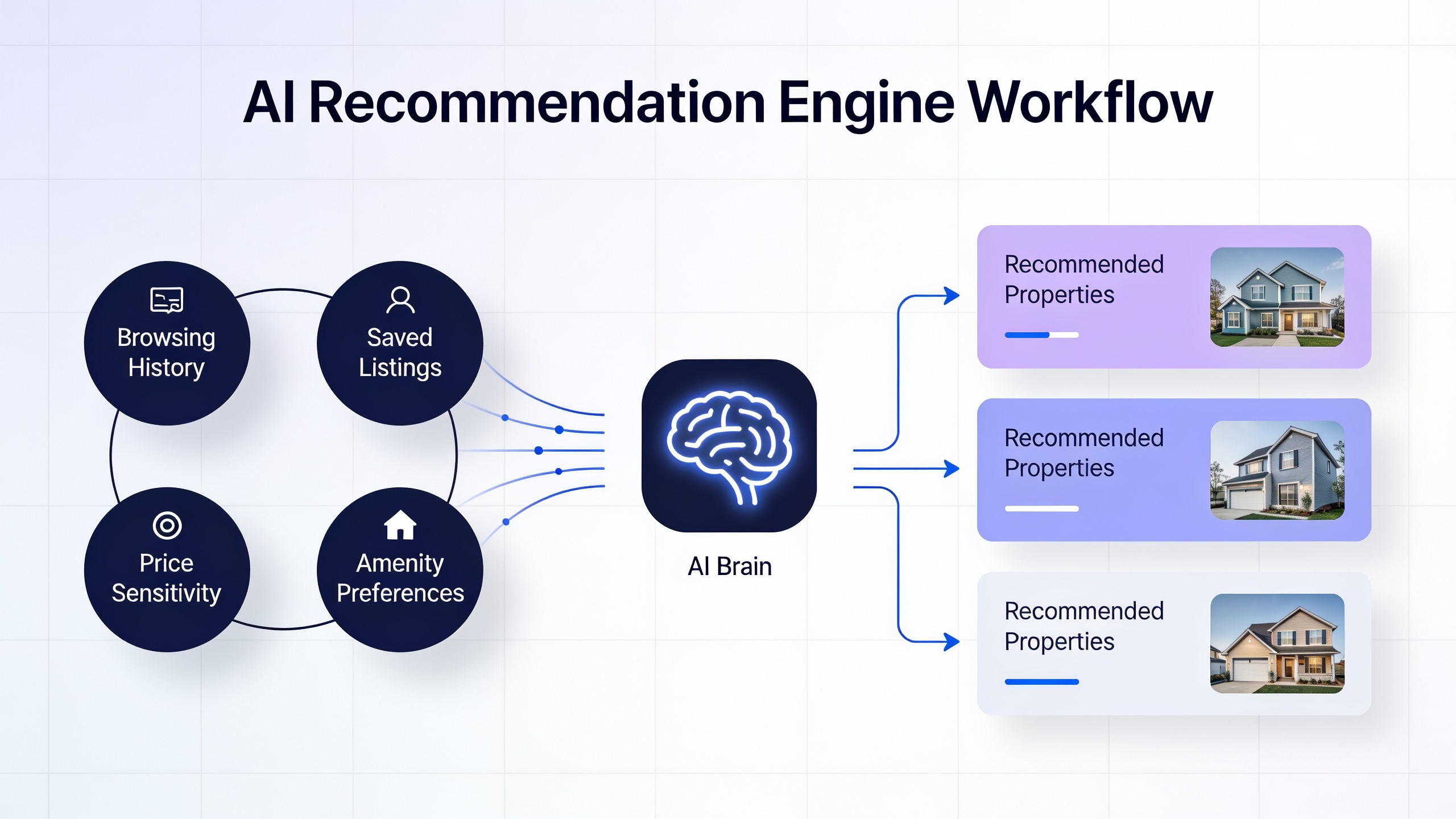
The good news for you is convenience: less manual grinding, more relevant alerts. The bad news is a mild filter-bubble problem. The algorithm gets comfortable showing you the same flavor of house and quietly skips the thing you might actually love, like a slightly different neighborhood or a smaller lot with a bigger house. So every so often, ignore the recommendations and run your own fresh, wide-open search. Trust me on that one.
Tool #5: AI Chatbots and Virtual Showing Assistants
An AI chatbot for real estate is a conversational tool, usually baked into a listing site or brokerage app, that answers your questions in real time, books showings, and qualifies leads by asking about budget, timeline, and financing, all without a human agent needing to be at their desk. If you’re the type who browses listings at midnight (no judgment, same), it means getting an answer about HOA rules, square footage, or availability right then instead of waiting for office hours.
Some of these have gotten genuinely slick, hooking into calendar systems to book same-week showings automatically, or plugging into mortgage pre-qualification flows so you can get a handle on your budget before you fall hopelessly in love with a place you can’t afford. Others are… not that. Some are basically glorified FAQ bots that punt anything remotely complicated straight to a human. If you’re trying to sort out which apps actually do this well, alongside stuff like map search and mortgage calculators, the roundup of the best real estate apps for home buyers in 2025 is a solid next stop for seeing what’s really out there today.
Comparing AI Home Search Tools at a Glance
Each of these five tools tackles a different piece of the buying journey, and honestly, most serious shoppers end up juggling several at once. Here’s how they stack up, what each one’s best at, and where you still need an actual human in the loop.
| AI Tool Category | Best For | Key Benefit | Where Human Judgment Still Matters |
|---|---|---|---|
| Natural language search | Buyers who don’t know exact filter terminology | Faster, more intuitive search entry point | Precise financial and legal criteria still need manual filters |
| Predictive pricing / AVMs | Quick market-value sanity checks | Instant, data-driven price estimates | Unique homes, thin data markets, fast-moving conditions |
| Virtual staging / renderings | Visualizing potential in empty or dated homes | Faster, cheaper than physical staging | Confirming real condition and true dimensions in person |
| Recommendation engines | Buyers browsing over weeks or months | Proactive alerts on relevant new listings | Avoiding a filter bubble; periodically broadening the search |
| AI chatbots / showing assistants | Getting quick answers and booking showings | 24/7 availability, faster scheduling | Complex negotiation and contract questions need a licensed agent |
Is AI in Real Estate Trustworthy? Tips for Using These Tools Wisely
AI in real estate is genuinely useful, but it works best as a starting point, not the final word on price, condition, or fit. These tools are trained on patterns in data, and data has blind spots. A neighborhood changing faster than the comps can keep up with. A listing photo virtually staged to look a whole lot better than the place shows in person. That stuff slips right past an algorithm.
A few habits keep these tools helpful instead of misleading. Treat any AI price estimate as a range, not gospel, and cross-check it against a couple of comparable listings yourself. When you see virtually staged photos, hunt for a disclosure label (most reputable sites require one), and always ask for the unedited photos or a live video walkthrough before you get attached to a place. And let the recommendation engines and chatbots do the grunt work up front, thinning the pile and answering the basic questions, but bring in a real agent or a mortgage pro the second you’re seriously weighing an offer, haggling over price, or reading contract terms. AI can crunch data at a scale no person ever will. But it doesn’t have a fiduciary duty to you, and it definitely can’t read the room during a negotiation.
Frequently Asked Questions
Is the AI price estimate on a listing the same thing as an appraisal?
Nope. An AI valuation model (that AVM thing again) spits out a statistical estimate based on comparable sales and property data. A licensed appraisal means a trained professional physically walks the property and applies formal valuation standards. Lenders insist on a real appraisal for financing precisely because an automated guess isn’t considered reliable enough to hang a loan on.
How do I know if listing photos were virtually staged by AI?
Reputable platforms usually slap a small disclosure label on the photo or tuck it into the description, something like “virtually staged.” If you don’t see one but a room looks suspiciously flawless, or the furniture proportions feel just a touch off, it’s totally fair to ask the listing agent point-blank whether the images were digitally staged or altered.
Do these tools mean I don’t need a real estate agent anymore?
For most people, no. AI is fantastic at speeding up the discovery phase, narrowing your options, and answering routine questions instantly. But it won’t negotiate for you, it doesn’t have local context beyond whatever it was trained on, and it carries none of the professional and legal obligations a licensed agent owes their client.
Why do I keep getting recommended the same kind of homes instead of anything new?
That’s the recommendation engine learning from your past behavior, which is handy right up until it isn’t. It can box you into a narrow little feedback loop. If you feel stuck seeing the same listing on repeat, run a fresh manual search with broader criteria every week or two so you don’t miss something great sitting just outside your usual pattern.
Can I trust the answers an AI chatbot gives me on a real estate site?
Depends on the platform and how tightly it’s wired into live listing data. Basic bots pull from static FAQs and are fine for general stuff. But for anything property-specific, like current availability or exact square footage, confirm it with a human agent. Listing data can lag by hours or even days on some platforms, and the bot won’t know it’s out of date.
At the risk of stating the obvious: AI in real estate isn’t replacing the fundamentals of a smart home search. It’s just making them faster. Natural language search gets you to relevant listings quicker. Predictive pricing hands you a data-backed reference point. Virtual staging helps you see what a place could become. Recommendation engines keep the good matches rolling in without you lifting a finger, and chatbots shrink the gap between “I have a question” and “I have an answer.” Stack them together, sprinkle in a healthy dose of skepticism, and lean on a good agent when it actually counts, and these tools can turn what used to be a months-long slog into something that feels, dare I say, manageable. Whatever corner of the market you’re wrestling with right now.
Leave a Reply